Why Did Plato’s New Leader Argue Without Ever Taking a Side?
Escape to Athens: The Student Who Refused to Write

Sometime around 290 BCE, a teenager from the coastal town of Pitane slipped away from his guardian and boarded a ship for Athens. His name was Arcesilaus (c. 315–241 BCE), and he had decided he would rather study philosophy than follow the safe path laid out for him. Once in Athens, he joined Plato’s Academy—the most famous school of the time.
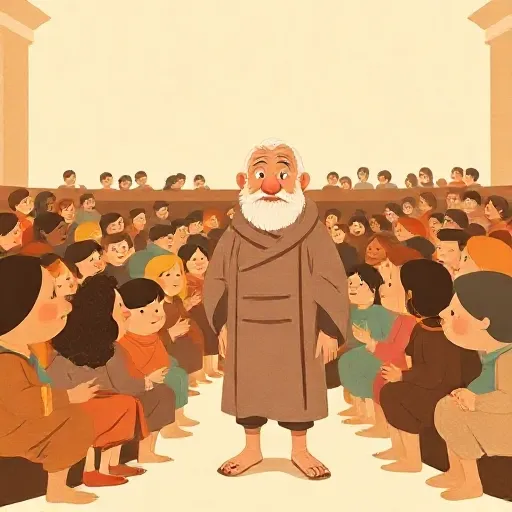
There he learned from great teachers like Crantor and Polemo. But Arcesilaus did not become the kind of philosopher who builds a system or writes books. He wrote nothing at all. Not a single scroll. Instead, he became a master of one thing: asking questions. When Crates, the head of the Academy, died around 268 BCE, Arcesilaus took over. For more than twenty-five years he led the school—and he turned it upside down.
The Socratic Question Machine
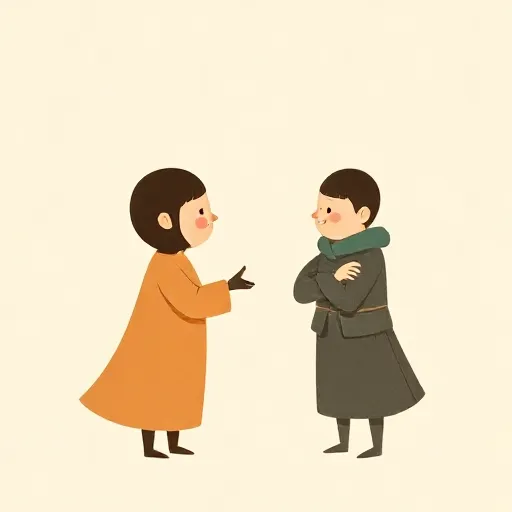
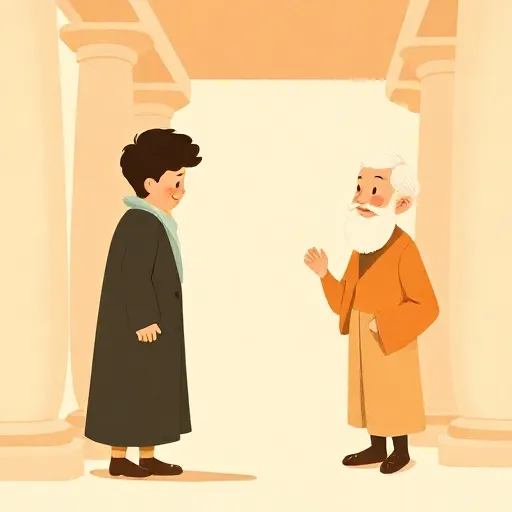
Arcesilaus claimed he was following the example of Socrates, who appears in Plato’s early dialogues. In those stories, Socrates never tells anyone what to think. He simply asks a series of questions. He takes the premises his conversation partner already accepts, follows them to their logical end, and shows that the person now holds two beliefs that cannot both be true. The result? The partner is forced to admit they do not know what they thought they knew.
Arcesilaus adopted this dialectical method—the art of arguing from the other person’s own starting points—and pushed it further. He refused to make any positive claim whatsoever. In every debate, he would only argue against whatever view someone else proposed. If someone said, “We can know things through our senses,” Arcesilaus would take the opponent’s own definitions and assumptions and show that they led to the opposite conclusion. But he never stepped forward to say, “And here is what I believe instead.” Some ancient writers even called him a magician or a sophist because he seemed to vanish into his own arguments. They could never pin him down.
That makes it tricky to figure out what Arcesilaus actually thought. If all you have are his attacks on other people’s ideas, how can you tell whether he secretly held a view of his own? This is the puzzle that has kept scholars arguing for over two thousand years.
The Stoic Puzzle: Can We Know Anything?

The new philosophical movement of Arcesilaus’s day was Stoicism. Its founder, Zeno of Citium, promised something thrilling: a reliable road to knowledge. Zeno believed that our minds receive impressions—mental images or appearances of the world, like snapshots. If an impression comes from a real object and perfectly captures that object in a way that could not possibly be false, then that impression is cognitive (it gives us a genuine grasp of reality). Assenting to a cognitive impression produces cognition, a sure piece of knowledge. A wise person, Zeno argued, should only assent to cognitive impressions. If you restrict your assent that way, you will never make a mistake.
Arcesilaus zeroed in on the part of that claim that said a true impression must be “such that it could not be false.” He argued that for any true impression you might have, there could be a false one that looks exactly the same. Think of looking at two identical eggs. You get an impression of a particular egg—it is brown, speckled, and sitting right there. But if someone secretly swapped it with its twin, your impression would be exactly the same in every detail. You would not be able to tell the difference. So your true impression does not come with a built-in guarantee. You might be looking at a fake twin, a dream, or a hallucination. Therefore, Arcesilaus concluded, no impression ever meets Zeno’s condition for being cognitive. If no impression is cognitive, then according to Zeno’s own rules nothing can be known. The Greek term is inapprehensibility (akatalêpsia).
Then Arcesilaus added a second step. The Stoics themselves taught that it is irrational to hold mere “opinions”—beliefs based on non-cognitive impressions. But since Arcesilaus had just shown that there are no cognitive impressions, the only way to follow Stoic advice is to assent to nothing at all. The wise person must suspend assent universally (epochê peri pantôn). So the Stoic system, when pushed by Arcesilaus’s questioning, seemed to command total suspension of judgment.
Did He Believe What He Said?

And now the problem sharpens. If Arcesilaus really believed that nothing can be known and that we should suspend all assent, then he was taking a stand on something—two things, actually. But his whole method was to argue without ever revealing his own commitments. What is more, the arguments for inapprehensibility and universal suspension depend heavily on Stoic ideas about impressions and assent. Yet we have evidence that Arcesilaus also attacked those very Stoic ideas when it suited him. He seems to have thought that Stoic psychology and theories of perception were wrong. So why would he build his own position on a foundation he rejected?
For a long time, some scholars have answered: he didn’t. They hold a dialectical interpretation. On this view, Arcesilaus was not committed to any doctrines at all—not even to the claim that nothing can be known. He was simply trapping his opponents with their own words. The trouble is that his own contemporaries, including the Stoic Chrysippus, believed that Arcesilaus genuinely recommended suspending all assent. And if we accept that he did have some commitment, we need a way to make sense of it.
Three main solutions are on offer, each picking a different kind of commitment that might not conflict with his method.
One possibility is that suspension of judgment was not a rational decision but a natural reaction. Call this Non‑Rational Non‑Belief (NRNB). After hearing equally powerful arguments for and against every view, Arcesilaus simply found himself paralyzed—unable to form any beliefs. He then acted on his impulsive impressions, much like an animal, without ever saying he rationally ought to live that way. The draw of this view is that it avoids the self‑defeating picture of someone rationally arguing that we should never rationally argue. But it struggles to explain why Arcesilaus kept inquiring so fiercely if he was just drifting passively.
A second view says Arcesilaus held his doctrines as rational suppositions rather than full beliefs—Rational Non‑Belief (RNB). Perhaps he hypothesized that nothing can be known, treating it as a working assumption that guided his practice. He could then follow logical chains without ever asserting that the premises are true. This makes room for a deeply intellectual life without solid commitments. The challenge is whether a life run entirely on “what if” can still be genuinely rational or even practically distinguishable from one run on beliefs.
A third view is Non‑Rational Belief (NRB). On this account, Arcesilaus did end up with the belief that nothing can be known, but that belief was not rationally earned. It was simply how things struck him after decades of arguing and never finding a position that stood up. He believed it without taking that belief to be justified by reason. This fits with his method: he kept using reason to examine everything, yet his guiding conviction that mere opinion is bad was never proven—it was just something he found himself unable to shake off. The problem here is that it is very hard to hold a belief while simultaneously judging that you have no good reason for it.
Living Without Belief: The “Reasonable” Life

The Stoics fired back with a practical objection. If you never assent to any impression, how can you act at all? Action, they thought, is caused by assenting to an impression that something is appropriate for you. Without assent, you would stand frozen like a statue.
Arcesilaus’s reply was brief but clever. He pointed out that even the Stoics admitted that non‑rational animals act without assent—they just follow their impressions of what looks suited to their nature. Why couldn’t a skeptical human do the same? And when it comes to more thoughtful choices, Arcesilaus introduced a new guide: the reasonable (eulogon). You can reflect on which action seems most reasonable given what you have experienced, and then go with that. You don’t need to believe it is the true or right thing; you simply do what strikes you as reasonable after careful thought. Then, if you are later asked to justify yourself, you can give a reasonable defense. This lets the skeptic navigate life without ever forming the belief that a particular action is absolutely correct.
The three interpretations handle this in different ways. The NRNB view says the skeptic just reacts impulsively to what appears “suited” without any rational weighing. The RNB view sees “the reasonable” as a rational norm that is itself held as a hypothesis. The NRB view suggests that Arcesilaus might not have been personally attached to this solution at all—he was just parrying the Stoic objection with their own tools, as his method required.
Why It Still Matters

You have never met an ancient Stoic. But you know the feeling of being trapped between two convincing stories. Maybe you read one article that says a certain food is amazingly healthy, and another that says it is dangerous. Or two friends give you opposite accounts of who started an argument—and both sound completely sure.
Arcesilaus lived in that space for his whole adult life, and he refused to pretend it was easy. He showed that you can keep thinking, keep questioning, and keep acting sensibly even when you are not sure you have the final truth. His method was not about giving up on answers. It was about taking the search so seriously that you never settle for an answer your own mind cannot fully support.
The real puzzle about Arcesilaus isn’t whether his skepticism was perfect. It’s whether it is possible to be so deeply committed to reason that you are willing to admit reason might never deliver a final guarantee. That question is still open, and now it’s yours.
Think about it
- If you could prove that nothing can be known for sure, would you still try to learn things? Why or why not?
- Imagine you never told anyone what you really thought. Could you still be a good friend? What would it cost you?
- When you find yourself stuck between two opinions that both seem strong, is it better to keep searching or just pick one so you can move forward? What might you lose either way?