Is Humanity a Real Thing, or Just a Word? The Priest Who Said Yes
The Chair and the Invisible Chairness
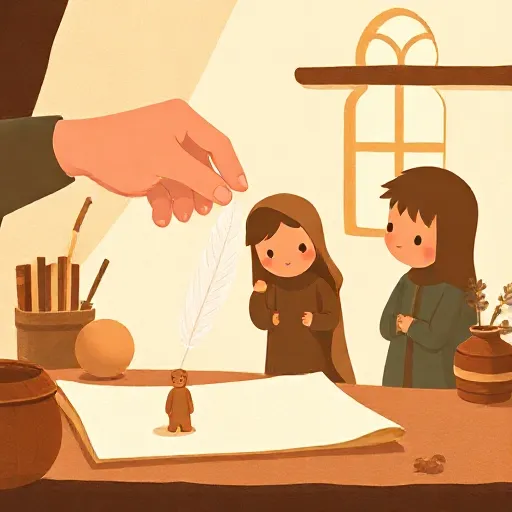
Imagine you are sitting in a classroom, and someone points at a wooden chair and asks, “What makes this a chair?” Is there some invisible chairness—a real pattern that all chairs share—that makes each one a chair? Or is the word “chair” just a handy label we invented for a bunch of things that look roughly alike?
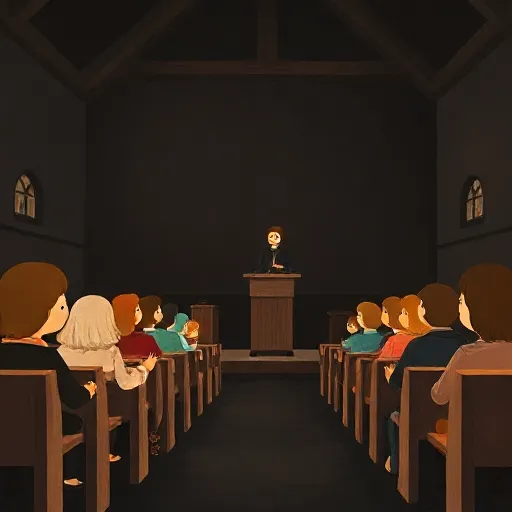
In the fourteenth century, a priest and Oxford scholar named John Wyclif (c.1331–1384) gave an answer that got him into enormous trouble. He said that yes, there is a real, invisible universal nature—a common essence—that a word like “human” or “chair” points to. And that answer, which at first sounds like a dusty old puzzle about words, ended up shaking the power of popes and kings.
Most earlier medieval thinkers agreed that general words work somehow, but they disagreed about what they name. Some, like William of Ockham (c.1287–1347), were nominalists: they thought that common terms like “human” are just mental shortcuts or names (the Latin word nomen means “name”). There is no real, extra-mental humanity out there—only individual people. Wyclif thought that was a huge mistake. He believed that language is a kind of perfect map of reality. If you have a common word, there must be a real common thing it names, otherwise how could we ever define anything or be sure our knowledge was solid?
A Map of Words and Things

Wyclif saw the world as a web of labels. Every simple term in language corresponds to a real universal—a nature or essence that many individual things genuinely share. For example, the word “human” directly and primarily signifies the universal human nature. That nature isn’t just a thought inside your head; it really exists inside every individual human, making each person what they are. He even said that a universal is really identical with each particular thing that shares it, but formally distinct: you can look at one and the same reality as a universal kind or as a concrete individual, like looking at a painted shape first as a circle and then as a red patch.
This gave him a new kind of logic. He described three layers of universals: universals before the thing (ante rem)—the eternal ideas in God’s mind; universals in the thing (in re)—the common natures actually existing in individuals; and universals after the thing (post rem)—the mental concepts we form after we experience the world. The universal humanity is really there in you; it isn’t an extra ghost floating beside you, but it is really you, just considered from a slightly different angle. That meant some very strange sentences could be true, like “The universal is particular”—because the universal humanity and this particular human are the very same reality, only thought about differently.
This conviction led Wyclif to rethink what a proposition actually does. Instead of just saying that one set is included in another, a statement like “Socrates is human” expresses a real identity: the singular essence of Socrates and the universal essence of humanity share the same empirical reality, but with a formal distinction between them. He called this kind of predication “essential” or “formal,” and it allowed him to claim that language could capture the deep, layered structure of being itself.
When Logic Meets the Eucharist
Now, if you believe that words and things are that tightly linked, you run straight into the central miracle of the medieval Church: the Eucharist. According to the Church, during Mass the substance of the bread and wine is transformed into the actual body and blood of Christ, even though the “accidents”—the taste, shape, and smell—stay the same. This process was called transubstantiation.
Wyclif could not accept it. In his universe, a substance cannot simply be annihilated or replaced without its accidents. An accident needs a substance to exist in—just as the colour of your hair can’t exist without your hair. If God destroys the bread, the accidents would have nothing to hold them, which Wyclif thought was logically impossible. Moreover, he argued that God cannot annihilate any creature because everything that has being is rooted in God’s own essence and ideas; annihilation would be like removing part of God’s own eternal plan.
So Wyclif said that after the consecration, the bread and wine remain fully present. The body of Christ is there too, but in a spiritual, “habitudinal” way—a relation of presence that doesn’t require the bread to vanish. He called it a kind of habitudinal predication: the same loaf is both ordinary bread (by its earthly nature) and the body of Christ (by a divine relation). Church authorities were horrified. In 1377 nineteen of his teachings were condemned; by 1382 many of his followers were forced to recant. His body was later exhumed and burned as a heretic.
Who Has the Right to Rule?
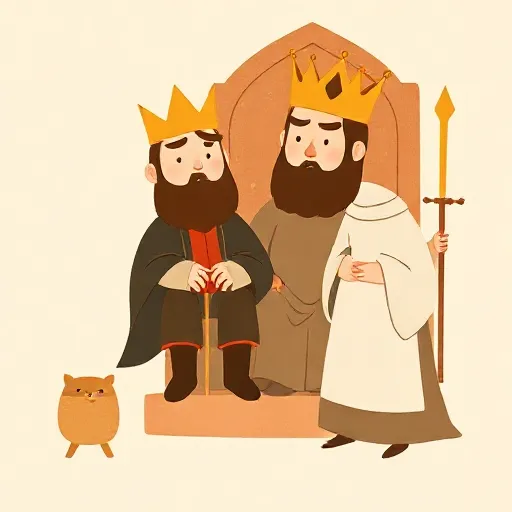
Wyclif’s extreme realism didn’t stop at bread. It reshaped his entire view of power. He held that true dominion (lordship or authority) depends entirely on being in a state of grace. God is the only absolute owner of everything; human beings merely borrow what they have. A king or a pope can only exercise just authority if they are among the Elect—those predestined by God to be saved.
The problem is, no one on earth can know for certain who is among the Elect. So you can never be completely sure that a bishop, a priest, or even a pope is spiritually qualified to rule. Wyclif concluded that the visible church could not claim unquestioning obedience. If a cleric lived sinfully, he forfeited his right to property and authority; a righteous king could step in and take church land to use it well. The true Church, he said, is the invisible community of the saved, not the institutional hierarchy.
This was not political theory in the usual sense. Wyclif wasn’t trying to design a state; he was a religious reformer who saw all human government as a reflection of divine lordship. But the results were explosive. His ideas inspired followers like Jan Hus in Prague, and they helped set the stage for the Protestant Reformation more than a century later.
Why Wyclif’s Dangerous Idea Still Matters

At bottom, Wyclif raised a question that never went away: are the big, shared categories we use every day—like “human,” “species,” or even “justice”—real things in the world, or are they just handy labels? His answer landed him in the fire, but the debate continued. If you think that words simply name real essences, then arguments about what counts as a human or what counts as true authority can have world-changing consequences, from civil rights to medical ethics. Today, scientists and philosophers still argue about whether biological species are real natural kinds or convenient groupings. Lawyers and citizens debate whether “the people” means a concrete collection of individuals or an almost mystical body that endures over time.
Wyclif shows that a quiet-looking question about language and being can turn into a question about who gets to rule and what happens on the altar. The next time you point at something and ask, “What is that, really?” you are walking the same path as a priest who refused to stop asking—and refused to hide what he thought he had found.
Think about it
- If every common word named a real universal nature, what would that mean for words like “dragon” or “unicorn”? Do they have to point to something real?
- Imagine you can’t know who is truly good. Would you trust a leader who might secretly be unworthy? How would you decide who to follow?
- Wyclif’s ideas about the Eucharist got him condemned. Can a logical argument ever tell you whether a miracle is true, or do such questions lie beyond pure reason?