
Can Something Common Be White? The Medieval Puzzle of Universals
The Puzzle: Can You Say ‘Humanity Is White’?

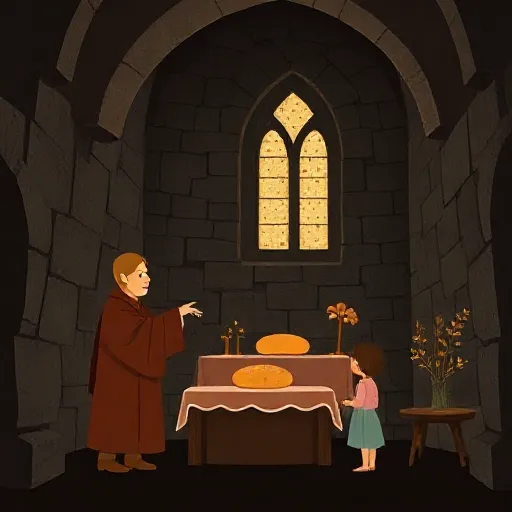
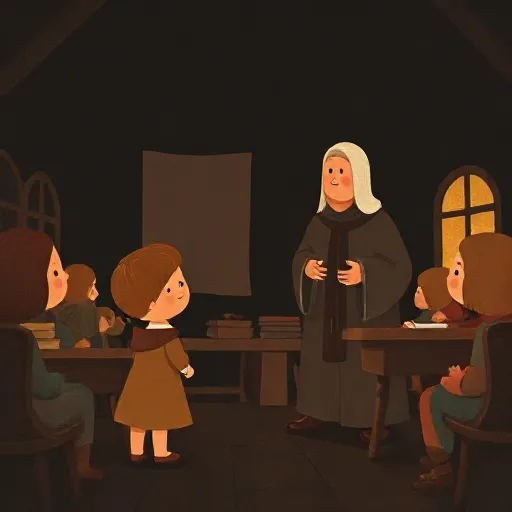
One afternoon around 1410, a young student named John was walking through an Oxford courtyard with his teacher William Penbygull (c. 1375–1420). John pointed at a friend with pale skin and said, “Socrates is white.” The teacher nodded. Then John, half joking, added, “Humanity is white.” Penbygull didn’t laugh. Instead, he said, “In a special way, that is true.”
You probably think John’s second sentence is nonsense. Whiteness is a color you can see on a person or an animal. “Humanity” is not a thing you can point to—it’s the general idea of being human. So how could it be white?
To answer that, Penbygull and other Oxford thinkers dug into what universals are. A universal is something that many particular things share, like the universal “humanity” shared by all human beings, or “whiteness” shared by all white things. Particulars are the individual objects: this person, that cat, that snowflake. For centuries, philosophers had argued about whether universals are real things or just convenient words. The Oxford Realists of Penbygull’s time believed universals are real. But if they are real, we have to explain what happens when we say something like “Humanity is white.” That puzzle is the heart of the story.
John Wyclif: The Man Who Thought Universals Were Real… and Tricky

The Oxford Realists built on the work of John Wyclif (c. 1328–1384), a fiery philosopher and theologian. Wyclif thought there were three kinds of universals. First, ideal universals existed in God’s mind—the perfect blueprints of everything. Second, formal universals were the common natures shared by individual things, like the human nature that makes every person a human. Third, intentional universals were the mental signs we form when we think about those common natures.
It is the formal universals that caused the trouble. Wyclif said a formal universal, like humanity, is really identical with its individuals, say Socrates. They are, at bottom, the same thing. But they are formally distinct. Think of a clay pot and the lump of clay it was made from. The pot and the lump are really the same stuff—the very same clay. Yet the pot has a shape the lump lacks. In a similar way, humanity and Socrates are really the same reality, but they have opposite formal traits: the universal has generality (the natural tendency to be common to many), while the individual has thisness (the impossibility of being common). They are the same thing seen from two angles.
This curious identity forced Wyclif to rethink predication—the logical relation between a subject and a predicate in a sentence. If universals and individuals are partly distinct, not every predicate that fits an individual can be directly slapped onto its universal. Wyclif distinguished three kinds of predication.
The first was formal predication. Here the form signified by the predicate is directly present in the thing signified by the subject. “Socrates is white” is formal predication, because the whiteness inheres right there in Socrates.
The second was predication by essence. In this case the same empirical reality plays both the subject and predicate role, even though the formal principle hinted at by the predicate differs from the one hinted at by the subject. Wyclif allowed sentences like “The universal is particular” as instances of predication by essence. The substance is the same, but we are seeing it now as universal, now as particular.
The third, most unusual, was habitudinal predication. Here the predicate form does not inhere in the subject at all, directly or indirectly. It only implies a relation to it. Wyclif used this mainly for theological statements: “God is known by many creatures.” The predicate “known” doesn’t sit inside God; it signals a relation between God and the knowers.
The problem was that habitudinal predication rested on a completely different ontological footing from the other two types. A sentence could shift from true to false without any change in the subject itself. Many later Oxford scholars thought this made the system wobbly. They wanted a cleaner way.
Robert Alyngton’s Fix: Predication Through Individuals

Robert Alyngton, a later Oxford thinker writing around 1400, set out to improve Wyclif’s theory. One big move he made was to drop habitudinal predication entirely. He trimmed the kinds down to two: formal predication and what he called remote inherence (which was really a refined version of predication by essence).
Alyngton also stepped back from Wyclif’s claim that formal universals exist “in act” outside the mind. He thought that as natures they were prior to being either universal or individual. Universality was their special property, but it wasn’t what made them what they were. Still, he agreed with Wyclif that a universal and its individuals are really identical and formally distinct.
This delicate balance let Alyngton explain tricky sentences. He said that accidental forms—like whiteness or running—cannot inhere directly in a substantial universal such as humanity. They can only be indirectly attributed to the universal, by way of the individuals that instantiate it. If at least one individual man is running, then the statement “Humanity is running” is true in the remote inherence sense. Notice how Alyngton used a neuter adjective, running not a runner, to signal that the property does not sit right inside the universal but reaches it through the individuals.
So formal predication still required a direct presence of the predicate-form in the subject (“Socrates is an animal”). Remote inherence covered cases where the predicate belonged to the subject only thanks to a partial sharing of metaphysical parts. The puzzle of “Humanity is white” was solved: you could say it was true, but only because individual white humans existed to lend their whiteness to the common nature.
William Penbygull’s Final Touches and a New Kind of Identity

Penbygull, our teacher from the courtyard, polished Alyngton’s system and added his own original ideas. He kept formal predication and predication by essence (what Alyngton called remote inherence) but he also added a third kind: causal predication. This applied when the item signified by the predicate wasn’t present in the subject at all—not directly, not indirectly. Instead, the subject had been caused by the predicate. It was a relation of dependency, not inherence.
More dramatically, Penbygull subdivided formal accidental predication into two sorts. The first, secundum motum, covered forms that need a substrate capable of undergoing change, like whiteness, quantity, or growing larger. These forms had to inhere directly in individuals, because only individuals can genuinely change. The second, secundum habitudinem, covered forms such as relations and causal connections. These could inhere nominatively in both individuals and universals, since they didn’t require a changing substrate.
But the deepest change Penbygull made was to the notion of identity itself. Under standard medieval logic, two things were identical if they shared every single predicate. Since the universal has generality and the individual has thisness, they could never be identical under that rule. Penbygull recognised that if we want to keep claiming universals and individuals are the same reality, we need a different measure.
He offered new definitions. Two things are non-identical if there is no form present in the same way in both—they belong to completely different categories. Two things merely differ if at least one form is directly present in one but not the other; this still leaves room for many shared forms. Two things are absolutely identical only if every single form is present in exactly the same way in both.
On this scheme Socrates and humanity are not absolutely identical, but they are not utterly non-identical either. They differ, but they share a long list of forms: animality, corporeity, substance, and more. They are partially identical. The copula “is” in statements like “Humanity is white” no longer means “is a member of a set” or “is included in a class.” Instead it marks a degree of partial identity between two compound entities, measured by how many forms they share.
Why Does This 600‑Year‑Old Puzzle Still Matter?

You probably haven’t spent much time asking whether “catness is fluffy.” But the medieval argument about universals is not just a dusty curiosity. Whenever you say something like “In a way, I’m still the same person I was at five,” you are grappling with partial identity. You know that many things about you have changed—your size, your thoughts, your bones—but some deep pattern seems to have continued. Penbygull’s idea of sharing forms while allowing difference is a tool for thinking about exactly that.
The debate also shaped how philosophers later thought about language. It forced them to see that simple words like “is” can hide many different logical relations—direct inherence, indirect attribution, causation, or partial sameness. Modern philosophy of language still investigates how we manage to talk about abstract things (justice, humanity, numbers) using concrete-sounding sentences.
Next time you hear a sentence that sounds a bit too sweeping, like “Money is the root of all evil” or “Love is patient,” pause for a second. Are those statements forcing an abstract universal to wear a concrete hat? Penbygull and his friends would say yes—and they’d hand you a logical toolkit to figure out exactly what the sentence is trying to say.
Think about it
- Suppose someone says “Humanity is curious.” Do you think they are making a claim about each individual human being, about an abstract idea, or about something else? Can you construct arguments for two different interpretations?
- If a white horse named Snowy runs, can you truthfully say “Horseness runs”? Why might an Oxford Realist say yes? (Hint: think about what makes Snowy a horse in the first place.)
- A statue is carved from a block of marble. If you smash the statue, the lump of marble remains. Were the statue and the lump ever completely identical? How does Penbygull’s idea of partial identity help you think about this?