Are Triangles Real? The Medieval Fight Over Universal Ideas
What’s So Special About a Triangle?
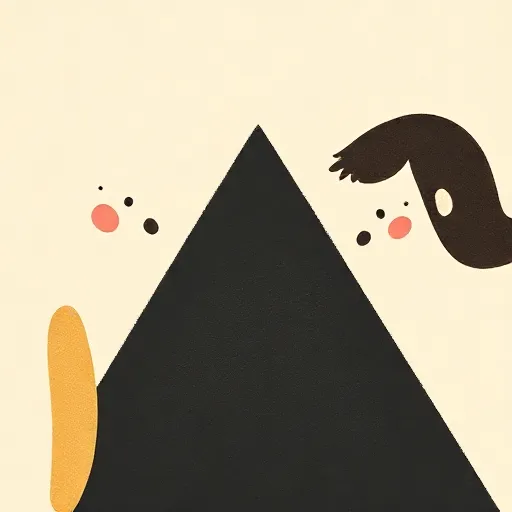
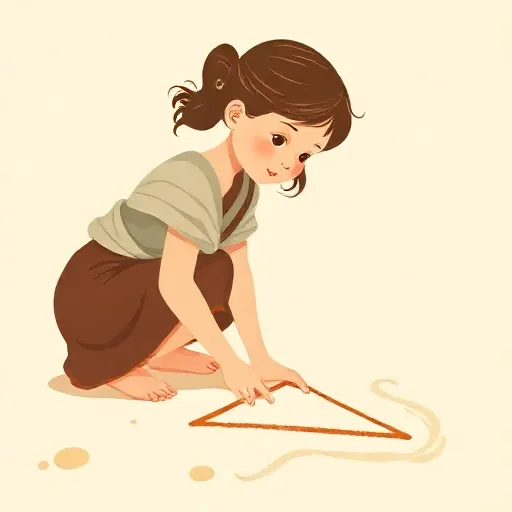
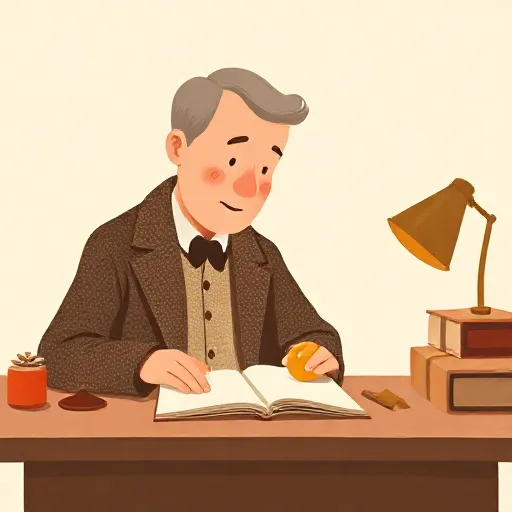
Imagine you are in a geometry lesson, around the year 1150. The teacher draws a triangle inside a semicircle — and then proves, step by step, that any triangle drawn this way is a right triangle. That’s called Thales’ theorem. You follow the reasoning and it feels solid. But then a question pokes at you: We only looked at this one drawing. How can the proof possibly cover every triangle, everywhere, for all time?
If you squint at the chalk lines, you notice they aren’t really straight. Zoom in, and they become jagged smudges. So the proof wasn’t really about that messy, physical triangle after all. It must have been about a perfect, invisible triangle — one you can only picture in your mind. The ancient Greek philosopher Plato (c. 428–348 BCE) said that’s exactly right: we grasp a perfect Form or Idea of a triangle. The drawing just helps us remember it.
Plato’s answer feels elegant: you know the theorem for all triangles because you know the one perfect, universal Triangle itself. But trouble starts immediately. A universal triangle would have to be a model for all triangles — isosceles, scalene, right, and so on — without being any particular kind. Yet a triangle must be either isosceles or scalene (if it has three sides). A universal triangle would have to be both isosceles and scalene and neither, which is impossible. So a real, mind‑independent universal triangle seems as unreal as a round square. That’s the deep crack in Plato’s theory, and it’s the crack that split the medieval world.
Porphyry’s Three Awkward Questions
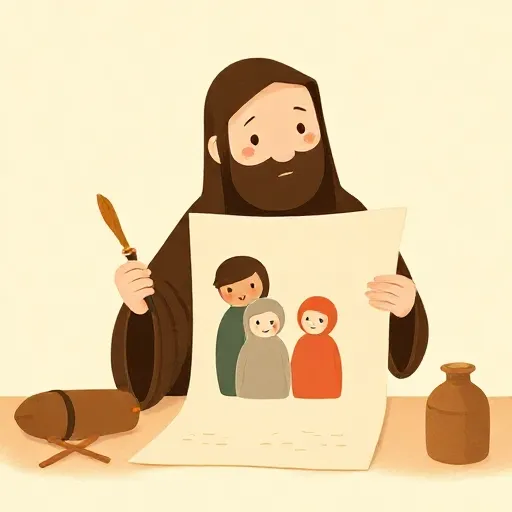
A philosopher called Porphyry (c. 234–305 CE) wrote a short introduction to Aristotle’s logic, and in it he dropped three clever questions that he politely refused to answer. He asked: (1) Do genera and species — that is, kinds like animal or human — exist in reality, or only in bare thoughts? (2) If they are real, are they bodily or bodiless? (3) Are they separated from the things we can sense, or do they live inside them? Porphyry said these questions were “profound” and needed a “greater investigation.” Medieval thinkers took that as a challenge.
The first great answer came from Boethius (c. 480–524). He started by defining a universal: it must belong as a whole, all at once to many distinct things, and it must help make each of those things what they are. That sounds reasonable — when many people are human, a universal “humanity” should be in each. But Boethius showed that such a thing creates a wreck.
Anything real has its own act of being — the thunderbolt of existence that makes it this reality rather than that one. If the universal was real and helped constitute each human, then its one act of being would have to be identical with the distinct acts of being of Socrates, Plato, and every other person at the same time. That’s impossible, like one heartbeat powering a thousand bodies. Boethius also rejected the idea that the universal is just the collection of individual essences, because then you’d need another universal to unite those, and so on forever.
So Boethius concluded that universals can only exist in the mind. But wait — doesn’t that make them false? He answered by pointing out that thinking of something in a universal way is not the same as thinking it is that way, and it doesn’t make the thought false. When you simply think of a triangle without deciding whether it’s isosceles or scalene, you’re not making a mistake; you’re just abstracting — separating in thought what cannot be separated in reality. That’s the core of Aristotle’s view: universals are mental products, formed when the mind grasps the common features of individuals and leaves out what distinguishes them. So the contradiction that plagued Plato vanishes, because universals don’t share being with things; they share only in the mind’s way of looking.
God’s Mind: The Idea Before the Thing
Plato’s perfect forms didn’t disappear; they just moved. Instead of existing on their own in some invisible realm, they settled in the mind of God. Augustine (354–430) described the divine Ideas — what Plato called Forms — as the eternal, unchanging blueprints in God’s understanding, according to which every created thing is made. This kept the Platonist’s intuition (there are perfect models for things) while avoiding the earlier contradictions, because the Ideas don’t compete for existence with ordinary things.
But now two new problems burned. First, God is supposed to be absolutely simple — not made of parts. If there are many divine Ideas, how can they all be the one, undivided God? Thomas Aquinas (1225–1274) proposed a neat image. Just like one act of thinking about squares and triangles doesn’t turn your mind into more than one mind, God can understand his own essence in a way that simultaneously thinks all the possible limited ways a creature could share in it. The diversity is in the ways of being modeled, not in God’s single act of knowing. That calmed many (though not all) of the worriers.
The second problem was illumination. Augustine had argued that we can’t know absolute unity or truth just from our sense experiences; we need a special light from God to see the eternal reasons. But Aristotle’s fans pointed to human abstraction: our active intellect, working naturally on what our senses provide, can form the concept of unity by stripping away all the “manyness” of material things. Augustine’s followers (such as Bonaventure, 1221–1274, and Henry of Ghent, c. 1217–1293) didn’t reject abstraction; they said it isn’t enough for the deepest certainty. Henry distinguished knowing a true thing (say, seeing a circle) from knowing the truth of the thing — whether it perfectly matches what it’s supposed to be. For that, he thought the mind’s own abstracted concepts needed a top‑up from the divine light, a kind of clarifying click when you suddenly “get” a deep definition. The Aristotelian‑minded, like Aquinas and later Scotus, replied that the agent intellect, given to our minds by God, is already that light. So illumination and abstraction ended up not as enemies, but as two sides of a long, careful argument about just how much the human mind can manage on its own.
Abelard’s Surprising Answer: The Cause That Isn’t a Thing
By the early 1100s, the debate took a sharp semantic turn. Peter Abelard (1079–1142) looked at universal words like “man” and asked: what real thing makes it correct to apply that word to every human? If you try to point to some real, single item that is “humanity” floating inside people, you crash into Boethius’s old contradictions. If you say it’s nothing, then the word seems meaningless.
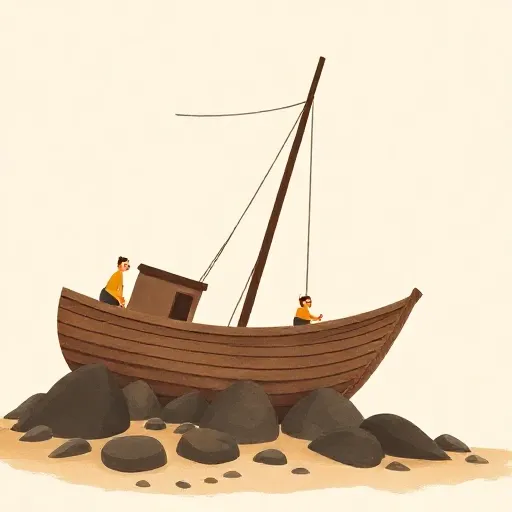
Abelard’s bold move was to answer: the common cause is not a thing at all; it’s a status — a way things are. For example, what makes the word “man” fit Socrates, Plato, and you is simply being a man. But “being a man” isn’t another substance; it’s the fact that each of them is a human. Compare: the cause of a shipwreck is that the pilot was absent. That cause isn’t a ghostly absence‑object; it’s a state of affairs. In the same way, Abelard said, the real foundation for universal names is a kind of pattern — but one that exists primarily in God’s mind and only secondarily in our concepts.
This view kept universals firmly tied to language and thought, not to mysterious shared entities. Still, it left many questions dangling: if a status is not a thing and we can’t picture it, how do we manage to point to it with words? Abelard thought the first person to invent the word “man” was dimly aiming at the status even without fully understanding it. That puzzle, and the flood of new Aristotelian texts pouring into Europe, soon pushed thinkers toward a more elaborate, realist map.
The Realist Map: One Nature, Many Existences

By the 13th century, a powerful way of drawing the map emerged, inspired by the Persian philosopher Avicenna (980–1037). Think of a common nature, like horseness — or, less barnyard, humanity. Avicenna said horseness in itself is just horseness: not one, not many; not existing in any horse or in any mind, but simply what it is when you define it. Aquinas developed this into a tidy three‑way distinction that medieval realists (followers of the via antiqua, the “old way”) used for the next two centuries.
First, consider human nature as it really exists in Socrates. Here it is individualized and mind‑independent; it’s what makes Socrates a human, mixed with all the things that make him this human and not the next. Second, consider human nature as it exists in the mind after abstraction. Now it is a universal species — an objective concept, the mental item you think with when you think “human” in general. This concept is universal only in what it represents; as a thought in your head, it’s just one more mental act. Third — and this is the clever part — you can consider human nature absolutely, setting aside both its existence in individuals and its presence in any mind. In this absolute consideration, human nature has no number and no location. It’s what makes it true to say that individuals share the same nature, even though nature itself isn’t one extra thing.
The analogy: a novel. The story isn’t any single copy of the book, nor is it a ghostly “super‑book” hovering in a library. It exists only in its many copies and in readers’ minds. And yet we can truthfully say that all those copies contain the same story. The realist map allowed you to talk about sameness without multiplying the furniture of the world recklessly.
The problem was that this drawing grew very complicated. Realists argued over how many distinctions you need (intelligible species, objective concepts, formal distinctions, haecceity — a principle of “thisness” that Scotus proposed), and they worried about exactly what parts of the picture are the same and what are different. By the early 1300s, a razor‑sharp voice cut through the thicket.
Ockham’s Razor and the Fight That Never Ended

William of Ockham (c. 1287–1347) looked at the realist map and saw a jungle of almost‑things — common natures, intentional distinctions, objective concepts — all invented, he thought, because philosophers forgot that words are just signs. Ockham launched a radically simple account, the via moderna (“modern way”).
In his picture, only individual things exist. Your cat, this apple, that thought in your head. Universals are of two sorts: (1) concepts, which are just real acts of your mind that can represent many individuals indifferently — you think “cat” and it fits any cat; (2) spoken or written words, which are common because they are subordinated to those concepts. A common term like “man” doesn’t point to some shared nature inside people; it directly signifies each individual man. When you use a relational term like “father,” it signifies you and connotes another thing (your child), without needing an extra “fatherhood” glue.
This move cut ontology down to size. Instead of fretting over whether your height plus my height creates a new “equality‑thing,” Ockham said: if we are both six feet tall, then your height just is my equal in that respect. No extra entity required. This love of simplicity won many followers, and by the 1400s, universities were divided into “ancient” and “modern” schools, often talking past each other and accelerating the collapse of the medieval scholastic conversation itself.
Yet the problem refused to die. In early modern philosophy, and even today, whenever we ask how a single word can pick out infinitely many individuals, or whether biological species are real kinds or just convenient groupings, we are replaying the medieval drama. The next time you say “humans have rights,” or your science teacher says “all mammals are warm‑blooded,” you are using universal language whose foundations were quarried by monks, logicians, and razor‑wielders long ago. The triangle you first drew in the margin is still whispering its question: How can one thought hold the whole crowd?
Think about it
- If all the words you use name only individual things, could you ever state a general rule at all — for example, a law of science? Why or why not?
- Suppose an alien species had no concept of “triangle,” but could recognize some shapes as three‑sided. Would their knowledge be the same as ours if they couldn’t talk about “triangles” as a kind?
- If you redesigned a dictionary from scratch, what would you have to put in a definition so that it points to exactly the same collections of things in the world — without using the word itself?