Is 'Humanity' a Real Thing? The Medieval Battle Over Universals
A Curious Question in Oxford
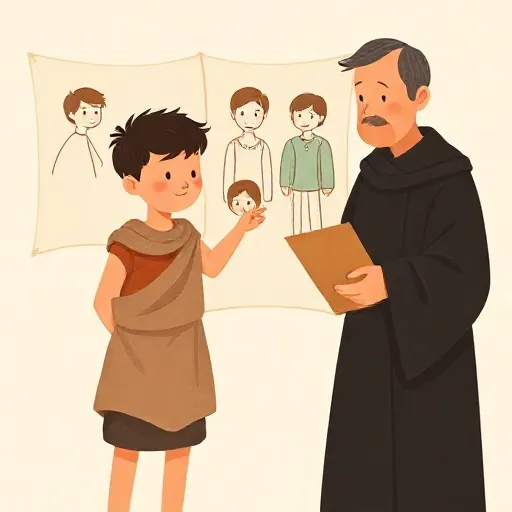
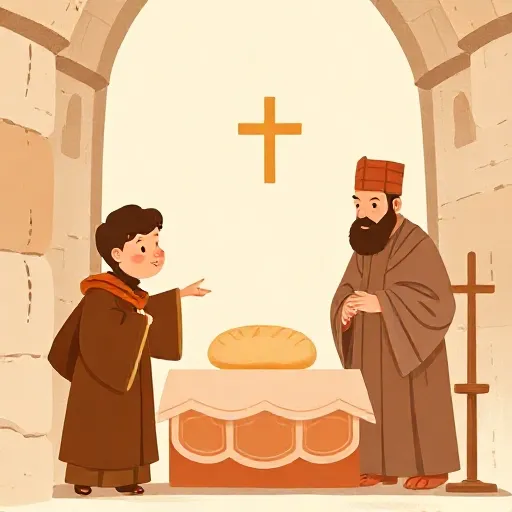
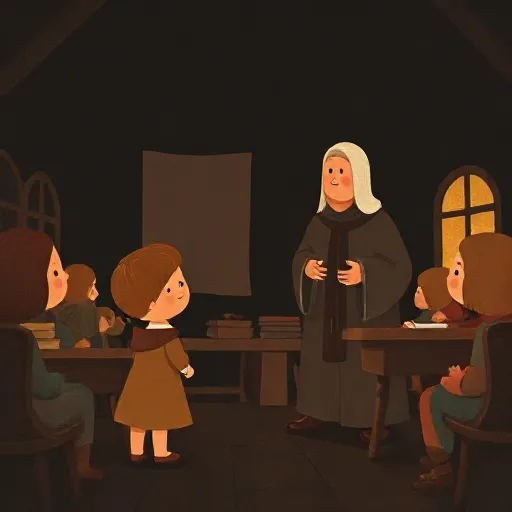
Oxford, England, around 1403. In a chilly lecture hall, students sit on wooden benches. One of them, a young man with dusty shoes, stands up and faces Johannes Sharpe (c.1360–after 1415), the teacher at the front. “You keep talking about ‘humanity’ as if it’s something real,” he says. “But all I see are separate people — you, me, the cook who makes the porridge. Is there really one thing called humanity out there, or is it just a handy word we invented?” Sharpe’s answer would try to settle a noisy medieval quarrel that still echoes today — the debate over universals.
A universal is a general form or nature that many particular things can share. For example, “humanity” is what (supposedly) makes all human beings human; “redness” is what red roses, red apples, and red fire trucks have in common. The big question was: do universals exist outside your mind, baked into the world? Or are they just mental labels we use to group similar objects? This question split philosophers into two rival camps.
The Two Camps: Realists and Nominalists
Realists answered with a firm yes. For them, common natures like humanity really exist in the world, independent of our thinking. They believed that Aristotle’s ten categories — substance, quality, quantity, and so on — carved reality at its joints. Even if you weren’t thinking about it, “horse‑ness” was out there, present in every horse. Language, for a realist, mapped neatly onto these real kinds.
Nominalists argued the opposite. According to them, only individual things exist — this horse or that horse. The word “horse” is just a convenient sign your mind creates to group similar-looking animals. William of Ockham (c.1287–1347), the most famous nominalist, insisted that our mental, spoken, and written language is a system that merely regards the world from the outside; it doesn’t copy the world’s structure. The table of ten categories, he said, is a classification of words, not of things.
Ockham’s Knife: Why the Universal-Man Couldn’t Exist
Ockham didn’t just disagree — he aimed a sharp logical weapon at realism. He used a basic rule of identity: if A and B are truly the same thing, then anything you can truthfully say about A you can also truthfully say about B. Now, consider the universal “humanity” and an individual human like Socrates. Realists insisted the universal and Socrates are identical in some way, yet they are different when considered as universal and as individual.
Ockham pounced. If the universal-man exists really in Socrates (in Athens) and also in Plato (in Rome), then that same single universal would be in two places at once — Athens and Rome. Worse, suppose Socrates sits while Plato stands. Then the universal-man would be sitting and not-sitting simultaneously. That violates the obvious truth that nothing can have contradictory properties at the same time. For many medieval thinkers, this spelled doom for the old realism.
The Oxford Trick: Real Identity, Formal Distinction
Not everyone gave up. A group of later English thinkers, called the Oxford Realists, proposed a clever fix. Leading this charge was John Wyclif (c.1320s–1384). He agreed that universals and individuals couldn’t be two separate things — that would lead straight to Ockham’s paradox. But he said they are really identical and only formally distinct. Real identity means they are the very same being: the universal-man just is this individual Socrates. Formal distinction means you can consider that same being under different descriptions without splitting it into separate objects.
Think of a clay statue. The statue and the lump of clay are really identical — they share the same hunk of matter. But “statue” and “lump of clay” are different formal concepts: you can say the statue is beautifully shaped (but not the clay), while the clay is wet (but not the statue as such), without any contradiction. In a similar way, the universal-man is really Socrates, but the descriptions “universal-man” and “Socrates” highlight different formal features. So you can avoid saying the universal is in two places: it is where the individual is, because it simply is that individual.
Johannes Sharpe fully adopted this plan. He insisted that universal forms exist in individuals — their being is the individual’s being — so they are real, not just mental. Yet he also recognized that language doesn’t always march in lockstep with reality.
Sharpe’s Bridge: Words Don’t Mirror the World
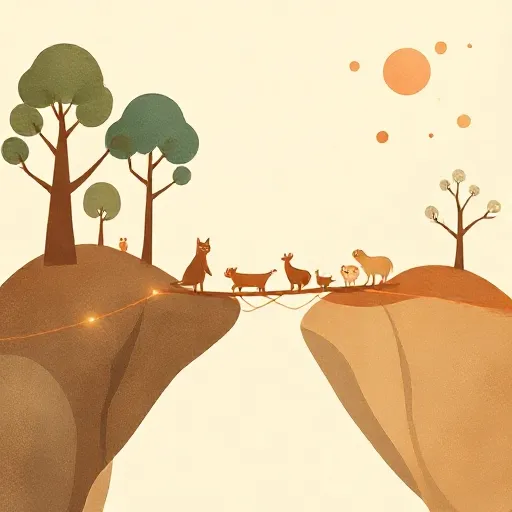
Sharpe noticed something the older realists often ignored: some general words are universal without pointing to any real common nature. Take “chimera,” a fire‑breathing monster that never existed. The term is common — it applies to many imaginary creatures — but it doesn’t correspond to a real essence. Or consider the word “individual.” It’s general, yet it doesn’t name a shared form; it names the quality of not being shareable. Sharpe listed six distinct ways a term could be universal. Only some of them required a common nature really existing in things. Others depended on a universal concept in your mind, like the concept of “being an individual.”
This was a breakthrough. By loosening the tie between language and the world, Sharpe borrowed a page from nominalism: our thoughts and words have their own rules, and they don’t have to be perfect pictures of extra‑mental reality. He didn’t abandon realism — he still believed universals are real constituents of things — but he admitted that how we talk about them doesn’t always mirror their structure. For example, the phrase “an individual man” is general even though no real universal of “individual‑man” exists; it works because of a negative concept. Sharpe therefore built a bridge between the warring camps.
Why It Still Matters: The Nouns You Use Every Day
Why should you care about a dusty medieval fight over “humanity”? Because you step into the same question every time you use a general word. Is “friendship” a real something that all friendships share, or just a handy name for a bunch of loosely similar relationships? Are biological species — “dog,” “dandelion” — real natural kinds carved out by evolution, or human‑made groupings? Philosophers, scientists, and artificial‑intelligence designers still wrestle with this. If you think categories are discovered, you’ll believe in real universals; if you think they’re invented, you’ll lean toward nominalism.
Sharpe’s middle way reminds us that the world might be richer than either extreme. Real shared natures could truly exist without forcing our words to copy them like a perfect photograph. Next time you say “this is a game” or “that feels unjust,” you’re doing philosophy — and a teacher from 1403 would be nodding from his bench.
Think about it
- A scientist tells you that “wolf” is a real biological kind with a shared genetic pattern. A friend says it’s just a word we apply to animals that look similar. Can both be right at once? Why or why not?
- If every person on Earth disappeared, would anything like “justice” or “beauty” still exist, or would there just be individual forgotten events? What would Sharpe say?
- Imagine you invent a new word “flarp” for things that are round and blue. Is “flarp” a real universal now, or did you just create a mental shortcut? Does it matter?