Why a Wobbly Sand-Triangle Can Prove a Perfect Theorem
A Triangle in the Sand
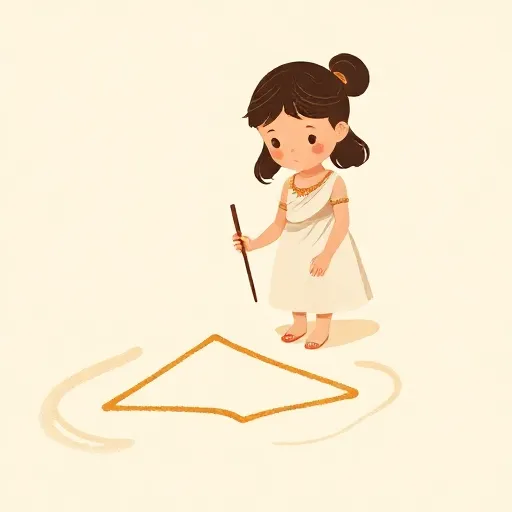
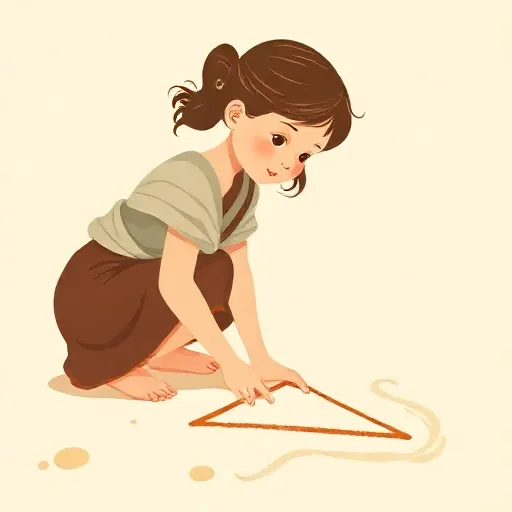
Imagine you are on a beach in ancient Greece. You pick up a stick and scratch a triangle into the sand. It is not perfect — one side is crooked, the corners are fuzzy. Yet somehow, by looking at this messy shape, a mathematician can prove something true about every triangle that has ever existed or will ever exist. How is that possible?
The philosopher Aristotle (384–322 BCE) wrestled with this puzzle. He never wrote a single book on the philosophy of mathematics, but his ideas are scattered through his works on logic, physics, and metaphysics. He lived at a time when Greek mathematics was exploding: geometers organized proofs, explored number theory, and discovered theorems about shapes and ratios. A fierce debate raged about what mathematical objects really are. Are they perfect, invisible Forms in a heavenly realm, as Plato suggested? Are they just thoughts inside our heads? Or are they somehow part of the physical world we touch and see?
Aristotle offered a radical middle ground. He agreed that we cannot ignore the way mathematics actually works. But he refused to believe in a separate universe of perfect triangles. His answer turned on a tiny Greek word: qua (pronounced “kwah”), meaning “in the respect that” or “in virtue of the fact that.” With that word, he solved three deep problems that had haunted the best minds before him.
The Three Headaches for Math Lovers
To understand Aristotle’s solution, we need to see the problems he faced. The thinkers in Plato’s Academy had identified three troubling puzzles about mathematics.
First, the problem of precision. Real-world objects are never exactly what mathematicians define. A drawn straight line has tiny wobbles; a physical circle is never perfectly round. Yet geometry proves things about lines and circles that seem to require flawless objects.
Second, the problem of separability. The objects of understanding should be eternal and unchanging — the truth “2+2=4” feels fixed forever. But a triangle drawn in sand will be washed away by the tide. Physical things change, get destroyed, are made of matter. So how can mathematical truths be about such shifty stuff?
Third, the problem of plurality. Suppose there really is a perfect Form of Triangle in some other world. But there would be only one Form of Right Triangle, one Form of Isosceles Triangle, and so on. Yet mathematicians need many right triangles at once — for a proof about diagonals, you might need two equal right triangles that are distinct. One single Form cannot give you two distinct triangles of the same kind.
Some philosophers, such as Plato’s nephew Speusippus, proposed a universe of intermediate mathematical objects — perfect instances, eternal and unchanging, but many in number. They sat between the Forms and physical things. That seemed to solve the puzzles. But Aristotle thought this created a pointless multiplication of worlds. He wanted an account that did not balloon reality with ghostly shapes.
The “Qua” Filter: Shapes and Numbers Alike
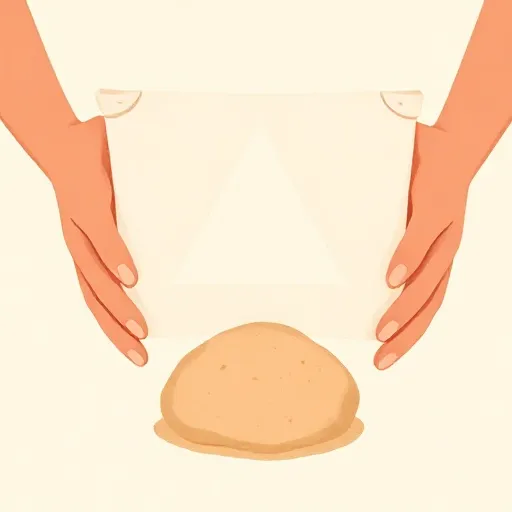
Aristotle’s genius was to notice that we never study a physical thing without some focus. When a blacksmith examines a bronze statue, he can study it qua bronze (its material) or qua statue (its shape). The statue is not two separate objects — it is one thing, looked at in two ways.
The same trick works for mathematics. Take a triangle scratched in sand. We do not have to care that it is made of sand, or that it is wobbly. We can study it qua triangle — in the respect that it is a triangle. We mentally “remove” all the other features. Aristotle called this process abstraction (from the Greek aphairesis, meaning “taking away”). We subtract the perceptible matter (the sand grains), the particular location, the time of day. What remains is the shape-as-shape, which we treat as if it were a separate object.
This solves the plurality problem instantly. There are countless physical triangles in the world — on paper, in buildings, in sand. Each can be studied qua triangle, so we have all the distinct instances we need. The proof about two equal right triangles simply points to two different physical drawings or imagined diagrams and treats them qua right triangles.
It also solves the separability problem. When we talk about a line AB “as if” it were a separate thing, we are using a useful fiction. The line is not really separate from its surface, but we act as though it is for the sake of the science. Mathematical statements about eternal, unchanging objects are really statements about what holds of any physical thing insofar as it has that shape — and those truths do not change, even if the sand does.
What about precision? Aristotle did not pretend that every real triangle is perfectly exact. But mathematical proofs do not depend on having a perfect instance in front of you. They depend on the properties that belong to a triangle universally — that is, to every triangle qua triangle. If a line is a little crooked, it is still a line, and the theorem about all lines still applies to it. The imprecision of our drawings does not break the proof, because the proof is about the nature of trianglehood, not about this particular speck of graphite.
The same idea works for numbers. When you count five cows, you are not staring at some invisible set of “five” floating in space. You are studying the cows qua unit — each cow is an indivisible thing counted. “Five” is the count that applies to any group of five distinct things. So arithmetic, too, studies physical objects, but filters out everything except their being countable units.
Starting Points: Axioms, Definitions, and Hypotheses
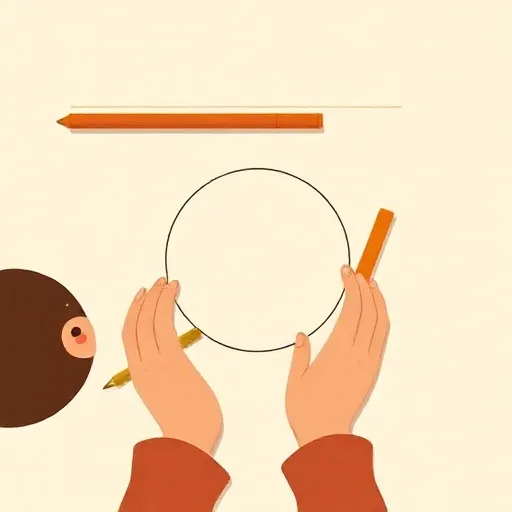
Before proving a theorem, a mathematician must state her starting points. Aristotle, thinking from his logical studies, divided these into three types.
An axiom is a statement so basic that anyone must accept it to learn anything in the subject. For example, “when equals are taken from equals, the remainders are equal.” An axiom is not proved — it is just seen to be true.
A definition is a stipulation. It says what a term means without claiming that the thing exists. For instance, you can define “unit” as “indivisible in quantity” without yet asserting that there are units.
A hypothesis is different: it asserts that something exists. For geometry, the hypothesis would be “there are points and lines.” In a proof, when the geometer says “Let there be a line AB,” she is applying that basic hypothesis to a specific case. The existence of triangles, however, is not a starting hypothesis — Aristotle thought you must prove that triangles exist, by showing you can construct them from lines and points.
This structure ensures that any science is built on firm ground. And because the hypotheses only claim that the fundamental entities (like points) exist in the physical world — not in a separate realm — the whole system stays anchored in reality. The proof then shows, step by step, what follows from those starting points.
Why a Bridge Does Not Need Perfect Triangles

So why does Aristotle’s dusty debate matter today? Every time you use a map on your phone, ride a bike, or cross a bridge, you rely on the idea that mathematics applies to the physical world. A bridge’s steel beams are never perfectly straight, and its angles are never exact to the last decimal. Yet engineers calculate them using geometric theorems as if they were ideal triangles and lines. That is exactly Aristotle’s “qua” trick in action: they study the bridge qua its mathematical shape, filtering out grain, rust, and wobble.
Moreover, Aristotle’s view helps us see why mathematics is not just a game with symbols. The shapes and numbers we learn about are not ghostly visitors from another dimension. They are real patterns in the stuff around us, seen through a special lens. That means when you figure out a proof, you learn something genuine about the world — not just about thoughts in your head.
Aristotle’s philosophy of mathematics was a careful balancing act. He refused to say mathematics studies a separate, invisible kingdom. He also refused to say it is only about mental images. Instead, he showed that real, physical objects can be the subject of eternal truths — if we look at them qua what they are. Next time you sketch a triangle in the dirt, remember: you are holding a piece of the universe’s deep structure, wobbly lines and all.
Think about it
- If you draw a triangle on crumpled paper and then unfold it, does the triangle still have three angles that sum to 180 degrees? Does the crumpling change the mathematical truth, or just the drawing?
- Could you study the shape of a cloud qua triangle, even if the cloud is never exactly triangular? Would the geometry of triangles still be useful for describing it?
- Imagine a world where no one ever drew a perfect straight line — only rough scratches. Could geometry still have been invented? What would a “point” or “line” mean in that world?