
Is a Word’s Meaning in Your Head, or in the World?
The Boy Who Thought Words Are Magic
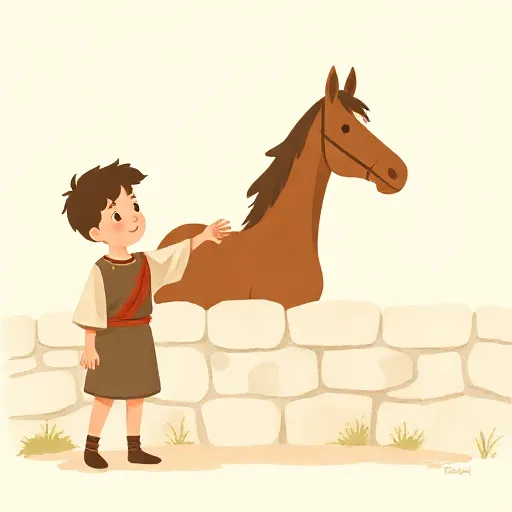
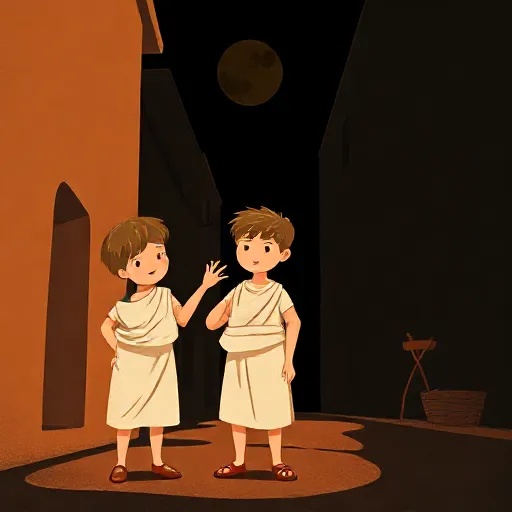
Imagine you are in ancient Athens, around 400 BCE. A boy named Cratylus turns to his friend Hermogenes and says that the word horse isn’t random, its very sound captures what a horse is — proud, swift, a living thing that gallops. Hermogenes laughs and says that that’s ridiculous, that they just agreed as a group to call it that, and that if they had all decided to call it sqwump, they would say the same thing about sqwump.
That argument — whether words get their meaning from some deep connection to the world or simply from human custom — is one of the oldest in philosophy. Cratylus was doing what we now call speculative etymology: he believed you could take a word apart and see the thing itself reflected in its pieces. For him, the Greek word for ‘human’ broke into parts that meant “one who reflects on what he has seen.” He thought that wasn’t an accident. Words were windows into reality.
Most people today, including nearly all linguists, think Hermogenes was closer to the truth. But the deeper question stayed alive: if words are not magic windows, where does their meaning come from?
The Morning Star and the Evening Star

Fast-forward two thousand years. By the late 1800s, philosophers were no longer staring at word pieces; they were staring at sentences and truth. A German thinker named Gottlob Frege (1848–1925) noticed something odd. The phrase “the Morning Star” refers to the bright object you see at dawn. The phrase “the Evening Star” refers to the bright object you see at dusk. As it happens, both are the planet Venus. So “the Morning Star is the Evening Star” is a true statement. But it’s not an obvious one — ancient astronomers discovered it. That means the meaning of a word, or a name, isn’t just the object it points to. If meaning were only that object, then “the Morning Star is the Morning Star” and “the Morning Star is the Evening Star” would say exactly the same thing. But they don’t. You can understand one without the other.
Frege introduced a pair of ideas that changed everything. The reference of a word is the actual thing it picks out in the world. The sense is the particular way that thing is presented — the aspect you grasp when you understand the word. Knowing the sense of “Morning Star” is what lets you find the planet in the morning sky, whether or not you realize it’s the same as the Evening Star. Word meaning, Frege argued, must involve both: the mental path (sense) and the real-world destination (reference).
The Twin Earth Trick

In the 1970s, an American philosopher named Hilary Putnam (1926–2016) played a trick that shook up the whole idea of meaning. He asked: imagine a place exactly like Earth — Twin Earth — down to every person, every tree, every language. On Twin Earth, there is a liquid that looks, tastes, and pours exactly like water. People call it “water.” Their word “water” works in all the same situations as ours. But on Twin Earth, that liquid’s chemical makeup is not H₂O. It’s a different, imaginary substance, which Putnam called XYZ.
Now, when an Earthling says “water,” the word refers to H₂O. When her identical twin on Twin Earth says “water,” the word refers to XYZ. Yet both speakers have the same thoughts, the same brain states, the same mental pictures when they say the word. So if meaning were just a thought in the head, the two words would have the same meaning — but they don’t. Meaning, Putnam concluded, “just ain’t in the head.” It depends on the actual stuff in the world you’re connected to.
This view is called semantic externalism: the meaning of at least some words (like “water,” “gold,” “lemon”) is settled partly by your real environment, not by what you think you’re talking about. A word latches onto a substance or a kind, and you might not even know its deep nature — but the word still refers to it.
Ache in Your Joints — or Muscles?

A different twist on externalism came from Tyler Burge (b. 1946). He imagined a person — call her Maria — who goes to the doctor and says, “I think I have arthritis in my thigh.” But arthritis is an inflammation of the joints, not muscles. Maria has a false belief about what arthritis can affect. Yet when she uses the word “arthritis,” it still means arthritis — the joint disease — not some broader notion of “body ache.” Why? Because meaning isn’t decided by just one speaker’s private understanding. It’s fixed by the wider linguistic community: doctors, dictionaries, the shared pattern of how the word is used.
This is social externalism. Your words’ meanings depend on something outside your own mind — the standards of the group you belong to. You don’t have to be an expert. You can be mistaken. But the word still carries the community’s meaning, not your personal version. Radical individual meanings — private “idiolects” — don’t really exist as public meanings. Of course, that raises a tough question: if meaning is public, how do you know you’re really using a word right?
Milk in the Fridge: When Meaning Slides Around

So far we’ve seen that meaning can reach outside your head. But can it also shift under your feet? In the late 20th century, a group of contextualists argued that the very same sentence can have different truth conditions depending on the situation.
Take the sentence “There is milk in the fridge.” If you say it during morning breakfast, you mean there is a carton of milk to pour. The sentence is true if a carton is there, false if there is only a dried puddle on a tray. But if you say the same words while cleaning the kitchen, the truth flips: a spill means “yes, there is milk (mess) in the fridge,” and the carton may not matter. You didn’t change an indexical like “I” or “now” — the context itself reshapes what counts as making the sentence true.
This makes the idea of a fixed, literal word meaning look shaky. A more radical version, championed by the French philosopher François Recanati (b. 1952), suggests that words don’t have a single stable meaning. Instead, they have a semantic potential — a history of all the ways they’ve been used before, which you draw on to interpret them in each new scene. Like a tool that can be a hammer, a doorstop, or a paperweight, a word’s job depends on what you need.
Contextualism doesn’t say words mean anything you want. But it does say that meaning is a partnership between the word, the speaker, and the situation. Some philosophers think this goes too far and makes communication impossible; others think it’s just honest about how language really works.
Why It Still Matters: Your Words, Your World

You live with these puzzles every day. When you learn a new word like “meme” or “cringe,” is its meaning locked in your brain, or does it live in the ever-shifting conversations around you? When you say “That’s fair,” do you and your friend truly mean the same thing, or do your different experiences tug the word in different directions? And if the word “water” could refer to something completely different on Twin Earth, could the words you use for friends, justice, or even “game” partly mean something you don’t yet know?
The debate over word meaning is not just about dusty dictionaries. It’s about how we connect to the world and to each other. Externalism reminds you that there may be facts about what your words refer to that outrun your current beliefs. Social externalism reminds you that language is a team sport — you inherit meanings shaped by generations. Contextualism reminds you that a word in a new kitchen might mean something you never expected.
Philosophers haven’t settled the fight. But every time you pause and ask, “Wait, what do you actually mean by that?”, you join a 2,400-year-old conversation — one that started on a sunlit street in Athens with a boy who heard a gallop inside a word.
Think about it
- If you call a dog “cat” your whole life but you mean the furry barking animal, does your word “cat” really mean dog to you — or does it still mean cat because of how everyone else uses it?
- Imagine you and a friend both say, “She’s brave.” You’re thinking of a soldier; your friend is thinking of someone who ate a whole ghost pepper. Do you both mean the same thing?
- If you discovered tomorrow that gold is not the shiny metal you thought but a plastic-like substance, would the word “gold” still refer to the stuff in ring shops, or would it now refer to the plastic?