The Philosopher Banished for Asking: Do You Have Free Will?
The Speech That Got a Philosopher Banished

On a bright July day in 1721, a professor named Christian Wolff (1679–1754) stood before the University of Halle and gave a speech that would cost him his job — and nearly his life. He praised the moral teachings of the ancient Chinese philosopher Confucius, arguing that you could be a good person without ever reading the Bible. That claim enraged a powerful group of theologians called the Pietists, led by Joachim Lange (1670–1744). They already distrusted Wolff’s philosophy because it seemed to explain everything — even human choices — as the unavoidable result of reasons and causes. To them, that left no room for God’s direct involvement or for truly free will.
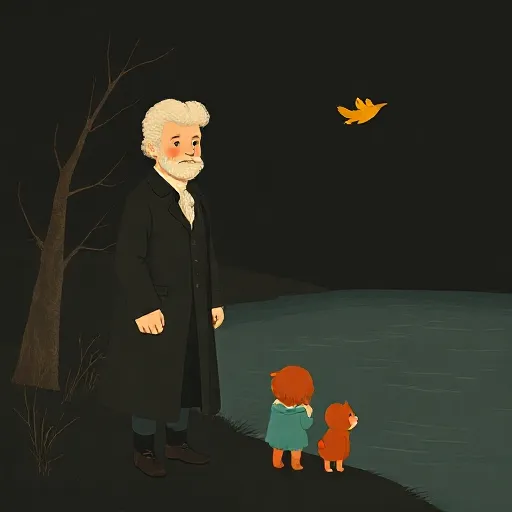
The argument escalated until, in 1723, King Frederick William I of Prussia ordered Wolff out of the country within 48 hours, on pain of death. Wolff packed, crossed the river, and — legend says — stopped to refund his students’ lecture fees. But the ideas that got him banished were far bigger than one speech. They were about what it means to know something, what a “reason” really is, and whether you are ever free.
What Does It Mean to Really Know Something?

Wolff wanted to turn philosophy into a proper science. In his 1713 book Rational Thoughts on the Powers of the Human Understanding, he defined science not as a pile of facts but as the habit of demonstrating propositions from certain and immutable principles. That sounds fancy, but the core idea is simple: real knowledge means you can trace every claim back to an unshakable starting point, like a geometric proof. If you just memorized that rain falls from clouds, you had “common knowledge.” If you understood why water vapor condenses and what gravity is, you had philosophical cognition — the kind that reveals the hidden chain of connections.
Wolff didn’t think you could get that kind of knowledge from pure thinking alone. He was a rationalist who took experience seriously. He called his ideal method a “marriage of reason and experience.” Observations from the senses — what he called historical cognition — must come first. You watch the stars, you measure shadows, you feel your own heartbeat. Then reason steps in to find the invisible links: the laws, the causes, the “grounds” that make those observations make sense. This two-step dance was Wolff’s answer to philosophers like Descartes, who he thought tried to deduce everything about nature just by sitting in an armchair and thinking hard.
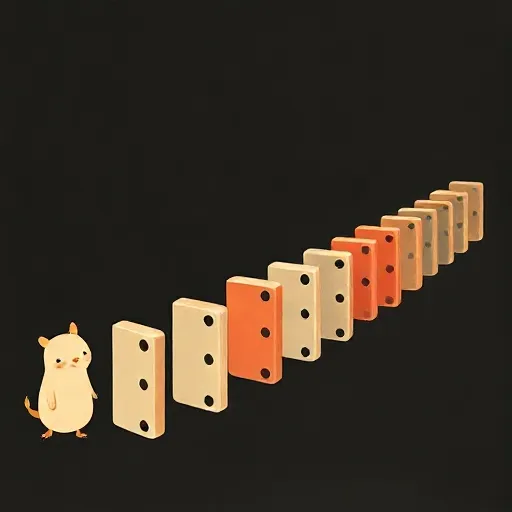
The Domino Principle: Why Everything Needs a Reason

At the bottom of Wolff’s entire system lay a single, unshakeable claim: nothing exists without a sufficient reason. Today we might call it the Principle of Sufficient Reason. The idea is that for anything that happens — or even for anything that could happen — there must be something that explains why it is this way and not another way. If a book is on your desk, there must be a reason: you put it there, or someone else did, or a gust of wind blew it open. If a thought pops into your head, there must be a reason too — even if you don’t know what it is.
Wolff went further than his famous contemporary Gottfried Wilhelm Leibniz (1646–1716). Leibniz mostly applied the principle to actual events, but Wolff insisted it applied to every possible thing as well. A talking cat doesn’t exist, but the concept of a talking cat still has a reason: the idea of a cat and the idea of speech don’t contradict each other. Wolff thought you could prove the principle itself from pure logic. His proof started with a simple idea: suppose something could exist without a reason. Then, he argued, you would have to say that “nothing” was the reason it existed — and that’s a contradiction, because “nothing” can’t be a reason for anything. This proof was attacked almost immediately by critics like Christian August Crusius (1715–1775), who spotted a sly confusion in Wolff’s use of the word “nothing.” The debate over whether the principle can be proved has never really ended.
Are You Free, or Just a Wind-Up Toy?

This is where the trouble started. Wolff’s Pietist enemies argued that if every human decision has a sufficient reason, then you can never act otherwise. You’re just a domino in a very long line, and calling that “freedom” is an illusion. That terrified them, because it seemed to make moral responsibility meaningless. If a murderer’s crime was determined by a chain of causes stretching back before his birth, how could God justly punish him?
Wolff’s answer was careful and technical — and deeply influenced by Leibniz. He defined freedom not as the ability to act randomly, but as the ability to act spontaneously from your own inner nature. A free action, he said, has three features. It arises from within you (it’s spontaneous). It isn’t forced by your essential definition (it’s contingent). And most importantly, it is guided by a clear, distinct cognition of what is good. In Wolff’s picture, you freely choose to help a friend because you clearly see that helping makes things more perfect — not because a cosmic puppet-master yanked a string. The cause is inside your own mind, even though it is a cause. This view is called compatibilism: the claim that your acts can be fully determined by reasons and still be genuinely free.
The Pietists weren’t satisfied. They felt, perhaps like you might, that if your choice was already settled by the web of reasons and causes before you even thought about it, then you never had a real “could have done otherwise” moment. Wolff replied that the feeling of being able to choose differently is just a sign that you don’t yet see the reason that tips the scale — not proof that the reason doesn’t exist.
The Rule of Making Things Better

Even though his metaphysics caused fireworks, Wolff’s moral philosophy was surprisingly simple. He borrowed a single concept from Leibniz: perfection. For Wolff, perfection means harmony or agreement among many parts. A well-tuned orchestra, a healthy body, a mind where every belief fits together — all of these are more “perfect” than their chaotic opposites.
From this slim idea, Wolff derived one universal rule of action, which he called the law of nature: “do that which makes you and your state or that of another more perfect, omit that which makes it more imperfect” He didn’t need to bring in God’s commands to make this work. He thought the rule was binding because every human naturally feels pleasure when they sense perfection and displeasure when they sense imperfection. That pleasure gives you a motive, and the motive creates an obligation.
This is what really scandalized the Pietists. Wolff was saying that a Chinese sage who never heard of the Bible could still live a deeply moral life — because reason alone, observing what makes human beings flourish, could uncover the same basic law. Centuries later, the idea that morality doesn’t depend on religion is common, but in Wolff’s Prussia it was dangerous. It severed virtue from revelation and put rational insight in the place reserved for sacred texts.
Why It Still Matters: Your Choices and Your Mind

Wolff returned to Halle in triumph in 1740, called back by the new king, Frederick the Great, an admirer of his philosophy. But the questions he raised never went away. Today, neuroscientists can sometimes predict a person’s finger movement seconds before the person feels they “decided” to move. That sounds like a vindication of the domino principle — and a direct challenge to the feeling of freedom. Yet others argue that the feeling of consciously choosing is real, and that a compatibilist view like Wolff’s is exactly what we need to make sense of a world governed by physical laws while still holding people responsible for their actions.
Wolff also left a quieter legacy: he fought for the idea that philosophy should be useful, written in everyday language, and accessible to anyone — including women, who began reading and debating his works in numbers unusual for the time. He believed that understanding the chain of reasons behind things wasn’t just for dusty scholars. It was a tool for living better, thinking more clearly, and maybe, just maybe, acting a little more freely.
Think about it
- If every thought you have has a cause, can you ever be truly creative — or is “new” just a chain of old thoughts rearranged?
- Wolff said we can know right from wrong by reason alone, without religious teaching. Can someone who doesn’t believe in God still be a deeply good person? Why or why not?
- Imagine you’re about to grab the last cookie, but then you remember your little sister wanted it. You put it back. Was that decision free if your brain chemicals pushed you one way and your kindness pushed you the other?