What Are the Tiniest Pieces of Language and Reality?
A Philosopher in a Trench

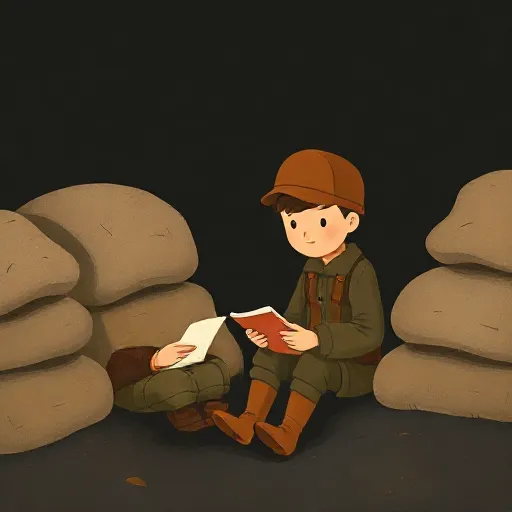
In 1914 a young Austrian soldier named Ludwig Wittgenstein (1889–1951) sat in a cold trench on the Eastern Front. While shells exploded in the distance he scribbled notes about a question that had nothing to do with war. He wanted to know: what makes a sentence actually mean something? And what, if anything, are the simplest, most basic pieces of language and of the world?
Wittgenstein’s answer grew into a short, strange book called the Tractatus Logico-Philosophicus. Its central idea was that language and reality both have a hidden, perfect structure. If you could somehow break a sentence apart completely, you would find tiny, unbreakable pieces — names — each pointing to a tiny, unbreakable piece of reality — an object. Everything we say about the world, he thought, is built out of these simple names for simple objects.
But Wittgenstein could never find a single example of a real, live simple object. And before his life was over, he decided the whole hunt had been a mistake.
The Ultimate Building Blocks: Names and Objects
Wittgenstein gave the word name a very strict meaning. A Tractarian name is a semantically simple symbol: its meaning does not depend on the meanings of its written parts, even when those parts are real words elsewhere. For example, the word “battle” appears to be one word, but you can hear “bat” inside it. That isn’t the problem. The real problem is that you can get rid of “battle” altogether and talk about the actions of people, weapons, and ground instead. A true name cannot be analysed away into other words. Natural languages, Wittgenstein suspected, contain very few — maybe zero — genuine names. Even words like “London” or “Obama” would disappear if you analysed them far enough.
So what are these names supposed to name? They name objects, the simplest bits of reality. An object has no parts. It cannot be taken apart and does not depend on anything else to exist. Objects are the fixed things behind every possible way the world could be.
But what kind of thing counts as an object? Wittgenstein’s readers have fought about this. One side, defended by Elizabeth Anscombe (1919–2001) and Irving Copi (1917–2002), says objects are all particulars — individual things, not properties or relations. They point to a remark in the Tractatus: properties are “first formed by the configuration of objects,” so they aren’t objects themselves. The other side, defended by Erik Stenius (1911–1990) and Merrill and Jaakko Hintikka, says objects also include properties and relations. They point to a notebook where Wittgenstein wrote that objects include relations and that “thing” and “relation” are on the same level. The debate is still alive. It is even possible that Wittgenstein had no fixed opinion — he might have believed that complete analysis would surprise us, showing that the final pieces don’t fit any familiar category.
The Argument from Substance: Why There Must Be Simple Things
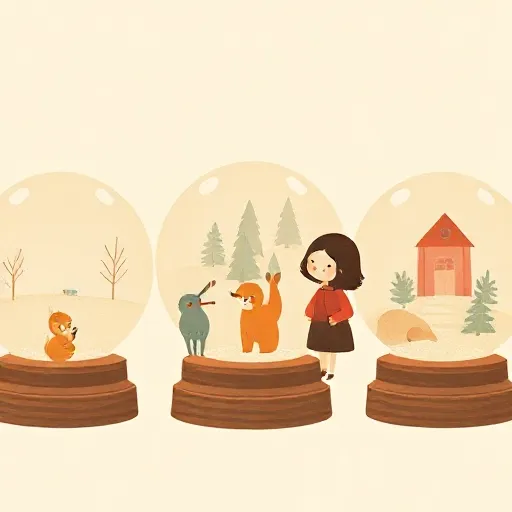
Wittgenstein didn’t just guess that simple objects exist. He argued for it with a tight chain of reasoning. He called the objects, taken all together, the world’s substance. For him, substance is what stays exactly the same across every possible world — like a glass globe that remains in place while the tiny scene inside it changes.
The argument runs like this. Suppose there were no substance — no object that exists in every possible world. Then everything would exist only contingently; in some possible worlds, any given thing would be missing. Now imagine a sentence that seems to be about a complex thing, like “The cat is on the mat.” If cats and mats are complex and could vanish entirely in some possible world, the sentence might be neither true nor false there — it would have no truth value. It would depend for its sense on another sentence being true (a sentence saying that the cat’s parts are arranged into a cat). If every sentence depended like that, then no sentence would have a determinate sense all by itself. But a sentence that fails to be true or false in some possible worlds doesn’t “reach through the whole logical space” — it isn’t a real picture of the world at all.
Yet we can draw up pictures of the world — we can say things that are definitely true or false, no matter how things might have been. So the starting assumption must be wrong. There must be substance: some things exist in every possible world. And if anything complex can fail to exist by falling apart, those necessary things must be simple. Objects, then, are the necessary, unchanging scaffolding that holds language in place.
The argument has been criticized. Some philosophers think a name can stay hooked to its object even in worlds where that object doesn’t exist, so sentences wouldn’t lose their truth value. Others point out that vague sentences seem senseful yet lack a crisp truth value in borderline cases. The debate is far from settled, but the argument shows how seriously Wittgenstein took the idea that meaning needs a solid floor.
The Dream of a Complete Analysis
Wittgenstein believed that if you handed him an ordinary sentence, he could, in principle, slice it into smaller and smaller pieces until only names remained. This view is called linguistic atomism — the idea that every proposition can be analysed down to elementary propositions made of names in direct combination.
He took his method from the logician Bertrand Russell (1872–1970). Russell had shown how to rewrite sentences that use the word “the” — such as “The king of France is bald” — so that they no longer treat “the king of France” as a single naming word. That phrase, Russell said, is an incomplete symbol: it means something only in the context of a whole sentence, and it does not stand for any one thing. Wittgenstein hoped to do the same for all expressions that seem to name complex things. He even sketched definitions that would eliminate terms like “[aRb]” — “a in the relation R to b” — by rewriting them as conjunctions of simpler claims.
If you could repeat this procedure long enough, you would eventually reach a final analysis: a sentence containing only genuine names, each one a simple symbol for a simple object. There would be no more incomplete symbols to remove. Wittgenstein thought it was obvious that analysis had to end this way, because an unanalysed sentence gets its sense from the sentences that analyse it. If it had an infinite analysis, it would never acquire a sense at all.
But here was the snag. How would you know you had actually reached the final analysis? Wittgenstein offered only one clue: if a proposition is indeterminate — if it is unclear whether it is true or false in a certain situation — that signals the need for more analysis. Yet he never gave a workable test for this kind of indeterminateness. As a result, the whole programme remained a brilliant blueprint on paper, never built.
Why It All Fell Apart
In 1929 Wittgenstein wrote an article that cracked his earlier system open. The problem came from colours. The sentences “This point is red all over at this moment” and “This point is blue all over at this moment” cannot both be true. Yet that incompatibility doesn’t look like a logical impossibility — it isn’t like saying “It is raining and it isn’t raining.” In the Tractatus, Wittgenstein had been confident that if you analysed colours far enough — into facts about the velocities of particles, say — the conflict would become a logical contradiction. But by 1929 he saw that for qualities that come in degrees, like brightness, no such analysis could work. The impossibility of something’s having exactly one degree of brightness and exactly two degrees at the same time could not be turned into a logical contradiction. It was a mathematical impossibility. That forced him to give up the idea that all necessity is logical necessity and that elementary propositions are logically independent.
A deeper crack appeared a few years later. In the Tractatus, Wittgenstein had treated a universal claim like “Everything is G” as an infinite conjunction: “a is G and b is G and c is G…” He had assumed that the “…” was unproblematic. By 1932 he realized his mistake. He had confused two kinds of dots: “dots of laziness,” where we simply skip writing out the rest of a finite list, and “dots of infinitude,” which gesture at something that can never be written out. An infinite conjunction is not really a logical product; it’s more like an open-ended process. The whole idea of the “general form of the proposition” in the Tractatus was sloppy.
Beneath even that, Wittgenstein spotted his deepest mistake. He had been thinking of logical analysis as if it were like chemical analysis — as if there was a definite, hidden formula that analysis uncovers, even though he couldn’t yet say what it was. He later called this attitude “dogmatism.” The confident soldier in the trench had slowly turned into a philosopher who suspected that the very question “What are the simplest pieces of language?” might be badly formed.
Why This Old Puzzle Still Matters
You might never spend an afternoon wondering whether “London” is a Tractarian name. But Wittgenstein’s dream and its collapse touch something ordinary. Whenever you try to explain how a word works — say, “game” or “fair” — you are doing a little bit of logical analysis. You are asking what that word is built from and whether there is a simplest core meaning that all its uses share. Often, you find that there isn’t.
Wittgenstein’s story also shows that even the most careful thinker can change their mind completely. He built a crystalline picture of language and reality, then smashed it himself. That isn’t failure; it’s how philosophy moves. The hunt for the ultimate building blocks of meaning has not ended — it has just become more modest. Today’s philosophers of language and linguists still search for the elementary pieces of meaning, but they expect the pieces to look messy and overlapping, not neat and atomic.
So when you hear someone insist that there must be a single, simple definition of “justice” or “love,” you can ask the Wittgenstein question: Have you actually found it? And if not, what makes you so sure it is there?
Think about it
- If you had to pick the simplest object in the universe — something with no parts — what would you name? Could you ever be sure it really has no parts?
- Imagine a language that is just starting, with only a handful of words. Would it need “simple names” to work, or could it get by with words that shift their meanings depending on the situation?
- Wittgenstein once believed that every sentence could be broken down completely, then later thought the whole idea was a mistake. When, if ever, is it wise to give up on a big idea you’ve believed for a long time?