Why Ludwig Wittgenstein Threw Away His Own Book
The Young Man Who Questioned Everything
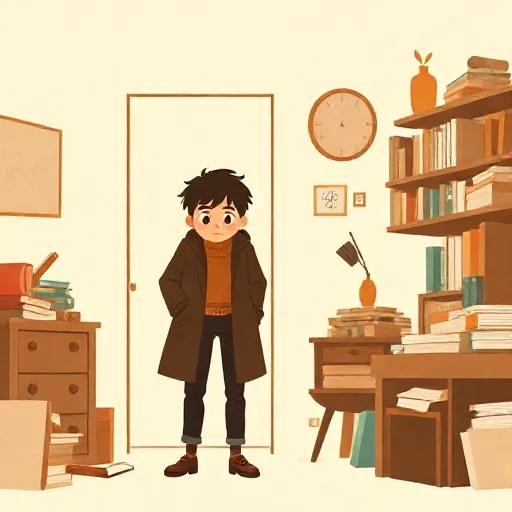
In 1911, a 22-year-old Austrian engineering student named Ludwig Wittgenstein (1889–1951) knocked on the door of Bertrand Russell (1872–1970) at Cambridge University. He had a single burning question: was philosophy a waste of time? Russell, already famous as one of the world’s sharpest logicians, expected an ordinary student. What he got was a stubborn, peculiar young man who, within a year, convinced Russell that he would solve the deepest puzzles about language and reality.
Wittgenstein’s journey began with aeronautical engineering, but his obsession with the foundations of mathematics led him to philosophy. After that encounter with Russell, he spent intense years thinking, writing, and retreating into isolation in Norway. Then World War I broke out. He served in the Austrian army and, while on leave and in a prison camp, worked on the notes that would become his first masterpiece, the Tractatus Logico-Philosophicus.
The book was published in 1921. Its central idea was that language could be made perfectly clear, if only we understood its hidden logical structure. To Wittgenstein’s own astonishment, he believed he had solved every major problem of philosophy. He then left philosophy, gave away his family fortune, and became a schoolteacher and a gardener. But within a decade, he realised his first grand vision was not the end of the story—it was a trap. He returned to Cambridge and began to dismantle his own work, piece by piece.
Building a Perfect Picture of Language
Wittgenstein’s early solution was astonishing in its ambition. He claimed that the world, thought, and language all share the same logical form. The Tractatus opens with a bold vision: “The world is all that is the case.” The world is made not of separate things, but of facts—combinations of objects arranged in particular ways. These combinations are states of affairs. A state of affairs that actually exists is a fact.
Here we meet the first of his big ideas: the picture theory of meaning. A thought, or a sentence, works like a model or a picture. Just as a map uses lines and colours to stand for roads and towns, a proposition uses names arranged in a certain structure to stand for objects arranged in a certain way. For this to work, the arrangement of signs in the sentence has to mirror the arrangement of objects in the fact—they share the same logical form. It is as if the sentence reaches right out to reality and says, “This is how things stand.”
That means a proposition has sense only if two conditions are met. First, its structure must obey the rules of logic. Second, every simple name in it must hook onto a real object. When both are true, the sentence is bipolar: it can be either true or false, and the difference between the two shows you something about the world. This gave Wittgenstein a tool to handle all meaningful language. He even wrote out a general form of any truth-function, showing how complex propositions are built from elementary ones by repeated logical operations. At this stage, he was confident he had trapped the essence of saying anything at all.
The Dark Side of the Picture: Sense, Nonsense, and Silence
One consequence of this picture theory was fierce and unforgiving. If a sentence cannot exhibit its logical form and its names cannot refer to objects, it is simply nonsense. Not false, not silly, but genuinely meaningless. Yet many sentences that people use—especially in philosophy, ethics, and aesthetics—seem to break these limits. “1 is a number,” “Socrates is identical,” or “the world has a purpose” all fail to picture any possible fact.
Wittgenstein made a crucial distinction here. Some statements, like tautologies and contradictions (for instance, “It is raining or it is not raining”), do not represent facts. They are not nonsense, however; he called them senseless (sinnlos). They mark the boundaries of what can be said, working like the edges of a map that show where the map stops. True nonsense (unsinnig) is worse: it pretends to say something about the world but actually breaks the conditions of sense entirely.
And then came the most startling twist. The Tractatus itself is full of sentences about the limits of language, about logic, about the relationship between words and the world—and yet, by its own rules, those very sentences are nonsense. They try to say what can only be shown. The logical form of reality, the fact that sentences picture anything at all, the mystical: all of it cannot be put into words; it makes itself manifest.
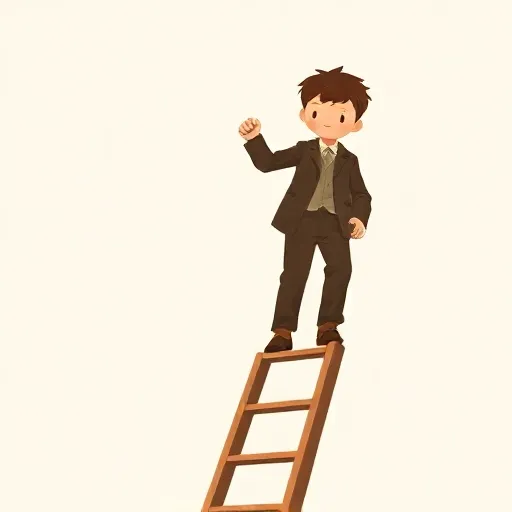
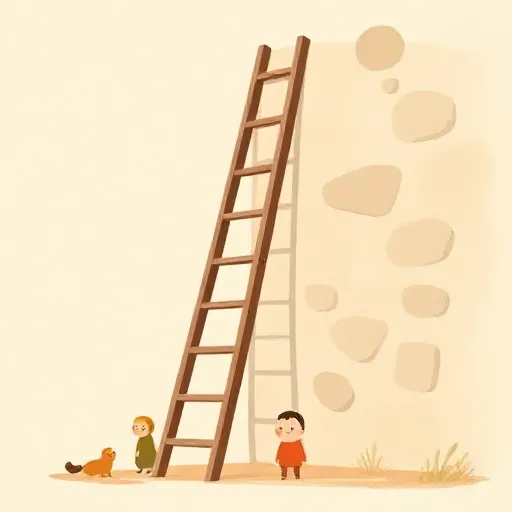
Wittgenstein’s famous final advice—Whereof one cannot speak, thereof one must be silent—was not a dramatic plug for silence. It was the logical conclusion of a book that had drawn a line around language from the inside, and then found itself on the wrong side of the line. He compared the book to a ladder: you climb it to see the world rightly, and then you must throw it away. The work that had solved all philosophy was itself a piece of nonsense that you had to recognise as such.
From Logic to Life: The Game of Language
When Wittgenstein returned to philosophy in 1929, he no longer believed in the dream of a perfect logical skeleton beneath language. He called his earlier work “dogmatic.” The real trouble, he now thought, was not that philosophers failed to find the right logical forms, but that they were looking for a single, hidden essence of meaning at all.
His new starting point was disarmingly simple. Instead of asking what meaning must be, we should just look at what we actually do with words. The core slogan of his later philosophy is: the meaning of a word is its use in the language. Think of words like tools in a toolbox. You would never say a hammer, a saw, and a ruler all serve the same function just because they look a bit alike; the same is true of words. So Wittgenstein told philosophers, “Don’t think, but look!”—pay attention to the countless, messy ways a word is actually used.
To highlight this, he invented the concept of a language-game. In a primitive language-game, a builder might call out “Slab!” and an assistant fetches the slab. The meaning of “slab” here is tied entirely to the activity of building, not to a picture of an object in a logical space. Real language is a sprawling collection of overlapping games—asking, thanking, joking, speculating, translating, singing—each woven into a form of life, the shared human behaviour that makes communication possible.
This also led him to abandon the search for precise definitions. For many concepts, there is no single thing that all uses have in common. Instead, there is a family resemblance: a network of overlapping similarities, like the way family members share a nose here, a laugh there, without any one trait belonging to everyone. Asking for the essence of “game” or “language” is a philosophical mistake. What matters is the fluid pattern of similarities that guide us from case to case.
The Rules We Follow, The Private World We Can’t Have
Looking at use brought Wittgenstein face to face with a deeper problem. When we follow a rule—say, continuing the series 2, 4, 6, 8, …—what makes the next step “right”? You might say you have grasped the rule in your mind, but what if a pupil writes 1000, 1004, 1008, 1012 and insists they are going on in the same way? Wittgenstein drove this doubt to a famous paradox: no course of action could be determined by a rule, because every course could be made out to accord with the rule.
This isn’t a sign that meaning is hopeless; it’s a warning. What saves us from chaos, he argued, is not a mystical inner signpost nor a mental picture, but the shared practices and reactions of a community. Following a rule is a custom, a piece of public life, not a private mental event. This line of thought led directly to his attack on the idea of a private language—a language whose words refer to sensations known only to one person. If there were no public standard for when a word is used correctly, the speaker couldn’t even tell whether they were using it right or wrong. A truly private language would be no language at all.
This shift also changed what counted as grammar. For the early Wittgenstein, logic provided the scaffolding of the world. Now grammar, in a much broader sense, took its place: the rules embedded in our language-games that tell us what kind of object anything is. Essence is expressed in grammar. A sentence like “I know what I am thinking” confuses us, because grammar shows that in the first-person case, knowing isn’t the same kind of thing as knowing what someone else is thinking. Tending to these grammatical differences is the work of philosophy.
Why It Still Matters: Showing the Fly the Way Out
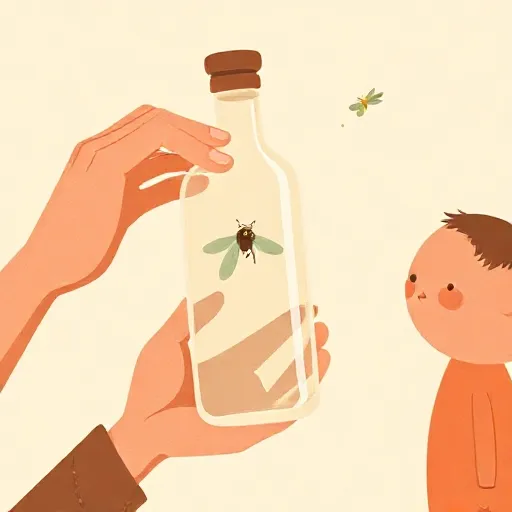
Throughout his life, Wittgenstein never thought philosophy should give you a theory. Philosophy is an activity—a kind of therapy for the confusions that language creates. In the Tractatus, that therapy meant using logical analysis to expose nonsense and then falling silent. In the later work, it meant collecting reminders of how words are actually used, so that philosophical problems dissolve rather than get solved. A real philosophical problem, he said, has the form “I don’t know my way about.” The aim is to show the fly the way out of the fly-bottle.
This idea still matters every time we get tangled up in words. Have you ever felt that a word like “know” or “see” must have one deep definition that explains everything? That craving for a single essence is exactly what Wittgenstein warns against. His lesson is that meaning is not a hidden aura inside a word; it’s woven into the practices of talking, asking, correcting, and living together. Understanding language means participating in the many different games we play.
And the quiet twist of his whole journey is that he never said, “Here’s the final answer.” He showed us what it looks like to stop demanding a final answer from words, and instead to pay attention to the life already going on in them. That invitation—to look, not to theorise—is as alive today as it was when he abandoned philosophy for a schoolroom in the Austrian hills, and then came back to tear his own ladder down.
Think about it
- If a friend tells you that a word like “fair” should mean exactly the same thing in every situation, could you show them a living example that doesn’t fit their definition?
- Imagine a language you invent entirely for yourself to name your own secret feelings. Could you ever be sure you were using it correctly? What would you need from others to make it a real language?
- Wittgenstein thought some of the most important things cannot be put into words at all—they are only shown. Can you think of something in your own life that is better expressed through action or silence than through talking about it?