Do You Really Know Right from Wrong If You Don’t Act?
The Bamboo Experiment That Failed
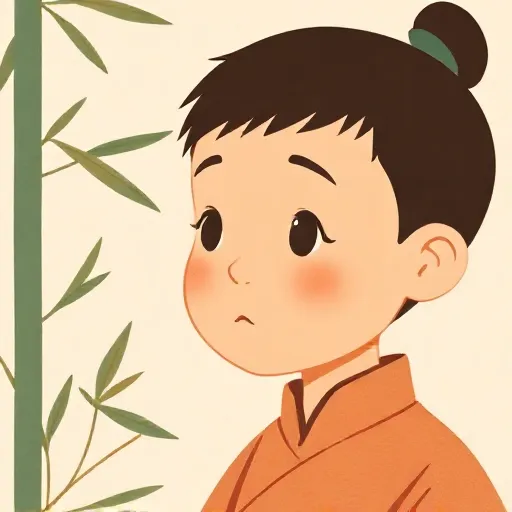
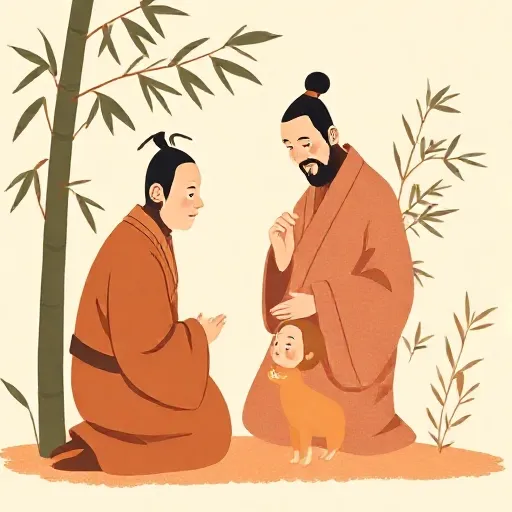
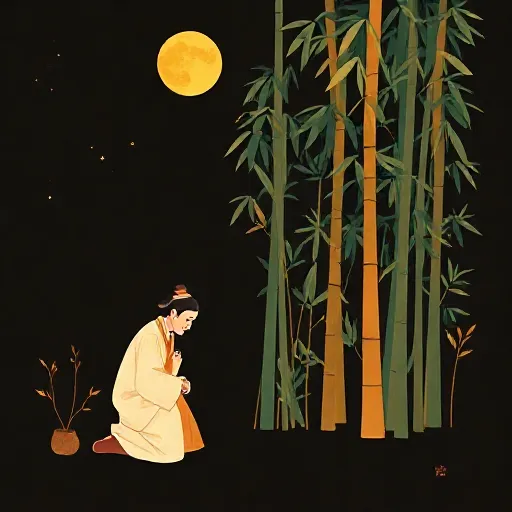
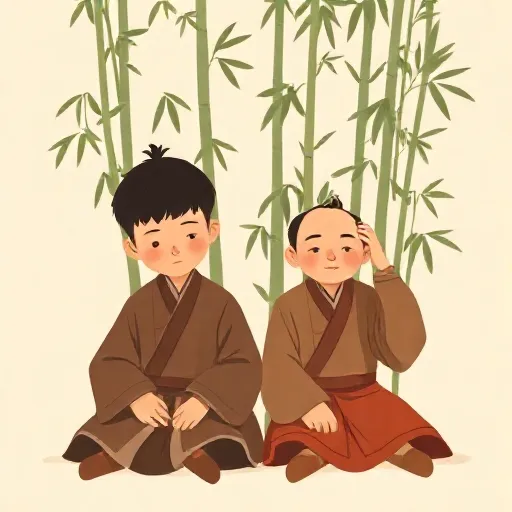
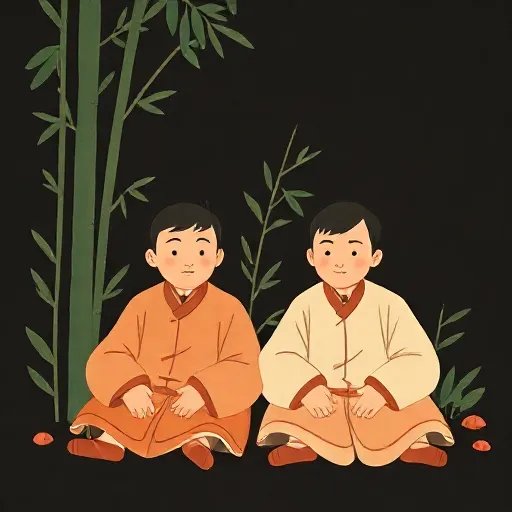
In 1489, seventeen-year-old Wang Yangming (1472–1529) sat in a garden with his friend Qian. They had both decided to become sages — perfectly good people — by following the method of the great philosopher Zhu Xi (1130–1200). Zhu Xi taught that you could grasp the moral order of the universe by “investigating things,” looking for the hidden Pattern (lǐ) that runs through everything. So Wang and Qian chose the bamboo in front of the pavilion. Day after day, they concentrated as hard as they could, trying to see the Pattern in the stalks. Qian became ill after three days. Wang kept going. After seven days of relentless mental strain, he collapsed too — and he had found nothing. Later, Wang wrote: “We sighed to each other and said that it was impossible to be a sage or a worthy, for we do not have the tremendous energy to investigate things that they have.”
That failure haunted Wang. If the universe’s moral truth was not something you could discover by staring at objects, how do you actually become a good person? The question drove him through Daoism, Buddhism, and eventually back to Confucianism, but with a radical twist that still upends how we think about ethics. Wang spent his life insisting that the answer was never outside — it was already inside every human mind, waiting to be acted on.
A Map of the Universe: Pattern and Qi
To grasp Wang’s rebellion, you have to understand the Neo-Confucian world he grew up in. Neo-Confucian thinkers believed that everything in existence has two aspects. First, there is Pattern (lǐ), the underlying structure or order of the universe — like a hidden moral blueprint. Second, there is qi, the actual “stuff” that makes up concrete things: the matter or energy that fills space and time. The complete Pattern is fully present in every single thing, from a rock to a person. But different things have different quality of qi: some qi is “clear,” like clean water, and some is “turbid,” like muddy water. The clearer your qi, the more the Pattern can shine through.
Zhu Xi, whose ideas dominated Chinese education, used this to explain why we struggle to be good. Humans are born with the clearest qi of any being, so we all have complete moral knowledge inside us. But each person’s qi is more or less turbid, so our natural moral sense gets clouded. One moment you spontaneously show compassion; the next moment selfish desires fog everything over. Zhu Xi’s cure was careful study: read the Confucian classics, under a good teacher if possible, and investigate things (gé wù) to grasp the Pattern in them. Only after that, he said, can you achieve Sincerity (chéng) — a steady awareness of moral truth that resists temptation. So knowledge had to come first, action second. As Zhu Xi put it, knowledge and action are like eyes and feet: you need both, but the eyes lead.
Wang’s Turn: The Mind Is Pattern
Wang’s life was upended in 1506 when he boldly protested a corrupt official at court. The official had him publicly beaten and exiled to a remote, barely civilized outpost in what is now Guizhou province. There, enduring physical and psychological hardship, Wang had a deep philosophical awakening. He realized that his earlier bamboo failure had been pointing to the truth all along: looking outside for moral truth was completely backward. He wrote a poem for his students: “Everyone has within an unerring compass; / The root and source of the myriad transformations lies in the mind.”
Wang began to argue that the mind is Pattern. There is no Pattern separate from your own mind, he said. “The mind is Pattern. Is there any affair outside the mind? Is there any Pattern outside the mind?” Every person is born with pure knowing (liángzhī), an innate moral compass. Mencius (4th century BCE) used this phrase to describe how even a baby knows to love its parents without being taught. Wang’s message was simple: you don’t need to study mountains of texts or exhaust yourself investigating things; you need to turn inward and trust that your own mind already recognizes right and wrong. This position echoed an earlier critic of Zhu Xi, Lu Xiangshan (1139–1193), who had said the same thing: just reflect, and your moral sense will become clear.
Knowing and Acting Are One
Wang’s most startling teaching is the unity of knowing and acting. Imagine a student caught plagiarizing an essay who tells an honor panel, “Yes, I knew it was wrong, but I gave in to temptation.” Zhu Xi would accept that as a case of weakness of will. Wang would shake his head. For Wang, that student hasn’t really known that plagiarism is wrong. He said: “There never have been people who know but do not act. Those who ‘know’ but do not act simply do not yet know.”
What could he possibly mean? Wang offered analogies. You can’t say you know pain unless you have actually felt it yourself. Just being able to repeat “pain hurts” isn’t knowing. The same goes for cold, hunger — and for goodness and badness. Truly knowing that something is good isn’t just saying the words; it’s being moved by it, the way you are instantly drawn to a lovely sight or repelled by a hateful odor. When you smell something rotten, you don’t first figure out it’s disgusting and then decide to recoil. The recognition and the recoiling are one event. If your nose were completely stuffed, you wouldn’t recoil — and you also wouldn’t know the smell.
Wang also had a practical reason. He thought the greatest sickness of his time was well-educated people who “separate knowing and acting into two distinct tasks” and think they must first learn everything before ever doing anything good. They become bookworms who talk about virtue their whole lives without ever fixing anything in the world. Wang’s teaching of unity was, he said, “a medicine directed precisely at this disease.” If you are sure you know what’s right, look at what you actually do. If you aren’t acting on it, your knowing is incomplete.
Rectifying Things, Not Just Investigating Them

This is where Wang took apart the very foundations of Zhu Xi’s system. The Confucian classic the Great Learning says that extending knowledge lies in gé wù. Zhu Xi and most schoolchildren were taught that gé wù means “investigating things” — encountering an object and exhaustively studying its Pattern. Wang, however, argued that gé wù means rectifying things: making them right. It’s about correcting your selfish thoughts and bringing your actions into line with your innate moral sense.
When the Great Learning speaks of “extending knowledge,” Wang said, it means extending your pure knowing — like stretching out your arm — not collecting more facts. There is no sequence of separate steps where you first investigate things to fill up your head with knowledge, then later make your thoughts sincere, then later correct your mind. Wang saw the whole path of self-cultivation as a single affair. It’s like describing a painting: you can talk about shading, coloring, composition, and perspective, but they all work together in one vivid image. You aren’t supposed to wait until you’ve perfectly studied ethics before you dare to be good. Every time you let your pure knowing guide a real decision, you are already cultivating yourself — knowing and acting as a unity.
One Body with the World — and Why It Still Matters
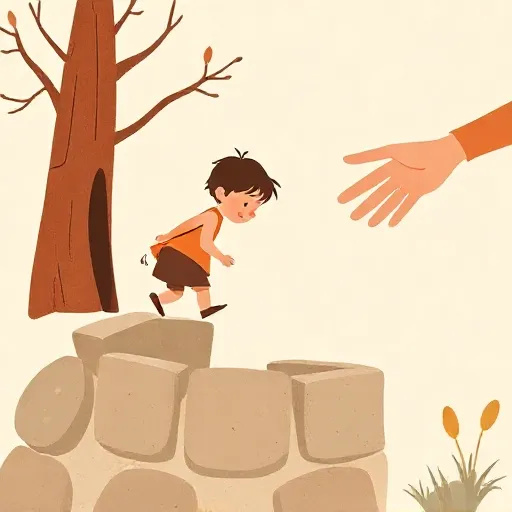
Wang supported his ethics with a bold metaphysical picture. He believed that our minds are one body with everything in the universe. He pointed to a famous thought experiment from Mencius: if you suddenly see a child about to tumble into a well, you instantly feel alarm and compassion, without calculating anything. Wang then extended the claim: when we hear the anguished cries of animals, we feel pity. When we see plants uprooted, we feel distress. He even argued that when we see a beautiful tile or stone broken, we feel a pang of concern. These reactions, he said, show that we are not fundamentally separate from the world — we are linked at the deepest level.
Not everyone finds this convincing. Psychologists know that some people truly never feel compassion for others. And modern science can offer evolutionary explanations for why we care about our own species, other animals, and even natural beauty — without needing a single cosmic Pattern. Still, Wang’s insight carries real weight. Even if we don’t share one metaphysical substance, we are deeply dependent on other people and on our environment. I am a friend, a student, a family member only because of those around me. In that sense, we do form something like one body.
Wang’s challenge hits hard today. In many schools, we teach ethics by discussing theories and analyzing dilemmas, but studies suggest that it often does little to change how people behave. Wang would diagnose the problem instantly: we’ve made ethics a subject you merely know, when it’s something you must do. To truly internalize that cheating is wrong, you have to feel the repulsion and refuse — not just write the right answer on a test. Wang’s whole philosophy is an invitation to stop asking, “Do I know enough?” and start asking, “Am I living out what I already know?” On his deathbed in 1529, he simply said, “This mind is luminous and bright. What more is there to say?”
Think about it
- If someone says, “I know smoking is bad for my health, but I do it anyway,” would Wang Yangming say that person truly knows smoking is bad? Why or why not?
- Can you think of a time when you learned a moral lesson in class but it didn’t change how you acted later? What do you think would have made a difference?
- Imagine a friend who always talks about being honest but cheats on a test. Is there a difference between knowing honesty is important and being an honest person? How would Wang answer?