Why Ancient China’s Smartest Thinkers Argued About Nothing
A Bamboo Grove After the Empire
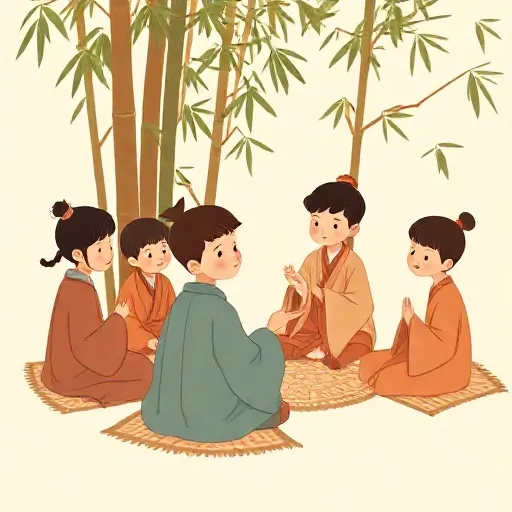
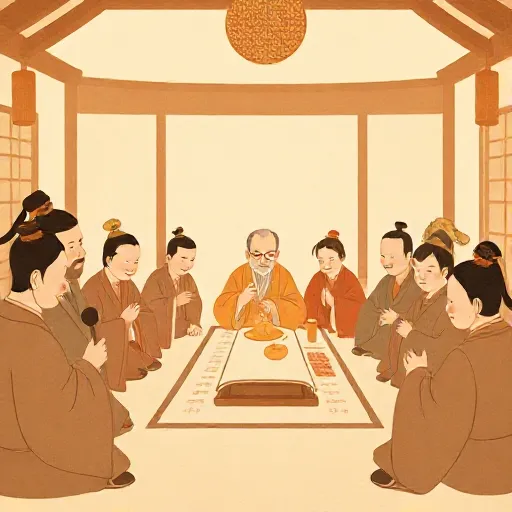
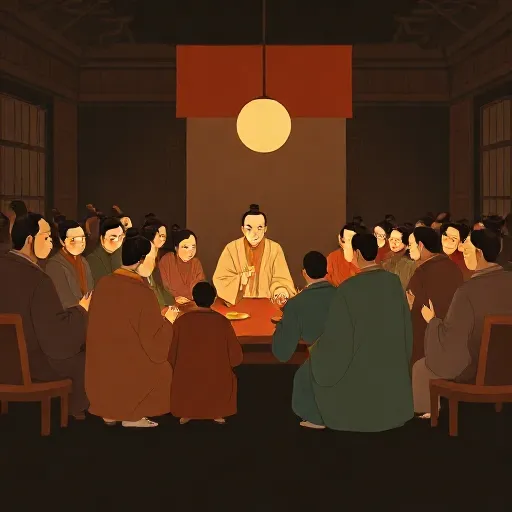
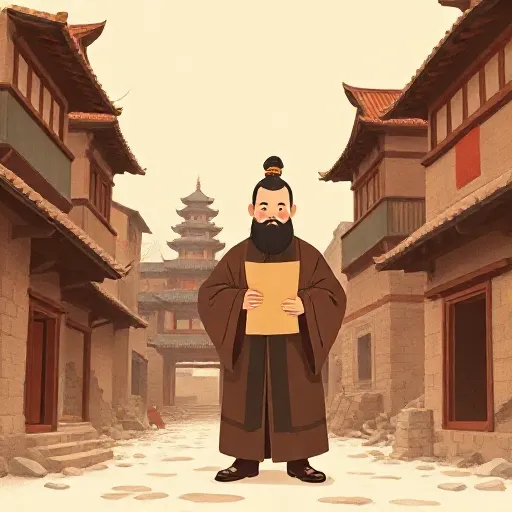
The year is around 220 CE. The mighty Han dynasty, which ruled China for four centuries, has crumbled. War, corruption, and hunger spread across the land. Old answers no longer worked. In the middle of this chaos, a group of sharp‑minded thinkers began meeting in a quiet bamboo grove. They weren’t building armies or writing laws. They were asking one huge, weird question: what is the Dao?
For centuries, Chinese teachers had used the word Dao to mean the hidden way or pattern behind everything—the flow of the universe. But after the Han fell, a new generation felt that the old explanations had grown stiff and shallow. They turned back to three ancient books: the Yijing (Classic of Changes), the Laozi, and the Zhuangzi. Together they called these the “Three Profound Works.” The movement that grew from reading them came to be known as Xuanxue—“Learning in the Profound” or, more colorfully, “Dark Learning.” The “dark” didn’t mean scary. It meant a truth so deep it was hard to put into words.
These thinkers weren’t rebels against Confucius. Most of them admired him as the greatest sage. What they rejected was the official Han Confucianism of their own time, which they saw as rigid, power‑hungry, and blind to the real mystery of the Dao. They wanted to crack open that mystery again—together, through argument.
He Yan and Wang Bi: The Fight Over Nothing
Two of the earliest and sharpest voices belonged to He Yan (c. 207–249) and Wang Bi (226–249). He Yan was a celebrity in government and fashion, a trendsetter who spotted talent early. Wang Bi, twenty years younger, was his protégé—and by the time Wang Bi died at twenty‑three, he had already written brilliant commentaries on the Laozi and the Yijing.
Both agreed on one explosive idea: the Dao is wu, which we can translate as “nothingness” or “non‑being.” But they meant it in almost opposite ways.
He Yan’s picture was cosmic. Everything in the world, he said, is made of qi, a kind of vital energy that flows and mixes. A person’s talents, mood, even their moral character are shaped by their particular blend of qi. The Dao is the source of all qi—and because it gives rise to every shape, color, and sound, it can’t have any single shape, color, or sound itself. It’s so completely full that it’s completely featureless. The word wu, then, points to an undivided wholeness beyond all names. A sage, in He Yan’s view, is born with such a refined qi‑endowment that they are never tugged by temporary emotions. They are like a still lake that perfectly reflects the sky.
Wang Bi shook his head. If the Dao is just a super‑charged invisible stuff, he asked, where did that stuff come from? You’d have to keep asking forever. So the Dao can’t be any kind of being at all—not even a supremely full one. It must be the logical ground that beings depend on, without being a thing itself. Wang Bi insisted that “Dao” is just a label for wu in this strict sense. The goal isn’t to lose your feelings but to not be trapped by them. The sage can weep for a friend, but their mind stays lucid like a polished mirror—reflecting without clinging.
This gave Wang Bi a warmer, more hopeful vision. Where He Yan believed only a few rare people were born as sages, Wang Bi argued that all of us share a Dao‑centered core. The job is simply to return to that original stillness, which he called ziran—“spontaneity” or “naturalness.” Acting from ziran means doing what fits your true nature, not piling on extra effort. Wang Bi gave this ideal a famous name: wuwei, often translated as “non‑action.” It doesn’t mean sitting like a stone. It means a ruler not raising massive taxes, a student not burying their mind in schemes, a friend not faking kindness. When Wang Bi said the sage “honors the root and calms the branches,” he meant that peace blooms when we stop forcing things and let the quiet order already there do its work.
Ji Kang and Ruan Ji: Nature’s Wild Poets
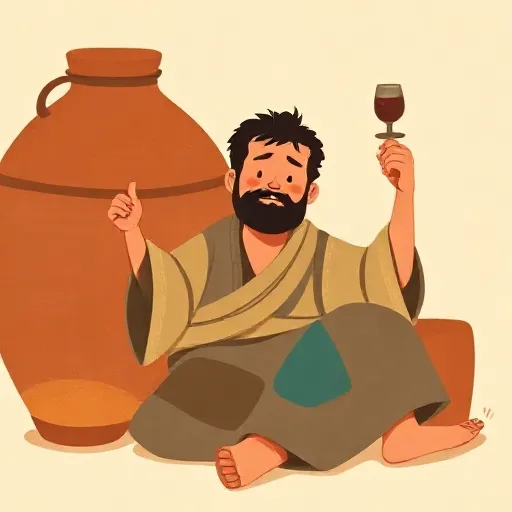
By the middle of the third century, a looser group had taken the stage. They were called the “Seven Worthies of the Bamboo Grove.” Two of them—Ji Kang (223–262) and Ruan Ji (210–263)—pushed the idea of ziran into truly daring territory.
Ji Kang was a master of the qin (a stringed zither), a poet, and an unyielding critic of pretense. He argued that the cosmos is a flow of qi, and that living well means clearing away anything that disturbs its natural balance—especially selfish desire. In his essay “On Nourishing Life,” he insisted that greed and fame are like weeds that choke the spirit. Simple breathing exercises and proper diet could help, but the real cure was to “dispel self‑interest.”
His boldest claim was about music. A piece of music, Ji Kang said, contains no built‑in sadness or joy. The same melody can make one person weep and another tap their foot. Emotion comes from inside you, not from the sound itself. This cut against the Confucian habit of labeling certain music as “proper” or “licentious” by what it supposedly made you feel. For Ji Kang, true music was just pure, organized vibration—like a mountain stream—that could calm your mind and help you return to your own nature.
Ruan Ji went even further in everyday life. The political world of his time was brutal and two‑faced. To protect his integrity, he often turned to wine—not just for pleasure, but as a quiet act of rebellion. When a powerful family tried to force him into a political marriage, he stayed drunk for sixty days straight until the plan fell apart. When his mother died, he wept so hard he coughed up blood, yet he refused to perform the stiff mourning rituals that he felt had become empty theater. In his essays, Ruan Ji sketched an almost anarchist dream: long ago, he imagined, there were no rulers and no ministers, and every living thing thrived in natural harmony. Kingship and scheming came later, like an itch that grew into an infection.
Neither Ji Kang nor Ruan Ji wanted to run from the world. They wanted to heal it by showing what a life of fearless honesty looked like. Their lives were their argument: rules that choke your genuine feeling aren’t just inconvenient; they twist you.
Guo Xiang: You Are Already Your Own Universe
A generation later came Guo Xiang (d. 312). He wrote a commentary on the Zhuangzi that still shapes how we read that book today. Guo Xiang agreed that the Dao is real, but he thought He Yan and Wang Bi were both stuck on the wrong idea. If wu means pure nothing, how can nothing create anything? And if the Dao is a supreme being, we’re back to asking where that being came from.
Guo Xiang’s answer: beings don’t come from nothing; they are “self‑generated.” Each thing—each person, each sparrow, each pebble—came into existence by being what it is, complete with its own inner pattern (li) and its own share of qi. There is no outside puppet‑master. The Dao isn’t a creator sitting somewhere above; it’s the universal fact that everything unfolds from its own nature. This view is sometimes called the doctrine of self‑transformation.
That sounds like a head‑spinning bit of metaphysics, but it had very down‑to‑earth consequences. If every being already has its own complete nature, then being a sage isn’t about being born with a special fairy‑dust qi. A sage is anyone who fully realizes their own nature—whatever that nature is. The carpenter who builds with care, the farmer who works in rhythm with the seasons, the child who asks honest questions: each can be a “sage” in their own way. Differences in talent are real, but they aren’t a ranking of worth. A fish is not a failed bird; its excellence is in swimming.
Wuwei, for Guo Xiang, didn’t mean doing nothing. It meant acting as yourself, without envy or forced imitation. Trying to be someone else only exhausts you and fails anyway. The legendary Cook Ding in the Zhuangzi could carve an ox effortlessly—not because he was magic, but because he followed the natural seams of the meat. In the same way, Guo Xiang taught, you can live in society, hold a job, even advise a ruler, and still be free. True freedom is roaming the world without being twisted by it—staying inwardly at home wherever you are.
Rules or Freedom? The Ripple That Never Stopped
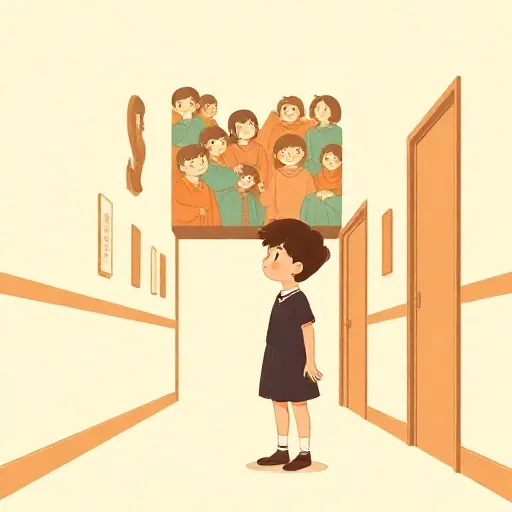
The debates inside Xuanxue circled around one sharp tension. On one side was mingjiao—the “teaching of names,” or the whole system of proper roles, rituals, and social rules. On the other side was ziran—the spontaneous, unpainted naturalness at the heart of the Dao.
Thinkers like Wang Bi and Guo Xiang believed the two could fit together. They argued that society’s basic structures—family, respect for elders, a ruler who governs lightly—are themselves part of the natural order, like the way your heart knows to beat. The trouble starts when rituals become stiff masks and authority turns into bullying. For them, the cure was not to smash every rule, but to return to the root: let rules flow from a calm, unselfish center. He Yan, too, had hoped that a truly wise ruler could hold the whole system steady like a still compass.
Ji Kang and Ruan Ji were less optimistic. They saw that, in their own time, mingjiao was caked with pretense. People followed mourning rites not out of love but for reputation. Officials hunted titles while the common people starved. So they pushed harder: sometimes you have to step outside the rule‑book entirely to remember what honesty even feels like. Their wine‑soaked, rule‑breaking flair wasn’t chaos for its own sake—it was a kind of ethical protest. But it also set a risky trend. Later, some nobles simply copied the wild style to seem cool, without any of the inner discipline.
That’s why a later voice, Yue Guang (252–304), asked a quiet but devastating question: “In mingjiao itself there is a blissful abode,” he asks, “so why go to such extremes?” In other words, you don’t have to abandon responsibility to be free. You can find calm, genuine living inside society, not just outside it.
And that question is still yours. Every day you face a little version of the mingjiao‑versus‑ziran puzzle: does this classroom rule let you be yourself, or does it squash something honest? Is there a way to keep the structure without losing your spark? The ancient bamboo‑grove thinkers didn’t all agree on an answer, but they gave you a map for thinking it through. The Dao, they believed, isn’t locked in a dusty temple. It’s in a quiet mind, a genuine feeling, a simple choice to be real rather than impressive. Nothingness, it turns out, isn’t empty at all.
Think about it
- If a school rule feels unfair, is it more honest to break it openly or to try to change it from inside the system? What would Ji Kang or Yue Guang say to you?
- A song with no words can make you feel joyful. Does that feeling come from the sounds themselves, or entirely from your own mood? What would Ji Kang argue?
- If everyone in your town suddenly acted with total spontaneity—no pretending, no carefully chosen words—would the result be peaceful or messy? Why?