

What’s Good for Its Own Sake? A Puzzle That Started with Plato
The Chain of “Why?”

You agree to help a friend pack for her move. When someone asks why that’s a good thing to do, you might say, “It’s good because she needs help.” But then the person asks, “Why is it good that her needs are satisfied?” You answer, “Because it makes her happy.” And if they ask, “What’s good about happiness?” you might simply say, “It just is good.” At that point you’ve reached something that isn’t good because of something else — it’s good for its own sake. Philosophers call this intrinsic value (value “in itself”). Almost everything else has extrinsic value — value that depends on, or comes from, something else.
This idea seems simple, but it has sparked an enormous debate. If you can point to something and say, “That’s good for its own sake,” you have a foundation for all your other judgments about what’s worthwhile. If you can’t, perhaps nothing really matters in a deep way. For more than two millennia, people have argued about what sorts of things, if any, have intrinsic value — and whether the very idea makes sense.
Pleasure, Pain, and What Plato Thought

The ancient Greek philosopher Plato (428–347 B.C.E.) tackled this question by looking at pleasure. In his dialogue the Protagoras, Socrates argues that people don’t dislike pleasure itself; they object only to the bad consequences it sometimes brings — like a stomachache after too much cake, or missing out on future fun because you stayed up late. Pleasure, he concludes, is intrinsically good, and pain is intrinsically bad. But Plato didn’t think pleasure was the highest good. In the Republic and Philebus, he insists that knowledge and virtue make pleasure better, not the other way around.
Many thinkers followed him in declaring pleasure intrinsically good and pain intrinsically bad. Aristotle (384–322 B.C.E.), Plato’s student, agreed that pain is bad “without qualification” and pleasure its opposite, so pleasure must be good. Over the centuries, some philosophers went further and said pleasure and pain are the only things that are intrinsically good or bad. This view is called hedonism, and its most famous advocates include Jeremy Bentham (1748–1832), John Stuart Mill (1806–1873), and Henry Sidgwick (1838–1900).
But most philosophers have not been hedonists. They think other things — truth, knowledge, beauty, friendship, freedom, health — are valuable for their own sake, too. In the 20th century, the philosopher William Frankena put together a long list of possible intrinsic goods: life, consciousness, pleasure, happiness, truth, understanding, beauty, moral virtue, love, justice, freedom, and many more. That list shows just how wide the disagreement can be. Some people today even say that certain natural environments or animal species have intrinsic value, not just value as a resource for humans.
Could You Prove It by Locking It Away?

So how could anyone decide which things really are intrinsically good? The philosopher G. E. Moore (1873–1958) proposed a famous thought experiment. Imagine a thing existing “in absolute isolation” — completely by itself, with no consequences and no connections to anything else. If you would still judge that it’s good for that thing to exist, then it has intrinsic value. If you’d only call it good because of what it leads to, its value is extrinsic.
Moore used this test to argue against hedonism. He said it would be absurd to think a world containing only pleasure, with no knowledge, no love, no beauty, and no friendship, would be better than a world with all those things but a tiny bit less pleasure. For him, that proved pleasure alone couldn’t be the whole story.
Other philosophers tried to capture intrinsic value with a different idea: something is intrinsically good if it’s fitting to value it for its own sake. This is called the fitting attitude analysis. If you encounter a beautiful piece of music, it seems fitting to appreciate it just because of what it is, not because it will get you a reward. That natural thought has a lot of appeal. But challenges pop up. For instance, imagine an evil demon threatens to hurt you unless you value him for his own sake. It might be fitting in some sense to do what he says, but that doesn’t make the demon intrinsically good. This puzzle — called the “wrong kind of reason” problem — shows that defining intrinsic value through fitting attitudes is harder than it first appears.
Is “Good” Just a Word We Use?

Even bigger doubts have been raised about the whole idea of intrinsic value. One challenge comes from noncognitivism, the view that when we say something is good, we aren’t stating a fact that could be true or false. Instead, we’re expressing an emotion or giving a command. The philosopher A. J. Ayer (1910–1989), for example, thought saying “Pleasure is good” is like shouting “Hooray for pleasure!” If that’s all moral talk is, then there’s no real property of “goodness” sitting in the world at all.
Another challenge was launched by the philosopher Peter Geach. He pointed out that the word “good” works differently from color words like “yellow.” You can split “This is a yellow bird” into “This is a bird and this is yellow.” But you can’t neatly split “She is a good singer” into “She is a singer and she is good.” Goodness always seems to be relative to a kind — a good thief isn’t good in the same way a good doctor is. Geach concluded that talk of something being “just plain good” on its own is a mistake.
Defenders of intrinsic value respond that they aren’t talking about “plain” goodness in an empty sense. They’re talking about a particular moral kind of goodness — a value that things like happiness or virtue have regardless of the kind they belong to. But the debate hasn’t been settled, and many philosophers continue to ask whether the whole idea of value that’s built into an object all by itself can survive these linguistic and metaphysical attacks.
Can a Frying Pan Be Good for Its Own Sake?
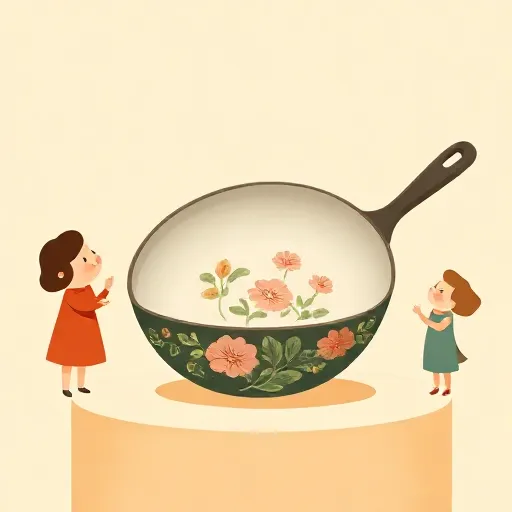
Even if we accept that some things are valuable for their own sake, a new question arises: what kind of thing can have that value? Thinkers like W. D. Ross (1877–1971) argued that intrinsic value belongs to facts or states of affairs — the fact that someone is happy, for instance — not to physical objects like frying pans. But the philosopher Christine Korsgaard pushed back. She distinguished between final value (value something has as an end, for its own sake) and intrinsic value that depends only on a thing’s internal properties. A gorgeously enameled frying pan, she suggested, might have final value because of the role it plays in our lives, even if that role is an extrinsic, relational property. Others have given similar examples: the pen Abraham Lincoln used to sign the Emancipation Proclamation might be valuable for its own sake because of its history, not its shape.
These examples challenge the idea that only abstract things like facts can bear intrinsic moral value. Some philosophers try to simplify matters by insisting that the ultimate bearers of value are states of affairs or concrete objects like living things — but no consensus has been reached. The debate about value-bearers matters because it forces us to ask whether we’re valuing the right things in the right way.
When Good Things Don’t Add Up

If something has intrinsic value, can we measure how much value it has? Moore threw another puzzle into the mix with his principle of organic unities. He claimed that the value of a whole isn’t always the sum of the values of its parts. His example: the consciousness of a beautiful object has immense intrinsic value, even though the consciousness alone and the beautiful object alone have much less. Two pleasant tunes, each nice on its own, can combine into a noisy mess. So you can’t just add up the goodness of pieces and expect the total to be correct.
There’s also the problem of incommensurability. Some values may not be comparable on a single scale. Ross himself once wrote that no amount of pleasure could equal the value of a single act of virtue — meaning pleasure and virtue are so different that one can’t outweigh the other in a simple calculation. If that’s right, making big life choices (or societal choices) becomes deeply difficult: you can’t just tally up the good points and the bad points like a scorecard.
These puzzles remind us that intrinsic value is not a neat, tidy tool. And yet it matters for real life. When we argue about protecting a wilderness area rather than turning it into a shopping mall, we often appeal to the idea that the wild place has value in itself, not just as a resource. When we ask what makes a life well-lived, we reach for goods that don’t just point to something else. The question of what, if anything, is good for its own sake continues to shape how we treat each other, the planet, and ourselves.
Think about it
- If you could design a tiny pocket universe that contained only one kind of thing, what would you put in it to make it a good universe — and why?
- Can a painful truth ever be better than a pleasant lie? What does your answer say about whether truth has value for its own sake?
- If someone told you that nothing at all has intrinsic value and everything is just a tool for something else, would that change how you live? How?