

What Pushes You to Be Good?
The moment you decide to help

You see a friend struggling with a heavy backpack. You don’t think about it; you just grab a strap. Later, you wonder: why did I do that? Did I hope she’d do the same for me next time? Did I feel her frustration and want to ease it? Or did something inside me simply say this is the right thing to do?
For hundreds of years, philosophers have debated these exact possibilities. They call the inner push that makes us act moral motivation — the “why” behind a good deed. Three thinkers from the 1600s and 1700s shaped the way we still argue about it: Thomas Hobbes (1588–1679), David Hume (1711–1776), and Immanuel Kant (1724–1804). Each gave a completely different answer. Later, feminist philosophers asked whose answers had been left out. They brought a fourth motive to the table: care.
Hobbes: every kind act is hidden self‑interest

Hobbes lived through a brutal civil war, and his view of people was not optimistic. He began with a thought experiment: imagine a world without laws, without police, without schools. In that state of nature, he wrote that life would be solitary, poor, nasty, brutish, and short. Everyone would grab what they needed to survive, and no one would ever be safe. From this, Hobbes drew a sharp conclusion about what really moves us.
He argued that every single action — including a moral one — is driven by self‑interest. When you help a classmate, you might tell yourself it’s out of kindness, but Hobbes would say you actually do it because you expect something in return: gratitude, a reputation as a helpful person, or just the good feeling that comes from seeing yourself as decent. Rationality, he thought, simply means finding the smartest way to satisfy your own desires. And since the deepest desire in every human being is the urge for self‑preservation, morality itself must be built on the same foundation. We agree to be good to one another because it’s the safest deal on offer.
Hobbes didn’t think this made us terrible creatures. He just thought it made us truthful ones. If you want to understand why someone does a good thing, look for the benefit they get from it — however buried it may be.
Hume: your heart reaches out before your brain catches up

David Hume disagreed entirely. He was a cheerful man who loved conversation and good food, and he didn’t believe human beings were trapped inside a cage of self‑interest. Hume agreed with Hobbes on one important point: reason alone cannot make you move a muscle. Something has to feel important. But the feeling that does the real moral work, Hume said, is not selfish at all. It is sympathy — the ability to catch someone else’s feelings as if they were your own.
Think about watching a friend cry. You don’t first calculate whether comforting her will benefit you later. You just feel a pang of her sadness, and that pang pulls you toward her. Hume called this benevolence, a natural desire for others to be happy. Reason, he said, is the servant of the sentiments. It can figure out the best way to help, but it cannot decide what is worth wanting. Only the heart can do that.
For Hume, morality grows out of the things that make us wince and the things that make us warm. Parents loving their children was, to him, the strongest bond a mind could feel — far stronger than any cold rule. A just society isn’t built on selfish deals; it’s built on people who, through sympathy, learn to care about strangers almost as much as they care about family.
Kant: reason alone can tell you what you must do

Immanuel Kant lived a famously orderly life in a small German city, and his moral philosophy was just as disciplined. He rejected both Hobbes and Hume. For Kant, morality could not depend on whatever desire happened to be popping up inside you at the moment. Desires are messy, unpredictable, and different from person to person. If being good means following your feelings, then goodness would be wobbly. Kant wanted solid ground.
He argued that reason itself can motivate action. You don’t need a flash of sympathy or a quiet hope of reward. You can think your way to the right thing. When you recognize that a rule — like “keep your promises” — is one that every rational person would have to follow, that recognition alone can push you to act, even when your feelings are pulling you the other way. Kant insisted that this is what makes a person autonomous: you are truly free not when you chase what you want, but when your own reason gives you the law you obey.
For Kant, emotion doesn’t need to be crushed, but it must never be the boss. A moral act has its full worth only when you do it because it’s right, not because it feels warm or convenient. A shopkeeper who gives fair change out of honesty, not to attract customers, is the kind of example that really mattered to him.
A voice left out: what if caring comes first?
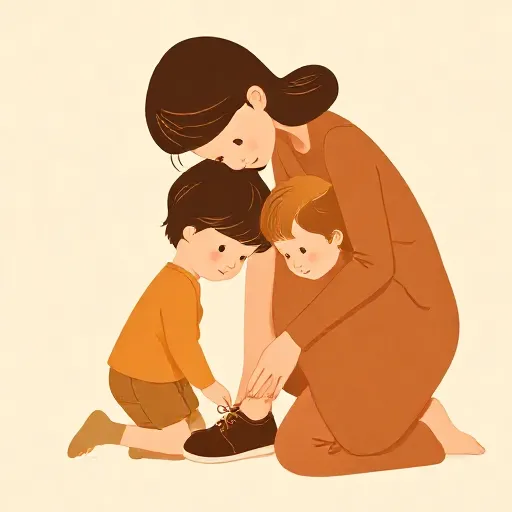
Here the story takes a turn. For centuries, the loudest voices in philosophy were men. Many feminist thinkers in the late 20th century noticed something: the traits that these theories either ignored, called weak, or pushed into second place — emotion, sympathy, tenderness — were the very traits that, historically, had been associated with women. Reason, meanwhile, had been linked with men and treated as superior. What if moral theory was tilted from the start?
Some feminists turned back to Hume and said he had been closest to the truth. Others went further and built something new: an ethic of care. The central idea is that care — not self‑interest, not abstract duty, not even broad sympathy for distant strangers — is the motive that deserves to be at the heart of morality. Care is what you see in a parent staying up with a sick child, listening to what this particular child needs. It is attentive, detailed, and rooted in real relationships rather than universal rules.
The psychologist Carol Gilligan gave this idea a big push. She studied how people talk about moral dilemmas and found that many girls and women tended to focus on preserving relationships, knowing the details of a situation, and avoiding harm — while many boys and men were more likely to appeal to justice and rules. Her work was fiercely debated. Critics pointed out that describing women as naturally more caring could quietly reinforce old stereotypes rather than break them. Still, the conversation had shifted. Philosophers were now asking: what if moral knowledge itself depends partly on caring about someone enough to really see them?
Why the argument still lives inside you

These old debates are not locked away in dusty books. They show up every time you help a sibling, choose not to cheat, or wonder whether you should share credit for a group project. Your own mind probably mixes all the motives the philosophers separated. A single good act might carry a tiny dose of self‑interest, a spark of sympathy, a quiet voice of duty, and a layer of care for the person in front of you. That mix is what makes being human interesting.
Thinking about these theories won’t give you a single answer to “what pushes you to be good?” But it will give you sharper questions. The next time you feel the impulse to help, you can pause and ask: whose engine am I running on right now? And perhaps you’ll notice something that philosophy often forgets — that the people actually affected by your choice might see motives in you that you never even noticed.
Think about it
- When you lend a pencil to a classmate you don’t know well, do you think part of you expects something in return — even just the hope they’ll think well of you? Does that make the act less good?
- If you had to design a school where everyone followed only Hobbes’s idea (self‑interest), what would break first? What about a school run entirely on Hume’s sympathy?
- Do you think boys and girls are taught to hear different inner voices when they decide what’s right? Or do the real differences run deeper — or not exist at all?