Is There Such a Thing as a Truly Selfless Act?
A Gift, a Sacrifice, and an Old Suspicion
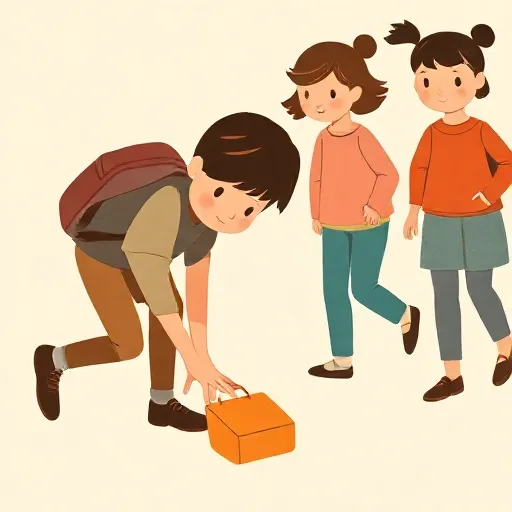
Imagine you see a classmate drop their lunch tray. You stop to help, even though it’ll make you late. Later, a friend asks why you did it. You might say, “It just felt like the right thing.” But philosopher Thomas Hobbes (1588–1679) would have been suspicious. He thought every voluntary act — even a gift — is done for the giver’s own good. Hobbes argued that if people saw no benefit for themselves, they simply wouldn’t help. This view is called egoism: all human motivation is ultimately self-interested.
Not everyone agreed. Bishop Joseph Butler (1692–1752) pushed back. He thought people sometimes act from genuine altruism — a desire for another person’s well-being for its own sake. The disagreement isn’t about whether people help. It’s about why. To see the difference, philosophers talk about ultimate desires (things you want just because you want them) and instrumental desires (things you want because they lead to something else). If you drink water to quench thirst, the thirst relief is your ultimate desire; drinking the water is instrumental. Egoists say every ultimate desire is self-focused. Altruists say at least sometimes an ultimate desire aims directly at someone else’s welfare.
This isn’t just a dusty old argument. If egoism is true, some worry that truly moral action might be impossible — because you’d always be acting from self-interest, never from pure duty. So the egoism–altruism debate cuts to the heart of what it means to be a good person.
Empathy on Trial: Batson’s Ingenious Experiments
Enter Daniel Batson, a modern psychologist who moved the debate from armchairs into the laboratory. Batson focused on empathy, the rush of soft, compassionate feelings you get when you see someone suffer. He proposed the empathy–altruism hypothesis: when you feel empathy, it triggers a genuinely altruistic desire to help. Egoists had a different story. They said empathic distress is unpleasant, and we help only to make our own discomfort go away — the aversive-arousal reduction hypothesis.
Batson designed experiments to test these rival predictions. In one famous study, participants watched a fellow student (“Elaine”) receive electric shocks. Some participants were told they could leave after a few trials if they didn’t want to help; that made escape easy. Others were told they’d have to keep watching if they refused, making escape hard. According to the aversive-arousal hypothesis, high-empathy participants should help only when escape was difficult. But the results defied that prediction: high-empathy people helped almost as often when they could easily leave as when they couldn’t. Their behavior looked more like genuine care for Elaine’s welfare.
In another study, Batson tested a different egoistic idea — that people help to avoid looking bad to others. Participants read a heartfelt note from a lonely student, Janet. When given a chance to spend time with her, high-empathy participants volunteered even when they believed no one would ever know if they refused. Fear of social punishment couldn’t explain their willingness to help.
When the Self Gets Blurry — and When It Doesn’t
A clever challenge came from researchers who said empathy might cause self–other merging. The idea is that when you feel what someone else feels, the boundary between you and them grows fuzzy — so helping them is really helping yourself. If that were true, the behavior wouldn’t be altruistic at all.
Philosophers point out that this depends on what kind of identity you mean. Numerical identity is being one and the same person (you at age ten and you at age thirty). Qualitative identity is being similar in qualities (two people who both love comic books). For egoism to be true, you’d have to literally believe the other person is you — numerical identity. But everyday empathy doesn’t make people believe that. When tests asked participants how “connected” they felt or how similar they were, they were measuring qualitative closeness, not a loss of self. So the self–other merging objection hasn’t toppled the empathy–altruism hypothesis, though the debate about what those closeness measures really show continues.
The Invisible Watcher: Could Religion Explain It?
One egoistic explanation that still lingers involves belief in a supernatural watcher. Many people in Batson’s experiments might have believed — consciously or not — that a divine being observes their actions and disapproves of selfishness. If that belief makes people fear punishment or hope for reward, then even a seemingly pure act of helping could secretly be motivated by self-interest. Batson’s designs couldn’t eliminate this possibility, because no envelope or closed door can hide you from a god. Researchers call this the divine punishment hypothesis, and it remains a live, if hard to test, alternative.
Not Egoistic, Not Altruistic: The Hidden Third Options

Even if every egoistic story fails, altruism might still not be the winner. Batson himself noted that people sometimes act from principlism — the ultimate desire to uphold a moral principle, like fairness or the greatest good for the greatest number. Helping because you believe it’s just isn’t the same as helping because you care deeply about that particular person. And if your ultimate goal is to follow the rule, the motive is neither selfish nor altruistic.
There are other non-egoistic but non-altruistic possibilities, too. Much of our daily helping is habitual — a learned, automatic response. If you’ve been praised since preschool for sharing, you might hand over your colored pencils without even thinking. Psychologists also recognize a Pavlovian system, where behaviors that helped our ancestors survive get wired in without any personal goal. A tiny child who spontaneously picks up a dropped object for an adult may not be acting from any deep desire at all, just an evolved or learned reflex. So the motivational universe is bigger than a two-sided fight.
Why It Still Matters (and What You’d Do)

After centuries of argument and dozens of clever experiments, no one has proven that pure altruism exists — and no one has proven it doesn’t. But the project has taught us how to ask sharper questions about why we act. And this question isn’t just for labs and libraries. It lives in your life. When you split your snack with a friend, is it because you want her to feel good, because you’d feel guilty otherwise, or because you’ve been taught it’s what you’re supposed to do? The answer shapes how we judge character, how we raise children, and how we design schools and laws. If we assume everyone is a selfish calculator, we build systems full of rewards and punishments. If we believe people can genuinely care, we might build trust instead. The experiment isn’t over — and you’re part of it every day.
Think about it
- If scientists proved that every kind act is secretly selfish, would you still feel grateful when someone helps you? Why or why not?
- Imagine you secretly give your favorite book to a library donation bin. Does it matter if your main reason is to feel proud of yourself, rather than pure generosity? Why?
- If a school gives prizes for helping others, might that make students less likely to help when no prize is offered? Should we reward kindness at all?