
How a Simple Question Broke Logic—and Then Fixed It Forever
A Letter That Almost Destroyed Logic

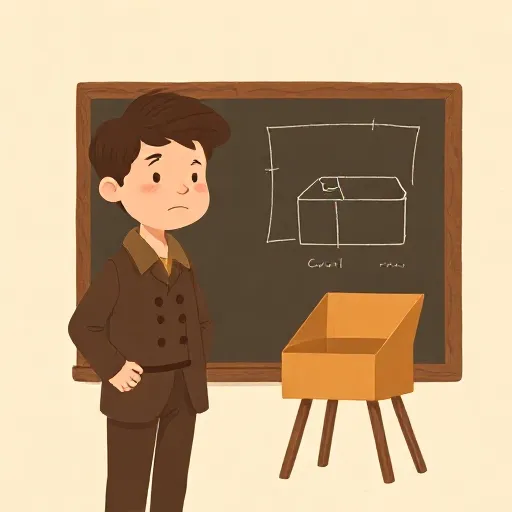
In 1902 a young British philosopher named Bertrand Russell (1872–1970) mailed a short note to the German logician Gottlob Frege (1848–1925). Frege had spent decades building a perfect logical language, one that would prove every truth of arithmetic from a few basic laws. His massive book was almost finished. Then Russell’s letter arrived. It contained a question so simple that Frege immediately saw his whole project was in danger.
The problem was about sets. Frege’s system allowed you to form a set for any property you could describe—the set of all books, the set of all red things, whatever you liked. Russell asked: what about the set of all sets that do not contain themselves? Suppose this set exists. Does it contain itself? If it does, then it’s not supposed to (because it’s the set of sets that don’t contain themselves). If it doesn’t, then it must (because it’s the set of all sets that lack themselves). Either answer forces the opposite answer. That is Russell’s paradox—a single, inescapable contradiction right in the heart of logic.
Frege’s elegant construction had a crack running through its foundation. A language designed to be perfectly rational could produce a statement that was neither true nor false without breaking. Logicians realized they needed a repair that would keep the expressive power but lock out such self-destructive loops. That repair became known as type theory.
Types: Building a Staircase Out of Logic’s Chaos
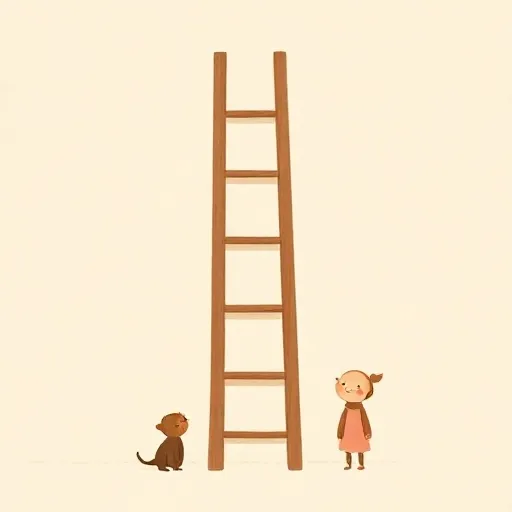
The key idea behind type theory is simple: every object and every function gets a type, and the type tells you what you are allowed to do with it. Think of types as rungs on a ladder. On the bottom rung you have individuals—ordinary things like people, apples, or numbers. One rung up you have sets of individuals. Another rung up, sets of those sets, and so on. A set can contain elements only from lower rungs, never from its own rung or higher ones. So the question “Does this set contain itself?” becomes impossible even to ask—the grammar of the typed language doesn’t allow it. The paradox simply cannot be written down as a well-formed sentence.
The American logician Alonzo Church (1903–1995) gave this staircase a precise shape in 1940. In Church’s type theory, every piece of language—constants, variables, even the logical words “and” and “or”—carries a type label. A well-formed formula is a string of symbols that respects those labels. The labels make sure that you can never combine things in a way that creates nonsense or self-reference. Church’s system also treats functions as the fundamental building blocks of everything. Sets, relations, properties—they are all just special sorts of functions. And that leads to a remarkable little notation that still shapes how computers think.
Everything Is a Function, Even “and” and “or”
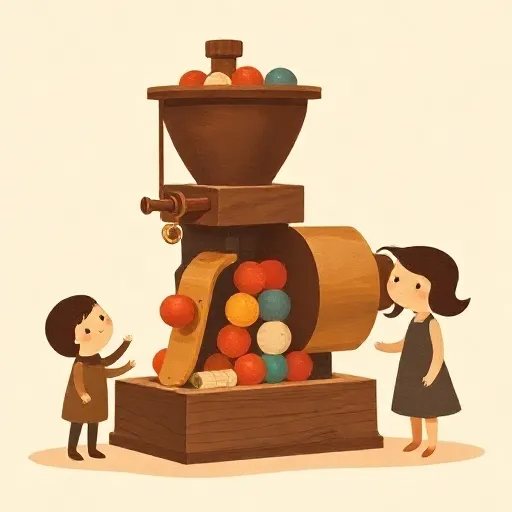
A function is like a tiny machine: you put something in, it gives something back. You can think of the addition function as a machine that takes two numbers and returns their sum. Church noticed that a function that needs two arguments can always be turned into a function that takes one argument and returns another function. For example, “add 5” is a function that waits for a second number and then adds 5 to it. So “add” itself, when given just one argument, produces a new function. This trick—representing multi-argument functions as chains of single-argument functions—is known as currying, and it means every function can be treated as taking exactly one input.
To write functions without giving them names, Church used the Greek letter λ (lambda). The expression λx. 4x + 3 stands for “the function that, for any number x, gives you 4 times x plus 3.” When you apply that function to the number 5, you simply replace x with 5 and calculate: 4·5 + 3 = 23. This process of replacing the input variable is called β-conversion (or β-reduction), and it is the engine that lets type theory actually compute things.
Because functions are everywhere, even truth and falsehood become objects of a function. The type o is the type of truth values. A property like “is red” is a function from individuals to truth values—it maps a tomato to true and a cucumber to false. A binary relation like “is taller than” is a function that takes two individuals and returns a truth value. The logical words “not,” “and,” and “or” are also functions: “not” takes one truth value and flips it; “and” takes two truth values and returns true exactly when both are true. So a whole statement like “it is raining and it is cold” is secretly the result of applying the function and to two truth values. In Church’s type theory, even the universal quantifier “for all” is defined using a function that checks whether a set contains every element of a given type. There is only one variable-binding operator—λ—and everything else is built from it.
From Napoleon to an Ostrich and a Cheetah: Logic in Action

Church’s type theory is not just a tidy way to avoid paradox; it is a real language for stating precise conditions. To see how it works, imagine a rich lady named Sheila who wants to move her two pets—an ostrich and a cheetah—from her hotel to a remote farm. The trip involves elevators, boats, donkey carts, and suspension bridges. Sheila knows a crucial rule: the ostrich and the cheetah must never be left together without her. Can she find a plan that gets everyone safely to the farm?
In typed logic, we can give each moment of the trip a type τ, each location a type ϱ, and each state (saying where Sheila and the pets are) a type σ. A plan is a function from moments to states, of type (στ). The rule “if the ostrich and the cheetah are together, Sheila is with them” becomes a long but perfectly clear formula using ∀ (for every moment) and ⊃ (implies). The formula can be written entirely with functions and λ’s. If we then ask whether there exists a plan that satisfies the condition, we are asking whether the typed formula ∃ p. Proposals(p) ∧ Acceptable(p) is true. A machine that understands type theory could actually check all possible plans—at least in principle—and verify the answer.
Long before anyone imagined automated trip-planning, Church’s type theory was used to express far more abstract ideas. Mathematicians could define iterations of functions and prove a theorem about fixed points entirely inside the system. Philosophers later found that the same language could encode modal logic—talk of possible worlds and necessity—simply by treating possible worlds as individuals of a certain type and modal operators as λ-expressions. In every case, the grammar of types kept the expressions meaningful and free of the old paradox.
Why It Still Matters: The Computers That Check Your Math

Today, the most visible legacy of Church’s ideas is inside proof assistants—computer programs that help mathematicians and engineers check their reasoning. Systems like Isabelle/HOL, HOL Light, and Agda are built on type theory. You type a mathematical statement into the assistant, and the program checks that every step of your proof obeys the type rules. If it does, a green checkmark appears. If it doesn’t, the assistant refuses to accept the argument.
This might sound like a luxury for pure mathematicians, but it has very concrete consequences. The same proof assistants have been used to verify that the operating system kernel of high-security hardware does exactly what its designers intended—and nothing else. They have been used to prove the Kepler conjecture about stacking oranges, a problem that stumped mathematicians for centuries. A network of typed functions can guard against bugs that would otherwise hide in millions of lines of code.
The paradox Russell discovered in 1902 forced logicians to climb a staircase of types. That staircase, with its quirky λ and its machines that turn functions into other functions, now stands under much of the digital world. The broken dream of a perfect logical language grew into something even more powerful: a language that humans can write and machines can check, keeping both our thoughts and our software a little safer.
Think about it
- If you could design a language where every word has a “type” so that you can never say a sentence that contradicts itself, what rules would you invent?
- Imagine you write a function that takes any animal and returns a description of its typical sound. Could you ever apply that function to itself? What would that even mean?
- Why might it be important that computers can check mathematical proofs without actually understanding them? What could go wrong if we rely on such machines?