How Close Can a Wrong Answer Get to the Truth?
Are Some Wrong Answers Closer to the Truth Than Others?
Imagine your whole class is guessing the number of planets in the solar system. One friend writes “9.” Another writes “9 billion.” Neither gets it right — the truth, since Pluto was reclassified, is 8. Yet the first guess feels much closer to the truth than the second. It may be false, but it’s not wildly off like 9 billion.
Philosophers call this idea truthlikeness (or sometimes verisimilitude). A statement that is false can still be nearer to the truth than another statement, and even some true statements can be closer to the whole truth than others — “between 7 and 9” is a true claim, but it’s not as complete as “there are exactly 8 planets.” So it seems obvious that truthlikeness isn’t simply a matter of being true or false. But making sense of exactly what truthlikeness is, and how to measure it, turns out to be surprisingly difficult.
This question matters because many philosophers today are fallibilists: they think that most of our best scientific theories are probably mistaken in some way, and will eventually be replaced. Yet many of the same philosophers are also realists (they think the goal of science is the truth) and optimists (they think we do make progress over time). If realism, optimism, and fallibilism are all true, then we must be able to say that later theories, although still false, get closer to the truth than earlier ones. That’s the logical problem of truthlikeness: how to define it so that it matches this picture.
Popper’s Big Idea — and Its Big Crash
The first philosopher to tackle the problem seriously was Karl Popper (1902–1994). Popper was a bold fallibilist who also deeply valued bold, content-rich theories. He wanted an account of truthlikeness that didn’t collapse into mere probability — after all, the more detailed a theory is, the less likely it is to be exactly right, but that doesn’t make it worse. So he built what is now called the content approach.
Popper imagined the whole truth about some subject as a giant set of all the true sentences that can be said about it — he called that set the Truth. Any theory, whether true or false, has two kinds of consequences: its truth content (the true sentences it entails) and its falsity content (the false sentences it entails). A theory gets closer to the Truth, Popper suggested, if its truth content grows without adding more falsity content, or if its falsity content shrinks without losing truth content.
At first, this seems elegant. A true theory that is logically stronger (says more) has more truth content, so it’s closer to the Truth. A false theory that makes fewer false claims while preserving true ones should also be better. But here Popper’s account hit a wall. Two philosophers, Pavel Tichý (1936–1994) and David Miller (born 1942), proved that on Popper’s precise definition, no false theory could ever be closer to the Truth than any true theory — not even a useless logical truth like “either it will rain or it won’t.” Even worse, all false theories turn out to be equally truthlike — none is closer than any other. That’s clearly not what we want.
Popper’s defenders tried a fix: compare only truth contents, ignoring falsity content completely. But that leads straight to the child’s play objection. If only truth content matters, then among false theories, the stronger one is always closer to the truth, no matter how wildly wrong the extra claims are. The false statement “there are 9 planets, and all of them are made of green cheese” would count as more truthlike than the simpler false statement “there are 9 planets,” simply because it has more content. That’s absurd. Something else had to be introduced.
A New Picture: Worlds, Maps, and Distances

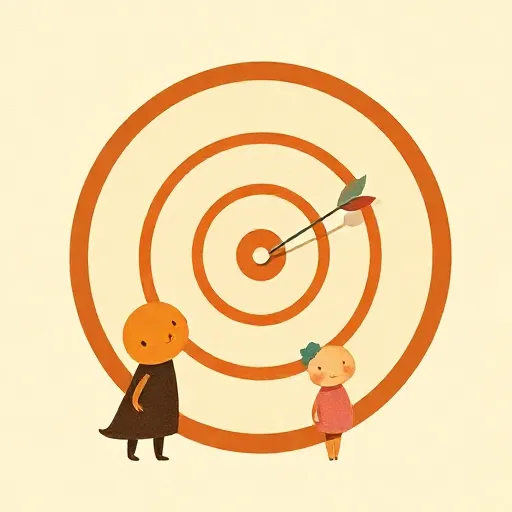
A very different idea was born when philosophers started taking the “likeness” part of truthlikeness seriously. Instead of counting sentences, the likeness approach treats propositions as carving up a logical space of possible worlds. Think of each complete possibility — a whole state of the universe in fine-grained detail — as a point in space. The actual world is a single point, the bullseye. The whole Truth is the proposition that contains only that one point.
Now suppose these worlds can be closer or farther from each other. If we can measure distance between worlds, we can then ask how far a proposition’s “footprint” is from the actual world. A false theory carves out a region that doesn’t include the actual world, but it might still sit quite near it.
Take a tiny example. Imagine only three features of the weather matter: whether it is hot (h), rainy (r), or windy (w). That gives eight possible detailed worlds, from h&r&w (hot, rainy, and windy) to ~h&~r&~w (cold, dry, and still). If the actual world is h&r&w, we can measure how close any other world is by how many features it gets right. A world with exactly one mistake — say ~h&r&w — is distance 1 away, a world with two mistakes is distance 2, and so on.
Now we can judge whole propositions. A false claim like “it is cold, rainy, and windy” (~h&r&w) covers only one world at distance 1. A claim like “it is cold, dry, and still” (~h&~r&~w) covers a world at distance 3. So the first is clearly closer to the truth. This way of automatically ranking falsehoods avoids the “child’s play” trap.
Different measures of overall distance have been proposed. The simplest, average distance, takes all worlds in a proposition’s footprint and averages their distances to the actual world. This often matches our intuitions — even some false propositions turn out to be closer to the truth than some very weak true ones. But average sometimes violates a Popperian idea that among true theories, the stronger one should always be closer to the truth.
Philosopher Ilkka Niiniluoto (born 1946) combined a “truth factor” (how close the nearest world is) with an “information factor” (how many distant worlds the proposition rules out) into a measure called min-sum-average. This allows both that some falsehoods beat some weak truths and that stronger true theories are always better. Still, no single measure has convinced everyone. The search for the right function — the “extension problem” — remains open.
When Swapping the Measuring Stick Changes the Answer

Just as the likeness approach seemed promising, a powerful objection appeared. Imagine we describe the same weather space with a different set of basic words. Instead of “rainy” and “windy,” we invent two new conditions:
minnesotan = hot if and only if rainy.
arizonan = hot if and only if windy.
Now we have a language based on hot, minnesotan, and arizonan. The claim “cold, rainy, and windy” (~h&r&w) in the old language gets translated as “cold, not minnesotan, and not arizonan” (~h&~m&~a). In the old language, that claim made only one mistake out of three. In the new language, it makes three mistakes out of three — exactly as many as the worst possible falsehood. The rankings flip.
David Miller used this to argue that the likeness approach is fatally framework-dependent — change the vocabulary and you change which theories count as more truthlike. If that’s right, truthlikeness doesn’t give a solid, objective foundation for scientific realism.
Two replies are still actively debated. The first says that not all vocabularies are equal: some properties really exist in nature, while others are made-up combinations. Only the real, natural properties should count when measuring distance. Think of it as carving reality at its real joints, using the best fundamental physics we have. The second reply denies that the two languages really express the same propositions at all. In the new language, the points in the space of possibilities stand in different geometrical relations to each other — so the propositions aren’t equivalent in the first place. On this view, changing the fundamental vocabulary changes what you’re talking about.
Neither answer is an easy exit: the first requires us to figure out which properties are genuinely fundamental — a huge task. The second threatens to make different scientific frameworks “incommensurable,” unable to be compared. That’s a real tension, and it’s very much alive.
Can We Ever Know We’re Getting Closer?

A tougher worry follows. If we don’t know the whole truth, can we ever know how truthlike our theories are? This is the epistemological problem. A simple dilemma says: either we can discover the truth directly, or we cannot. If we can, then we don’t even need a concept of truthlikeness. If we cannot, then we cannot discover truthlikeness either — so the concept is useless in practice.
Philosophers have pushed back. We may not know the final truth, but we can form expected truthlikeness — a best estimate based on the evidence. Suppose you have a bent coin and you want to know its bias toward coming up heads. You’ll never see the true, exact bias, but after tossing it many times you can confidently estimate it within a small interval. Similarly, given a measure of closeness-to-truth and a probability distribution over what the true state might be, you can calculate an expected truthlikeness for any hypothesis. You can then rationally say that one theory is probably closer to the truth than another, even while admitting you could be wrong.
However, knowing a single new truth doesn’t automatically push you closer to the whole truth. If your previous theory was false, adding a true claim can sometimes make it worse — like adding a true detail that pulls the overall picture further from the actual world. So even estimating progress is tricky.
This connects to the value of truth. Why do we care about truthlikeness in the first place? Part of the answer is that being in a belief state that is closer to the truth is instrumentally useful: true beliefs help us act successfully. But many philosophers think truth has a cognitive value that goes beyond practical benefits — we simply want to understand the world correctly. The challenge is to build a measure of cognitive value that takes truthlikeness seriously, not just flat truth. That work is still underway, and it sits right at the intersection of epistemology, decision theory, and the philosophy of science.
Why It Still Matters — For Science and for You
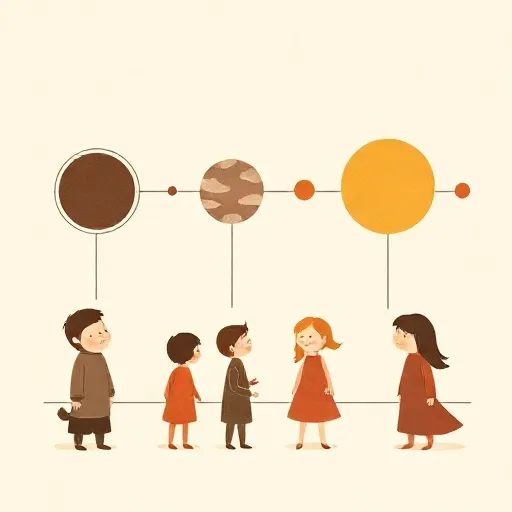
Most of the theories that science has ever generated are now known to be false. Newton’s physics replaced Aristotle’s, Einstein’s replaced Newton’s, and physicists are already hunting for a deeper theory. If we had no way of saying that Einstein is closer to the truth than Newton, and Newton closer than Aristotle, then the whole story of scientific progress would look like one long parade of mistakes with no direction. Truthlikeness gives us a way to see the history of science as genuine progress, even when the bullseye hasn’t been hit.
This isn’t just a puzzle for scientists. Whenever you change your mind about something — from who left the lights on to what happened in a story you read — you’re hoping your new belief is better than your old one. We live as fallibilists every day, trusting that our updated beliefs are probably getting closer to the truth, even if they aren’t the whole truth. Understanding truthlikeness helps explain what that “getting closer” actually means, and whether that hope is well-founded.
The debate is far from settled. But the question itself — how can a wrong answer be nearly right? — is one of the most exciting invitations in philosophy.
Think about it
- If your friend makes a wild guess that is accidentally almost right, while you make a carefully reasoned guess that is slightly less accurate, which guess is more truthlike? Does the way you arrived at the guess matter?
- Scientists once believed atoms were tiny indivisible spheres. Later they believed electrons orbit a nucleus. Both turned out to be incomplete or false in some ways. Can you still say the second theory was “closer to the truth,” or do you need the final truth to judge?
- If we can never be completely sure we’re getting closer to the truth, should we still trust that science is making progress? Why or why not?