
Can a Joke and a Math Problem Be True in the Same Way?
A Lunch Table Puzzle

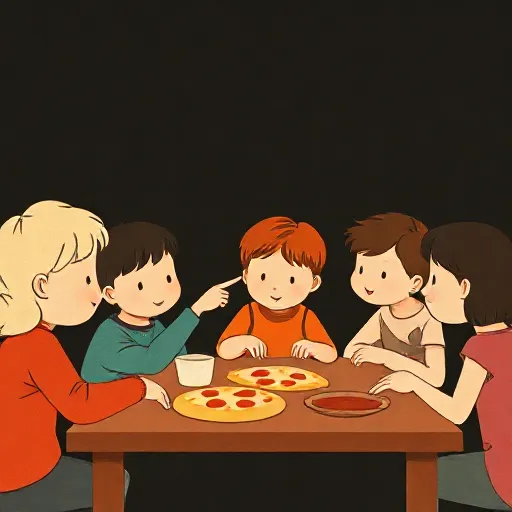
You’re at lunch, and someone says, “Ketchup on pizza is disgusting.” A few minutes later, your math teacher writes “7 + 5 = 12” on the board. Both claims are true. But are they true in the very same way? The pizza claim depends on taste and culture; the math claim seems unshakeable, true everywhere forever. If you start to wonder whether truth itself might come in more than one flavor, you’ve landed on a live philosophical debate. It’s called alethic pluralism, from the Greek word aletheia (truth). The idea is that there may be many ways of being true — not just one.
What Does ‘True’ Even Mean?

For centuries, philosophers tried to boil truth down to a single thing. The most famous candidate is correspondence: a sentence is true when it matches reality. “The cat is on the mat” is true if, in the real world, there really is a cat on a mat. Another influential view is coherence — a statement is true if it belongs to a tidy, consistent system of beliefs, the way a piece fits into a jigsaw puzzle. Both theories seem reasonable. But notice what happens when you apply them outside their comfort zone. Correspondence works beautifully for ordinary objects, like cats and mats. Yet what about “Killing innocent people is wrong” or “Jim Carrey is funnier than Adam Sandler”? It’s hard to point to a fact in the world that those sentences match. Coherence, meanwhile, might handle law or math well — a legal claim is true if it coheres with the whole legal code — but it stumbles with everyday science, where we want truth to be about mind-independent reality, not just about logical fit.
This puzzle is known as the scope problem. Any single candidate for what truth is — correspondence, coherence, something else — seems plausible in some areas of talk but wobbly in others. If we insist that truth is always correspondence, we struggle to explain ethics and comedy. If we insist it’s always coherence, we lose the grip on the physical world that science demands. The scope problem pushes us toward a surprising thought: maybe truth is not a one-size-fits-all affair.
A Philosopher’s Idea: Truth Comes in Many Flavors

The British philosopher Crispin Wright (born 1942) took the scope problem seriously. His answer is a version of discourse pluralism. Wright argues that any word counting as a truth predicate — a way of calling something true — must obey a small set of basic platitudes. These are uncontroversial claims almost everyone accepts: for example, “To assert something is to present it as true,” or “If a sentence is true, its negation is false.” If a region of discourse (say, chemistry, fashion, or morality) has a term that obeys these minimal rules, then that region has a lightweight truth predicate.
But that’s just the starting point. Some areas of talk pile on heavier platitudes. In science, truth might require that a statement “corresponds to reality” or “reflects how matters stand” — heavyweight demands that connect truth to a mind-independent world. In ethics, by contrast, we might not need that kind of correspondence; we might simply accept that a moral truth satisfies platitudes like being useful to believe or being justified by good reasons. Wright’s insight is that truth predicates come in different weights. What makes “Water is H₂O” true is not exactly what makes “Cruelty is wrong” true — yet both are genuinely true. The nature of truth itself can vary from domain to domain.
The Functionalist Twist: One Job, Many Workers

The American philosopher Michael Lynch (born 1966) developed a related view called functionalism about truth. Lynch compared truth to a job description. Think of a school principal: different people can fill the role — Ms. Adams this year, Mr. Singh next year — but the role’s duties stay the same. Similarly, Lynch proposed that truth is a functional kind — a second-order property. What a true sentence “does” is spelled out by a network of platitudes: true sentences are what we should believe, what we aim for in inquiry, what we preserve in good reasoning. That’s the F-role.
In different regions of discourse, different first-order properties (like correspondence, superwarrant — being ideally justified — or coherence) can step in and “play” the truth role. A statement about bacteria is true because it corresponds to biochemical reality; a statement about constitutional rights is true because it superwarrants belief within a legal system. Both wear the badge of truth because they do the same functional job, even though the underlying properties are different. Lynch’s picture keeps a single unified concept of truth (“having a property that plays the truth-role”) while allowing many ways of being true. It’s a middle path between the old monism (“one property fits all”) and a radical pluralism that abandons unity altogether.
Trouble in Pluralist Paradise: Mixed Sentences and Other Headaches

Once you say there are many ways of being true, a swarm of questions bites. Imagine a sentence like “Causing pain is bad and 7 + 5 = 12.” The first part seems to belong to morality, the second to mathematics. If each is true in a different way, what kind of truth does the whole conjunction have? This is the mixed compounds problem. Some pluralists reply that compound sentences get their own special truth property — a logical property tied to how conjunctions behave, not reducible to the truth of the parts. Others suggest using many-valued logic, assigning each type of truth a designated value and then letting operators pick the weakest or strongest value. A further worry is mixed inferences. If “Satiated dogs are lazy” and “Our dog is satiated” are true in biological and observational ways, but “Our dog is lazy” might be true in yet another way, does valid reasoning still preserve truth? Pluralists often respond that validity is just preservation of some designated truth value, not a single one.
Other critics raise the instability challenge. Suppose pluralists allow several truth properties, F₁ through Fₙ. Then it looks as if we can always define a big disjunctive property: being F₁ or F₂ or … or Fₙ. That single property would be shared by all true sentences — meaning we might be forced back into monism. Pluralists who concede such a property exists can still argue it is derivative; the more basic, domain-specific truths do the real explanatory work. A final familiar objection points to normativity. Truth seems to set a universal standard: you ought to believe what’s true, regardless of the subject. If truth fragments, do we get fragmented norms — one for trigonometry, one for immunology? Moderate pluralists answer that a single universal norm (“believe what is true in its own way”) still holds, because the domain-specific norms are all species of a common good. The debate is far from closed, but it has forced everyone to think harder about what truth demands of us.
Why It Still Matters: Your Truths and Mine

This isn’t just a puzzle for philosophy professors. Every time you scroll past a headline, argue about whether a movie is “genuinely funny,” or debate what’s right and wrong, you’re wading into pluralism’s terrain. If truth is one simple thing, then disagreements between science and morality look like a winner-take-all battle. But if truths can be plural — if a biological truth, a legal truth, and a comic truth are all real but different — we can take all sorts of claims seriously without forcing them into a single, uncomfortable mold. Alethic pluralism doesn’t force you to say that one kind of truth is “more true” than another. It instead invites you to notice the job each truth is doing in your life. The next time you hear “that’s just your opinion,” or you wonder whether a poem can be true in a way a weather report isn’t, you already have a name for the question.
Think about it
- If a scientist could prove beyond doubt that 2+2=4 is true in a mathematical way and “ketchup on pizza is disgusting” is true in a cultural-taste way, could both still count as equally real truths? Why or why not?
- Imagine two friends arguing about a movie. One says, “It’s hilarious — that’s a fact.” The other says, “Comedy is just personal taste, so it’s not really true.” Could a pluralist about truth say they’re both partly right? How?
- If truth comes in many forms, is it ever okay to say something false — for instance, telling a joke that isn’t literally accurate — because you’re using a “lightweight” kind of truth? Or would that weaken truth altogether?