

Can a Belief Be True Just by Fitting Your Other Beliefs?
What Makes a Story True?

Imagine you are scrolling through social media. A friend posts that a famous actor secretly built a rocket and flew to Mars. Some classmates believe it right away; others say it’s nonsense. You want to know the truth. How would you work that out?
You might look for evidence: NASA reports, telescope photos, maybe a live feed from Mars. That approach leans on what philosophers call the correspondence theory of truth. This theory says a statement is true if it matches, or corresponds to, facts in the real world. “Snow is white” is true because snow really is white. The actor story is false because no such rocket event happened. For centuries, correspondence felt like common sense.
But another group of philosophers saw a problem. What if we can never be sure we are seeing reality straight? What if we only ever check one story against the other stories we believe, like the rules of evidence and physics? These thinkers proposed a rival idea: the coherence theory of truth. This theory says a belief is true not because it matches the world “out there,” but because it coheres — hangs together — with the rest of the beliefs you already hold. Truth is a team sport, not a solo snapshot of reality. The debate between these two theories is the story we’ll explore.
Truth as a Team Sport: The Coherence Theory

At the heart of the coherence theory is a simple thought: a belief earns its truth-label by fitting into a system of beliefs. But what does “fit” mean? Early versions of the theory, some philosophers say, used only consistency. A belief coheres if it doesn’t contradict the system. That turned out to be too weak. You could have two beliefs, each consistent with your system, but they could contradict each other. A theory that labels both true at once fails to make sense.
A stronger version says coherence is entailment. This means the belief logically follows from the system, the way “the cat is an animal” follows from “all cats are mammals” and “all mammals are animals.” Another version, favored by the British idealist F. H. Bradley (1846–1924), says coherence is mutual explanatory support. Here, beliefs prop each other up the way beams in a roof hold together — each one helps explain and support the others. No single belief stands alone; they all work together.
Coherence theorists also need to pick whose beliefs make up the system. The specified set could be everything that real people actually believe right now. Or it could be what people like us would believe if we could investigate forever — the “limit of inquiry.” At the far end, some idealists imagined the set of beliefs held by an all-knowing being. Different choices lead to very different versions of the theory.
When Reality Is Just a Collection of Beliefs
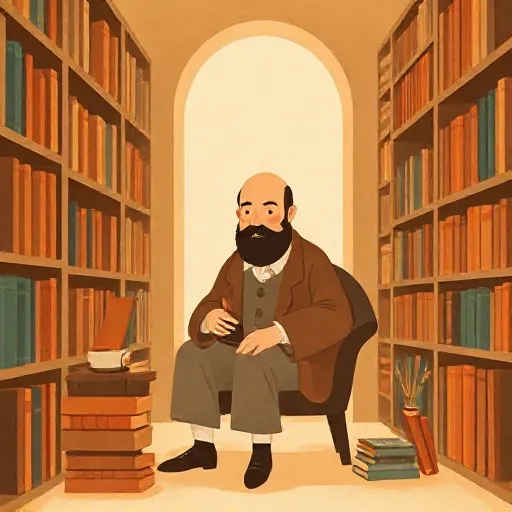
Why would anyone give up the straightforward idea that truth matches the world? One powerful push came from idealism. Idealist philosophers of the late 1800s, such as Bradley, argued that there is no real divide between our beliefs and what makes them true. From their perspective, reality is something like a collection of beliefs — or one enormous unified mind. If beliefs and the world are made of the same stuff, a belief cannot be true by pointing to something outside itself. It can only be true by fitting with other beliefs.
This “metaphysical route” leads to a striking conclusion: truth comes in degrees. A belief is true to the extent that it coheres, and no belief is ever perfectly true — just as a puzzle piece never shows the whole picture. For many thinkers today, idealism is a hard sell. Since the idealist worldview has few defenders, this path to the coherence theory has become a quiet side road. Still, its logic forces us to ask a deep question: if the world we know is always filtered through our minds, what remains that we can compare a belief against?
The Detective’s Dilemma: Can We Ever Get Outside Our Beliefs?

A second path, more traveled today, starts with how we justify beliefs. Brand Blanshard (1892–1987) argued that if a belief’s best test of truth is how well it coheres with our other beliefs, then truth itself must be coherence. Suppose you announced that truth still meant matching reality. Then a perfectly coherent set of beliefs might still miss reality — and coherence would be a poor test. Since we treat coherence as a trustworthy test, Blanshard said, truth cannot be correspondence.
This argument has a sharp reply, made by philosophers like Nicholas Rescher (1928–2024). A test can be good but fallible, like a weather forecast. If coherence is a useful but imperfect guide, then truth might still be about correspondence even when our test sometimes fails. Blanshard’s reasoning seems to require a test that never errs, and that is a much harder claim to defend.
A second epistemological argument gained ground in the 20th century. Thinkers such as Otto Neurath (1882–1945) and Carl Hempel (1905–1997) insisted we can never “get outside” our set of beliefs to compare them directly with naked facts. Neurath used an image: we are like sailors who must repair their boat at sea — we can never dock at solid reality to check the hull from outside. From here, some infer that we can only ever know that a proposition coheres with our beliefs, never that it corresponds to reality.
Critics push back. Even if we cannot know a belief matches the world, that does not mean it fails to match. Truth could still be about correspondence, leaving some truths forever unknown to us. So coherence theorists need a stronger step: they must argue that beliefs cannot correspond to objective facts, not merely that they cannot be known to do so. Some try to close that gap by looking at how we assign truth conditions — the situations under which a statement counts as true. They argue that speakers can only make a practice of asserting a statement under conditions they can recognize — and those conditions end up being the conditions under which the statement coheres with their beliefs. That move, however, remains a live battlefield.
Jane Austen’s Murder? The Big Objections

Opponents fire several bold objections at the coherence theory. The specification objection, from Bertrand Russell (1872–1970), asks: which set of propositions counts? Consider two silly examples. (1) “Jane Austen was hanged for murder” fits neatly with a made-up set of propositions. (2) “Jane Austen died in her bed” coheres with everything we actually accept about her life. By what right does the coherence theorist pick the second as true and the first as false?
A quick response says: we favor the set that matches the real facts — but that smuggles correspondence back in. Another says: choose the most comprehensive, simplest, or best system. Yet several systems might tie on those scores, leaving no clear winner. Coherentists have a better reply: the truth-making set is not just any random collection; it must be the set of propositions that is actually believed — or would be believed at the limit of inquiry. No one genuinely believes the set that includes Jane Austen’s hanging. So the theory can call that proposition false without cheating.
A deeper worry, pressed by Ralph Walker, pokes at the notion of “actually believed.” To say that a set S is believed, the coherentist must claim that the statement “S is believed” is true. But what makes that statement true? If the answer is “it coheres with a further set of beliefs,” we seem headed toward an infinite regress. The only way to stop the regress, Walker argued, is to admit that the truth of “S is believed” rests on an objective fact — exactly what the coherence theory denies. Coherentists reply that a regress is not always fatal; the correspondence theory faces a similar chain with “proposition p corresponds to facts,” which then requires a further correspondence claim, and so on. Neither theory gets a free pass here.
A second classic charge is the transcendence objection. There seem to be truths that fit into no one’s actual beliefs. Take “Jane Austen wrote exactly ten sentences on 17 November 1807.” Possibly no one ever believed that, and no finite being ever will, even at the limit of inquiry. Yet it feels like that sentence is either true or false, independent of us. Coherentists can avoid this problem only if they accept that truth coheres with the beliefs of an all-knowing mind. Other versions must bite the bullet and say that a proposition about unwritten sentences from centuries ago simply lacks a truth-value — a move many find uncomfortable.
A third challenge is the logic objection, also from Russell. Any talk of coherence seems to assume that the law of non-contradiction is true; two statements that contradict each other cannot both cohere with a system. If the law of non-contradiction were merely true by coherence, and we imagined it false, then the whole idea of coherence would collapse. Coherentists respond by noting that the law itself earns its keep within a system of beliefs — we accept it because without it communication and reasoning would be impossible, and we already believe those are possible. So the law is not a magical foundation; it’s a central supporting beam in the roof of beliefs.
Why It Still Matters: Whose Truth Wins?

You might think this debate belongs in dusty libraries. But it sneaks into your life every day. Imagine a group chat where a rumor spreads. You want to judge whether the rumor is true, but direct evidence is hard to get. If your only tool is to see how well the rumor fits with everything else you already believe — the known habits of the person in question, the physics of what’s described, the patterns of past gossip — you are effectively applying a coherence theory. The rumor becomes true by earning its place in your web of beliefs.
Yet when someone posts a blurry photo that seems to back up the rumor, you suddenly reach for correspondence: does the photo match real events? The tug-of-war between the two theories is the tug-of-war inside your own head. You cannot always exit your own beliefs, but you also cannot shake the feeling that some claims are true or false regardless of what anyone thinks.
This matters because it reshapes how we handle disagreement. If truth is only coherence with my belief system, then someone else’s perfectly coherent system could hold an opposite “truth,” and there would be no shared court of appeal. If truth is correspondence, we can point to the same external world and try to resolve differences by looking harder. Neither approach is fully comfortable. The coherence theory reminds us that we always operate from inside a web of assumptions, while the correspondence theory insists that the web is not the whole story. The ancient debate between them is far from over — and every time you pause before believing a wild headline, you are dipping your toes into philosophy.
Think about it
- If everyone in your class agreed a rumor was true because it fit perfectly with everything else they already believed, would that make the rumor actually true? Why or why not?
- Can you think of a time you believed something was true because it matched all your other beliefs, even though you could not check the real world directly?
- If you could never step outside your own mind to compare your beliefs with reality, how would you decide what is really true?