Is Touch Just One Sense, or a Whole Orchestra?
The Secret Chaos Inside a Simple Touch
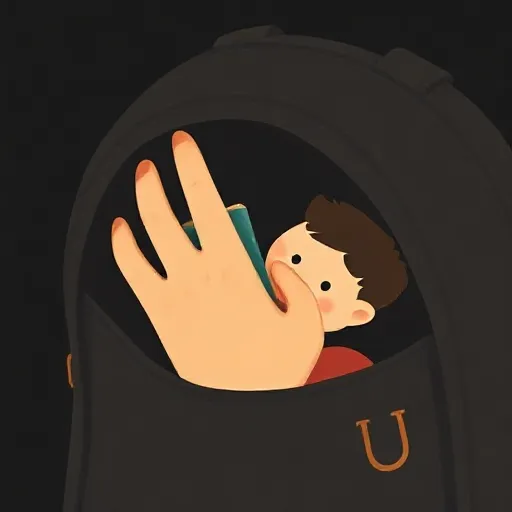
You are in the hallway at school, late for class, digging through your backpack without looking. Your hand instantly knows the crinkle of a scrap of paper, the hard cylinder of a pen, the soft corner of a cloth pencil case. All these different feelings come from the same sense — touch. But here is the puzzle: how can one sense give you so many completely different kinds of information?
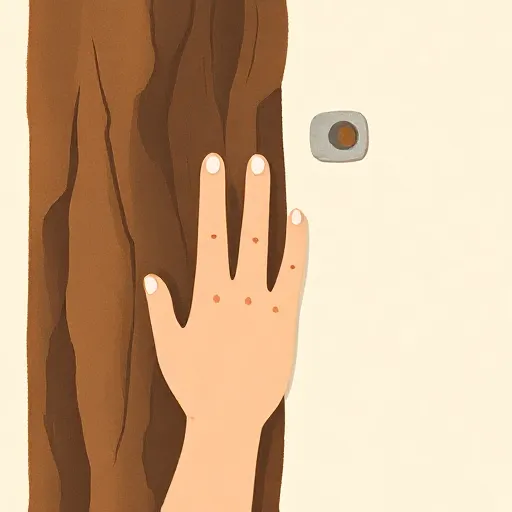
When we talk about “the sense of touch,” we usually mean what scientists call haptic touch — touch that involves movement, even tiny movements. If you press your finger down on a table and feel its solidity, that is haptic. If you simply hold still and feel the warmth of the table on your skin, that is cutaneous touch — touch relying only on signals from the skin itself. In everyday life, most of your touch experience blends these together so smoothly you never notice the join.
The real trouble starts when you ask what touch is for, or what makes it one unified sense at all. For vision, it seems easy: seeing gives you colors, and only seeing gives you colors. The ancient Greek philosopher Aristotle (384–322 BC) called color the proper sensible of vision — the feature that belongs to that sense alone. But touch? Aristotle noticed that it has no single proper sensible. Instead, it hands you pressure, temperature, vibration, texture, stickiness, and more. Your backpack dig proves it: your fingertips detect shape, hardness, and temperature all at once, using a jumble of hidden systems.
Is Touch One Sense or Many?
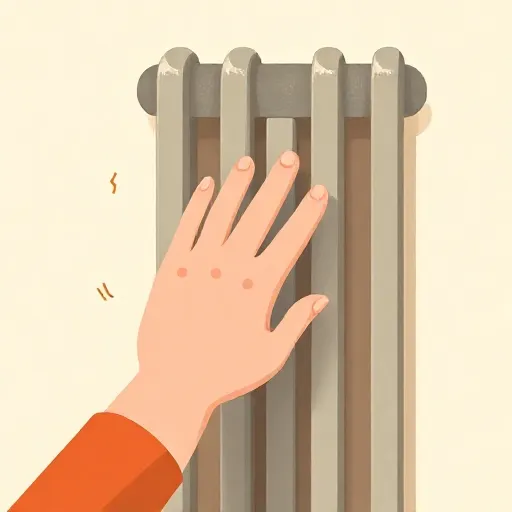
Underneath your skin, matters get even messier. The skin does not have one single “touch organ.” It is packed with many different kinds of sensory receptors. Some respond to pressure, some to cold, some to heat, some to vibration. Some channels that carry warmth are actually more similar, biologically, to the channels that carry pain than they are to the ones that carry vibration. So why do we lump warmth into touch, but we almost never count pain as part of touch?
This physiological mess has led many researchers to argue that touch is not really one sense at all. Instead, they say, it is a collection of senses that we happen to group together. The philosopher Matthew Ratcliffe pointed out that touch ends up “so heterogeneous that no criteria can unite its various characteristics and at the same time exclude characteristics of other senses.” In plainer words: touch is a grab bag. You can’t draw a neat box around all its parts without also catching things we usually call bodily sensations, like itching or a tingle.
Not everyone agrees that this disunity means we should throw out the idea of touch as a single sense. One view, defended by the philosopher Matthew Nudds, says we classify senses mostly by the kind of knowledge they give us. If I tell you that Anna touched the vase, you instantly know she was in a position to learn about its warmth, solidity, and texture. That practical chunk of information — “what you can learn through skin contact” — makes “touch” a useful label, even if the biology underneath is a patchwork. Another idea, from Fiona Macpherson, says we should stop trying to sort senses by a single rule. Instead, imagine a multidimensional map: one axis for the sense organ, another for the type of information, another for what the experience feels like. On that map, human touch would sprawl across a much larger territory than vision or hearing. Touch itself would still be weird, but in an entirely honest way.
Your Body Is the Ruler
Touch is never just about the object you are feeling. It always, somehow, involves your own body too. The philosopher Brian O’Shaughnessy (1928–2007) argued that all touch is built on a background of bodily awareness. You constantly know, without looking, where your arms and fingers are — a sense called proprioception. You also feel your muscles as they move — that’s kinesthesis. O’Shaughnessy thought that external touch uses your body like a template: you measure the shape and hardness of an object against your own position and effort. When you press a table, you feel the table’s resistance, but you also feel your own pressing.
Some thinkers worry that this makes touch sound too much like you are always focusing on your body. When you play a fast sport and your hand swats a ball, it feels like you are aware of the ball directly, not your arm. The philosopher Michael Scott pointed out that we often seem to have external touch awareness with no conscious bodily awareness at all. So maybe bodily awareness is just a helpful background system, not a necessary ingredient.
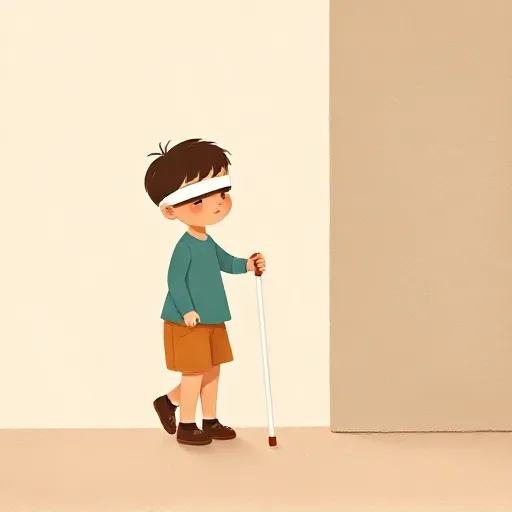
Another twist comes from tools. When you use a long stick to tap the ground, where do you feel the ground? Most people say they feel it at the tip of the stick, not in their hand. The philosopher Matthew Fulkerson argues that touch extracts information about distant objects from the body’s own signals — almost like doing a quick calculation. Your brain takes the vibration in the stick, combines it with your proprioception, and delivers the result that it’s hard concrete three feet ahead. On this view, your body is a medium, like air for light. You don’t notice the medium; you notice what it reveals.
Touch in Motion: You Have to Move to Feel

Try this: close your eyes and hold a key perfectly still on your palm. You can tell it is cool and maybe light. Now pick it up and move it around your fingers. Suddenly the ridges of the key’s teeth become clear, its exact weight and balance snap into focus. That difference is the heart of active touch.
The psychologist J.J. Gibson (1904–1979) argued that touch is not a passive receiver but an active haptic system. It involves your whole body — your muscles, your joints, your motor plan. When you swing a tennis racket, your hand and arm don’t just feel pressure on the skin; they feel the racket’s length and weight through motion. The psychologist Michael Turvey showed that people can judge the size and shape of an object just by wielding it around, without ever looking at it. That kind of “dynamic touch” would be impossible if touch only used skin receptors.
This close marriage between touch and action has led many philosophers to see touch as a model for how all perception might work. Alva Noë, for example, says vision itself is “touch-like”— it involves probing and exploring the world, not just taking a photograph. If you want to understand how sensing and doing are wired together, touch is the place to start.
The Gentle Touch That Says “You’re Safe”

Touch does more than give you facts about the world. It also carries a deep emotional charge. In the early 2000s, researchers discovered a special kind of nerve fiber they called CT-afferents. These fibers do not help you tell the difference between rough and smooth. Instead, they respond most strongly to slow, gentle stroking — the kind of touch you might feel when a parent runs a hand softly down your arm. When CT-afferents fire, they seem to produce a raw feeling of pleasantness.
This discovery opened a door. It suggests that some parts of touch are built from the ground up for connection, not for information. The psychologist Tiffany Field has shown that caring, affectionate touch — what researchers call affiliative touch — helps babies grow and even strengthens the immune system. Touch, it turns out, is a social glue.
The philosopher Carolyn Korsmeyer has explored another side of this: the special value we place on touching something “real.” Seeing a painting from across the room is one thing; touching the actual canvas, even gently, gives a feeling of direct contact and authenticity that vision alone cannot match. Touch, in this sense, isn’t just a way to check the temperature of your bath. It’s how you know you are not dreaming.
Why the Messy Orchestra Matters

Now you can see why your simple backpack dig is not so simple. That one sense you call “touch” is a team — maybe a whole orchestra — of separate sensory channels. It never switches off your bodily awareness; it often depends on movement; and it wires straight into your emotions. When you push against a wall and it pushes back, you feel, in a way that no other sense gives you, that you have met something real. Some philosophers say this is why touch feels so certain, so grounded.
The next time you search for your keys without looking, or feel an unspoken “it’s okay” in a long hug, you are using an ancient, beautifully tangled system. Touch is your most direct door to the world, and to each other.
Think about it
- If scientists built a robot hand that detects pressure, temperature, and vibration exactly like yours, would the robot be “touching” in the same way? What might be missing?
- Imagine you are using a long stick to tap the floor. Are you feeling the floor or the stick? Does your answer change if you close your eyes?
- Why do you think a slow, gentle stroke on your arm feels comforting, while a fast, rough one feels annoying? Does that difference say something about what touch is really for?