
If Pain Is All in Your Mind, Why Does Your Hand Hurt?
The toe that hurts even when nothing is wrong

Imagine you stub your toe on a chair. You grab your foot and say, “I have a sharp pain right in my toe.” It feels like something bad is in that exact spot. But if someone looked at your toe, they wouldn’t see the pain — just a toe, maybe red but no “pain” there. Where is the pain, exactly?
Our everyday way of talking about pain pulls in two directions at once. On one hand, we treat pain as if it’s a thing in a body part: we locate it, describe its shape (sharp, dull, throbbing), and even say “the same pain came back.” This makes pain sound like an object of perception, something we feel in the same way we see a discoloration on our skin.
On the other hand, we also treat pain as a private, subjective experience. Scientists and doctors define pain as “an unpleasant sensory and emotional experience associated with actual or potential tissue damage” (a definition from the International Association for the Study of Pain). This definition says pain is always a psychological state, a feeling. You can’t be wrong about whether you’re in pain — if you sincerely believe you’re in pain, you are. And nobody else can feel your pain directly. That’s the privacy of pain.
So pain seems to be both a thing out there and an experience in here. This is the act-object duality — the puzzle that pain is treated sometimes as the object you perceive and sometimes as the act of perceiving itself. The rest of this article explores how philosophers have tried to solve this puzzle.
Are pains mental objects you can point to?

Many early philosophers who thought about perception argued that we never directly see the outside world. Instead, we are directly aware of sense-data — private mental objects or qualities that stand between us and real objects. For example, when you see a red apple, you are really seeing a red, apple-shaped sense-datum in your mind, and only indirectly seeing the real apple. This is called indirect realism.
Sense-datum theorists like G.E. Moore (1873–1958), Bertrand Russell (1872–1970), and H.H. Price (1899–1984) found that pain fits this picture almost perfectly. Pains are classic examples of mental objects: they are private, subjective, and you can’t be wrong about them. They also seem to have location — you feel pain in your hand — but the “object” you’re aware of isn’t a physical thing. It’s a pain sense-datum.
This theory seems to explain why we have the act-object confusion: the word “pain” can apply both to the sense-datum (the object) and to the act of being aware of it. But it leads to strange consequences. If pains are mental objects located in your hand, then your mind somehow extends into public space. Could others stumble upon your pain? And if pain exists only when you feel it, how can it be “in” a location at all? Some tried to solve this by saying pains aren’t literally in physical space but in a private phenomenal space — a kind of inner map that mirrors your body. Yet then we must explain how the two spaces relate, and many felt this created more mysteries than it solved.
Feeling pain as a kind of seeing

A different approach came from philosophers like David Armstrong (1926–1993) and George Pitcher (1931–2018). They argued that feeling pain is a form of perception — specifically, perception of something extramental, like tissue damage. Just as seeing is the perception of colors and shapes, feeling pain is the somatosensory perception of disorder in your body. This view tries to keep direct realism about the external world while explaining pain.
According to this perceptual theory, when you say “I feel a sharp pain in the back of my hand,” you are reporting that you are having an experience that represents tissue damage in that location. But you are not claiming that tissue damage is actually there — you are reporting the experience itself. So pain is the experience, not the damage. The location you talk about is an intentional location — the place your experience says the damage is, even if the experience is wrong (as in phantom limb pain).
This solves the privacy problem: pain is a mental experience, so it is private. But it runs into a new problem called the problem of focus. In ordinary perception, you apply concepts to the object you see (you say “I see a red apple”), not to your visual experience. But with pain, the concept PAIN applies first to the experience, not to the perceived tissue damage. Why? The explanation usually points to the awful, unpleasant quality of pain: it forces your attention onto the experience itself. But as we’ll see, that explanation might not be enough.
The puzzle of why pain hurts
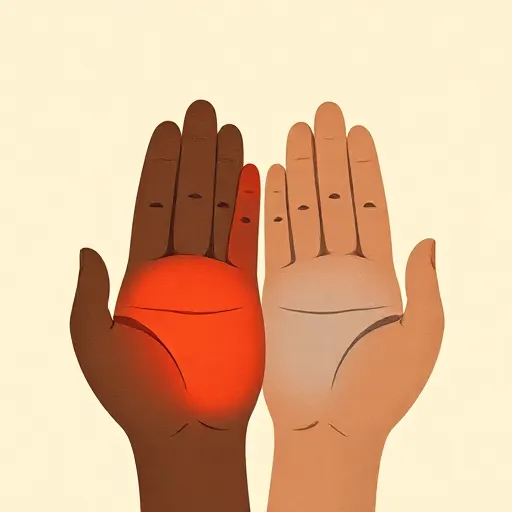
Pain isn’t just a neutral signal like “something is happening in my knee.” It hurts. It has a negative affective quality — a feeling of unpleasantness that makes you want it to stop. Early perceptual theories struggled to explain this. Armstrong suggested that the hurt is really a desire for the experience to stop, but many felt that puts the cart before the horse: the pain is painful so you desire it to stop, not the other way around.
Modern representationalist theories try to fold everything into the information the experience carries. Michael Tye (20th–21st century) argues that pain’s entire feel — including the hurt — is nothing but its representational content. A pain experience represents tissue damage and also represents it as bad. The experience feels the way it does because that is what it tells you about your body.
This raises the question: what does “bad” mean here? Some, like David Bain, say the experience represents the disturbance as bad for the organism. Others propose imperativism: instead of representing damage as bad, pain experiences command you to protect the body part (like a shout of “Stop!” or “Guard that spot!”). These mixed theories accept that pain has both a descriptive (“there is damage”) and a directive (“deal with it!”) side. The tough part is explaining how a mere command, or a representation of badness, can carry the raw unpleasantness we feel.
When pain doesn’t hurt: do pains exist at all?

Philosopher Daniel Dennett (1942–2024) took the puzzle in a radical direction. He looked at patients who, after certain brain surgeries or under morphine, report that they still feel pain but it no longer bothers them. They say it is pain, but it’s not unpleasant. Dennett argued that this reactive dissociation — the splitting of pain’s sensory and affective sides — shows that our ordinary concept of pain is incoherent. We believe (1) pain is essentially horrible, and (2) we can’t be wrong about our own pain. But these patients claim they have pain that isn’t horrible, while also being authorities on their own experience. Dennett concluded that the common-sense concept of pain is broken: nothing could satisfy both conditions, so pains as we usually think of them don’t exist. That’s eliminativism about pain.
Many philosophers push back. They say the common-sense concept isn’t that rigid; it can survive the discovery that pain’s unpleasantness can sometimes be stripped away. What the strange cases reveal is that pain is complex, with separable dimensions — not that pain is a myth. But Dennett’s insight stands: our self-knowledge about pain might be less simple than we think, and science can surprise us about the nature of our own feelings.
Why the puzzle of pain matters to you

The question “What is pain, really?” isn’t just for philosophers. It affects how we understand ourselves, how we treat people who suffer, and how we think about animals, babies, or anyone who can’t easily describe their feelings. If pain is purely in the mind, then a person’s report that they are in pain should be taken seriously, even without a visible cause. That’s a cornerstone of medical care. But if pain is a perception of physical damage, maybe we should look harder for hidden causes when someone says they hurt.
These puzzles also connect to the biggest mind-body problem: how does the physical stuff of brains produce the private, felt quality of a throbbing toe? The act-object ambiguity we started with — pain as both a thing out there and a feeling in here — turns out to be a window onto the mystery of consciousness itself. Next time you stub your toe, you might notice not just the “ouch,” but also the strange fact that something so private can feel so precisely located. Philosophers are still arguing about what that tells us.
Think about it
- If you could invent a machine that lets someone else feel exactly what you feel when you stub your toe, would that prove your pain is a public object? Why or why not?
- Imagine a person who says, “I feel a pain, but it doesn’t bother me at all.” Do you think that person is really in pain? What does your answer tell you about what pain is?
- If pain is just a signal that something is wrong in your body, why can’t a robot that detects damage and avoids it feel pain the way you do?