
Could You Ever Travel Back and Kill Your Grandfather?
The Day Kurt Gödel Discovered Time Loops

In 1949, the mathematician Kurt Gödel (1906–1978) dropped a bombshell on Albert Einstein. Gödel had been tinkering with Einstein’s own equations of general relativity and found something unexpected. He discovered a solution in which time could loop back on itself. In such a universe, a traveler could follow a closed timelike curve (CTC) — a path through space and time that returns exactly to its starting point. You could shake hands with your younger self.
Gödel’s solution wasn’t just a fantasy. It obeyed the actual laws of physics. That meant, in principle, time travel was physically possible. But if you could go back to the past, what would stop you from doing something impossible — like killing your own grandfather before your parent was born?
That question has haunted physicists and philosophers ever since. It turns out the answer is far stranger than a simple no.
The Grandfather Paradox and Self-Consistency

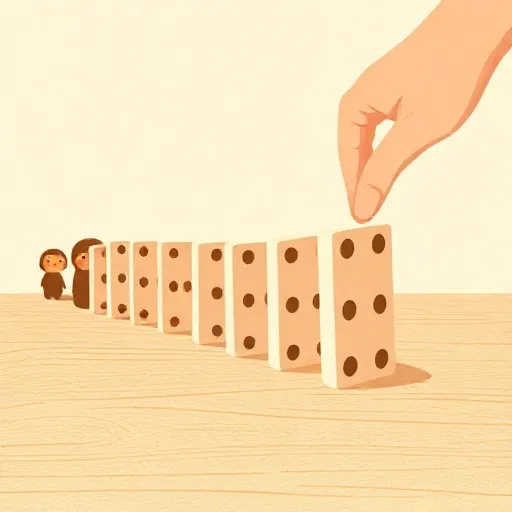
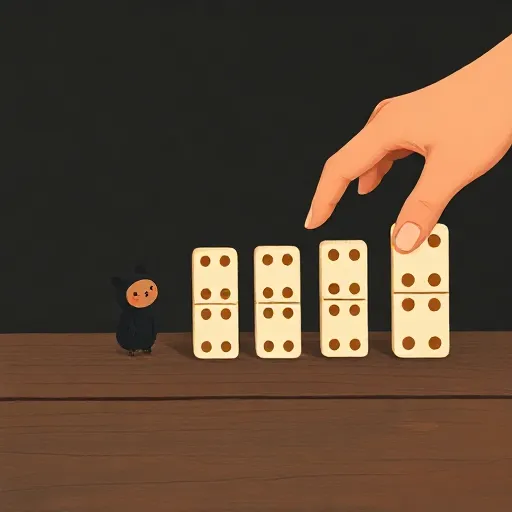
Imagine Kurt, a time traveler, aiming a rifle at his grandfather, Adolph. Kurt is a crack shot and has every intention of pulling the trigger. If he succeeds, Adolph dies young, Kurt is never born, and Kurt never travels back — so who fired the shot? This is the consistency paradox.
Some have argued that logic alone prevents such a deed. The past cannot be changed because it has already happened. Events must form a consistent story. But that doesn’t explain how physics would stop Kurt: would his gun jam? Would a sudden gust of wind push his bullet astray?
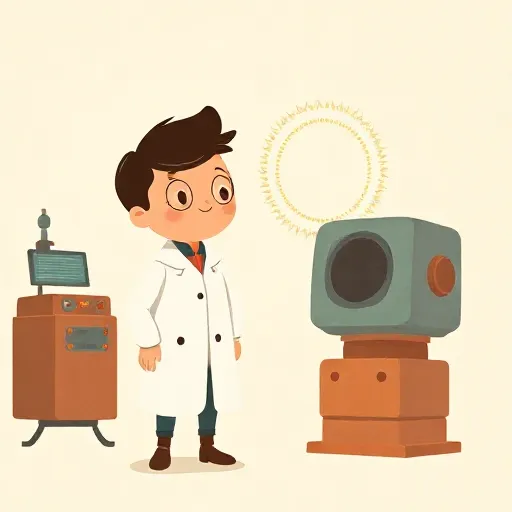
Physicists John Wheeler (1911–2008) and Richard Feynman (1918–1988) proposed a clever answer in 1949. They imagined a camera set up to photograph whatever comes out of a time machine. Later, the developed film is placed back into the time machine to be photographed. If the image and the film disagree, you get a paradox. But, they argued, nature’s laws are continuous — small changes in input produce small changes in output — and that ensures a self-consistent solution exists. For any continuous mapping of shades of gray, there is always a fixed point: a shade that exactly matches the shade of its own photograph. The loop settles into a uniform gray. No paradox.
This idea generalizes. So long as the states of a system can be represented as points in a closed, continuous space (like all the shades between pure black and pure white), a consistent loop always exists. You might call it the universe’s self-consistency insurance.
Why a Dial Could Still Cause Trouble

But Wheeler and Feynman’s escape route has a catch. What if the state-space is not closed? Imagine a pointer on a dial that can point to any angle between 0 and 1, but not exactly 0. Now suppose you build a machine that sets the pointer to exactly half the value of whatever angle it receives from the time machine.
If the pointer starts at some value, say 0.8, and encounters its older self coming out of the time machine at some value y, it will move to 0.5 * y. For consistency, the incoming value y must equal that new position. That means we need y = 0.5 * y, which only works if y = 0. But 0 is not allowed! Without that exact point, no consistent state exists. The loop simply cannot close, even though all the rules are continuous.
This shows that in some possible worlds, time travel would demand constraints on what can happen before the time machine is ever used. The state of the world on the “normal” side of time would have to be just right — almost as if the universe had been fine-tuned to avoid a paradox.
Too Many Histories: The Underdetermination Problem

Once physicists started building toy models of time travel regions, they faced a second surprise. Instead of over-constraining the past, many of these models produced the opposite problem: too many consistent solutions.
Imagine a simple world with only one particle and a time machine. You can calculate all the possible ways the particle could interact with its own past self. In some cases, the same initial condition is compatible with wildly different histories. The particle might collide with itself twice, three times, or not at all. Nothing in the laws of physics picks one history over another. There isn’t even a probability — you just have an underdetermination.
It’s like the story of an unwritten book. Suppose a time traveler brings a book back from the future and gives it to their younger self, who then publishes it so it can be carried back. The book has no author. Its contents are determined by nothing. In physics terms, the region containing the CTC fails to have a unique evolution from the initial data.
This underdetermination is just as strange as the constraints. It suggests that if time travel exists, the world might have multiple equally real pasts — or that something outside our current physics fixes which history gets chosen.
Quantum Blur and the Many-Worlds Escape
Could quantum mechanics save us from these paradoxes? Physicist David Deutsch (born 1953) thought so. In the 1990s, he argued that if you treat the time-traveling system as a quantum blur of possible states — a mixed state — consistency can always be found without imposing prior constraints. You don’t need the pointer to hit exactly zero; the system smears itself across possibilities until it lands on a self-consistent combination.
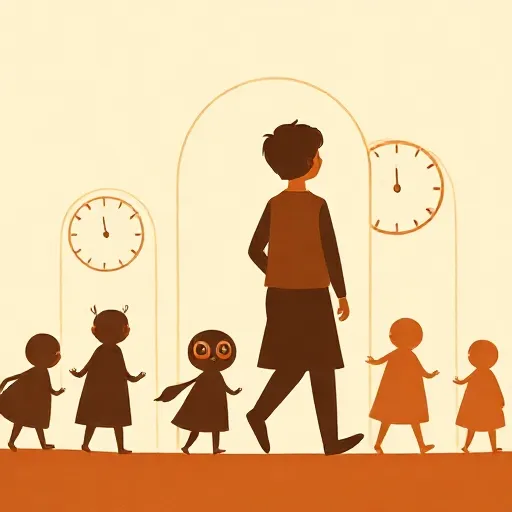
But there is a twist. To make sense of these quantum mixtures, Deutsch relied on the many-worlds interpretation of quantum mechanics. In this picture, the time traveler doesn’t just go back in time; they also slide into a different branch of reality. You might visit a past that looks like your own, but it isn’t exactly the same world. From the perspective of any single history, no one ever truly returns to their own unchanging past. So the grandfather paradox isn’t solved — it’s sidestepped, because you’re never really in the same timeline.
Many physicists remain unconvinced. Deutsch’s argument simplifies the quantum entanglement between the time traveler and their environment in ways that may not hold up in a full theory. And if the solution only works by giving up on a single shared past, some would say it’s not time travel at all — at least not in the sense science fiction promised.
Why This Still Matters

No one has ever found a time machine, and we have no evidence that closed timelike curves exist in our universe. Yet this debate isn’t just about science fiction. It forces us to confront the deepest features of time itself: Is the past fixed? Is the future uniquely determined? Do we have free will if the universe can conspire to make events self-consistent?
Even if time travel is never built, thinking about it reveals hidden assumptions in our ordinary picture of the world. The same equations that describe black holes and the expanding universe also allow time loops. So if time travel is impossible, the reason must go beyond Einstein’s laws. It must come from something else — perhaps from thermodynamics, or from a yet-undiscovered principle that protects the order of cause and effect.
For now, the universe keeps its secret. If you ever find a way to visit your own past, don’t count on being able to change it. Something — maybe logic, maybe quantum weirdness, maybe pure coincidence — would almost certainly stop you.
Think about it
- If you had a time machine and tried to change a test score you got last year, would you succeed? What could possibly stop you?
- Suppose the universe always forces events to be self-consistent. Does that mean you have no free will whenever you’re near a time machine?
- If many equally possible pasts exist, would it be fair to hold someone responsible for an event that might never have happened in your version of history?