
Can You Go Back in Time and Change Anything?
What Does It Really Mean to Time Travel?

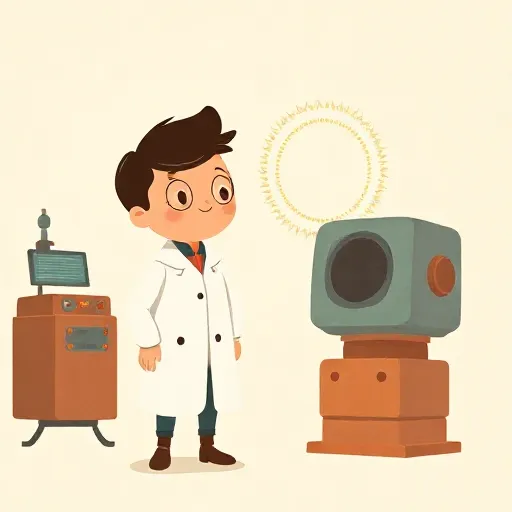
The year is 2070. Maya climbs into a gleaming pod, taps a screen, and feels a gentle hum. Outside the window, technicians watch the pod fade from sight. Inside, Maya’s wrist timer ticks forward ten minutes. Then the door opens onto a room from 1984: neon leg warmers, a boom box, and a calendar saying January 14. She has traveled to the past.
This story seems like time travel—but what makes it count? Not every journey through time qualifies. Sleeping for twelve hours moves you into the future, but no one calls that time travel. Staying in a closet for seven hours simply matches the world’s clock. Even flying west across the International Date Line can make you arrive before you departed by the calendar, but that’s just a trick of time zones. True time travel, the philosopher David Lewis (1941–2001) argued, involves a mismatch between two different kinds of time.
Lewis called the time measured by clocks and calendars outside the traveler external time. The time the traveler experiences—marked by a wristwatch, a heartbeat, a sense of “how long it took”—he called personal time. Time travel happens when the journey’s duration in personal time doesn’t equal the difference in external time between departure and arrival. If Maya ages ten minutes while the external clock jumps backward forty years, she has time-traveled. If she steps into a rocket that loops through a twisted region of space and arrives in her own past without ever disappearing, that counts too. The key is the discrepancy between the two clocks.
The Grandfather Problem: If You Travel Back, Can You Change History?
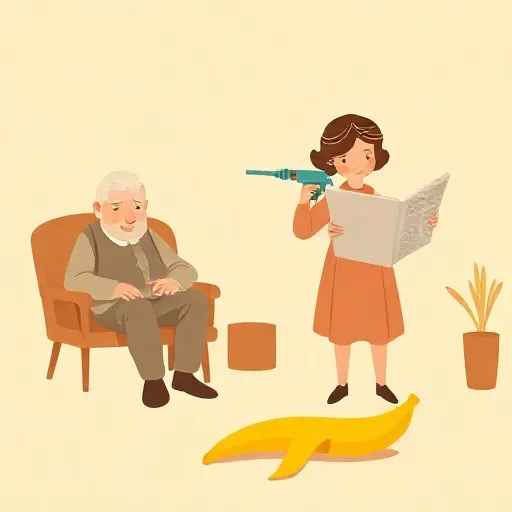
Time travel to the past stirs up a deep worry. Suppose Tim steps into a machine in 2050 and emerges in 1921, face to face with his own grandfather as a little boy. Tim has a loaded weapon, training, and a motive. Could he kill the boy? If he does, his parent never is born, so Tim never exists to travel back. That seems like a contradiction: Tim kills Grandfather and Tim never existed. Many scientists and writers—from Isaac Asimov to Stephen Hawking—concluded that backwards time travel must be impossible. The logic simply won’t allow it.
But philosophers noticed a crucial distinction. Changing the past means making it different from what actually happened—turning a “yes” into a “no.” In a universe with a single past, that’s incoherent. If Grandfather really survived 1921, then no action can make him die that year. However, that doesn’t prevent a time traveler from participating in the past—being one of the people who made history unfold as it did. A time traveler can’t undo what happened, but she can do whatever did happen. The puzzle is: if Tim goes back with the full intention to kill, what could possibly stop him?
Could a Banana Peel Save the Universe?

Lewis gave a surprising answer: nothing magical is needed. The time traveler would fail for “some commonplace reason.” Tim’s gun jams. A noise distracts him. He slips on a banana peel. The past protects itself, not through time guardians or mysterious forces, but through ordinary bad luck. So time travel does not force a contradiction—Tim can go to the past without killing Grandfather, because he simply doesn’t succeed.
The philosopher Paul Horwich (born 1947) objected that this still makes time travel extremely unlikely. If every attempt to kill Grandfather is foiled by a chain of accidents, we have a pattern: attempts and slips, over and over, with no direct causal connection between them. Horwich argued that such an uncaused correlation—like two students always wearing the same shirt without ever planning it—is possible in any single case, but a long run would be so improbable that we should treat time travel as no more likely than flipping a fair coin and getting heads a thousand times in a row.
Other philosophers, including Nicholas J. J. Smith, pushed back. They argued that time travel scenarios don’t automatically force uncaused correlations; the coincidences might be built into the story only if we already assume a certain kind of setup. The debate over whether backwards time travel would require a freakish string of luck remains unsettled.
But Can Tim Kill Grandfather, or Can’t He?

Even if Tim fails every time, a separate puzzle lingers about the word “can.” It seems correct to say Tim can kill Grandfather—he has the weapon, the training, the will. Yet it also seems correct to say Tim cannot kill Grandfather—because we know Grandfather survived 1921, and nobody can change the past. We seem to be saying both that Tim can and that he cannot.
Lewis resolved this by noting that “can” is sensitive to context. When we say “Tim can kill Grandfather,” we are considering facts about Tim’s skills and circumstances. When we say “Tim cannot kill Grandfather,” we are taking into account the further fact that Grandfather did not die in 1921. The two claims are true in different senses, so there’s no genuine contradiction—only a harmless shift in meaning.
The philosopher Kadri Vihvelin (late 20th century) disagreed. She argued that “Tim can kill Grandfather” is simply false, even relative to his skills. For the statement to be true, she claimed, there must be at least some situation in which Tim tries and might succeed. But at any world like ours, if Tim tried, he would inevitably fail—because the past is fixed. So she holds that we should just say Tim cannot kill Grandfather. Philosophers still argue about who has the better case.
Guess What? Time Travel Might Create Objects Out of Thin Air

Backwards time travel also opens the door to causal loops, where an object or a piece of information has no ultimate origin. Imagine a time traveler steals a time machine from a museum in 2050, uses it to go back to 1980, and donates the machine to that very museum. The machine is never built by anyone. Or picture a time traveler who teaches her younger self the secret of time travel—knowledge she herself only learned because, years earlier, her older self had taught her. The loop has no starting point.
Some find this disturbing. It seems to violate the idea that every effect needs a cause that came before it. Lewis accepted that a causal loop as a whole would be inexplicable—like the Big Bang—but he saw that as strange, not impossible. Others argue that backwards time travel doesn’t even require loops; one can travel to the past and affect it without creating an object that exists for no reason. Either way, the existence of “things that come from nowhere” forces us to rethink what an explanation should look like.
Does the Past Even Exist for You to Visit?

Underneath all these puzzles sits a bigger question about time itself. If you can travel to 1985, does that year still exist? Many philosophers and physicists think of time as a block universe: past, present, and future are all equally real, like every frame of a movie existing at once. The mathematician Kurt Gödel (1906–1978) showed that Einstein’s equations permit a universe where you can fly a rocket along a looping path and end up in your own past. Gödel argued that such a universe has no objective “now” that flows forward—it’s all just there in a single block.
But not everyone accepts the block universe. Presentists believe only the present exists. They reply that time travel can still make sense: all that’s required is that certain events did happen in the past (a traveler appearing in 1985 with the right memories) and that certain events will happen in the future (the traveler departing in 2070). The idea of a personal timeline that disagrees with external time is tricky for presentists, however, and philosophers continue to debate whether time travel is compatible with a view that denies the past is real.
Why It Matters—Even If You Never See a Time Machine

You may never step into a time machine, but these arguments matter. They show that a simple daydream—going back to warn your past self about a mistake—can clash with logic in surprising ways. They force us to examine what the word “can” really means, how causes work, and whether the past is fixed in a way the future is not. Every time you regret something and wish you could change it, you’re brushing up against the same puzzles that philosophers and physicists grapple with.
The logic of time travel is really a laboratory for thinking about time itself. Could the future already be waiting for you, as real as the present? Is there a single flowing “now” that moves from moment to moment? No one has settled these questions. Wrestling with them won’t give you a blueprint for a time machine, but it will show you that the world is stranger—and your own choices are more interesting—than they first appear.
Think about it
- If you could visit your own past but were guaranteed you could not change anything you already remember, would you still go? What could you actually do there?
- Imagine you found a notebook in a library that seems to have been written by your future self, telling you how to build a teleporter. If you follow the steps and succeed, where did the knowledge come from? Does that bother you?
- If all moments of time already exist like slices in a loaf, are your future choices already settled, or can you still surprise yourself? How would you test this idea?