Can You Build a Machine That Makes Time Loops?
A Machine That Makes Time Loops

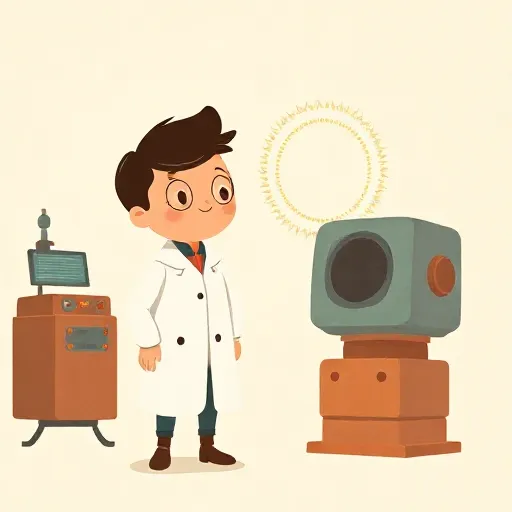
It’s the year 2150. A physicist flips a heavy switch. The device hums. In the center of the lab, a thin ring of blue light appears. This isn’t just a ring—it’s a path through spacetime, the four‑dimensional fabric that combines space and time. If you stepped through it, you’d meet yourself from a few seconds ago, walking out the other side.
That’s the dream of a time machine—but not the kind you see in most science fiction. H. G. Wells imagined a machine you sit in, dial a date, and wait while time rewinds. Physicists call that a Wellsian time machine. The kind they argue about today is a Thornian time machine, named after physicist Kip Thorne (born 1940). It doesn’t whisk a person to the dinosaurs. Instead, it warps spacetime to create closed timelike curves (CTCs)—paths through space and time that loop back on themselves. A particle following one would return to its own past.
General relativity, Einstein’s theory of gravity, says massive objects can bend spacetime. In principle, a clever arrangement of matter and energy could create CTCs where none existed before. The deep question is not just whether such a machine could be built. It’s whether we can ever say the machine caused the loops—and what that tells us about time itself.
What Does It Mean to “Cause” a Time Loop?
You flip the switch. Loops appear. Did the machine make them happen? To answer, we need to know how the universe grows from its past.
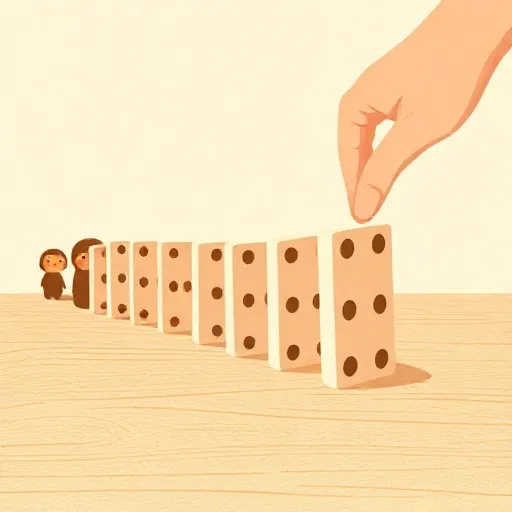
Many physical theories are deterministic—the state of the world at one moment completely fixes later moments, like a chain of dominoes. In general relativity, a snapshot of spacetime with no loops (a partial Cauchy surface) determines everything that happens in a certain nearby region, the future domain of dependence. That’s the zone where cause and effect work cleanly.
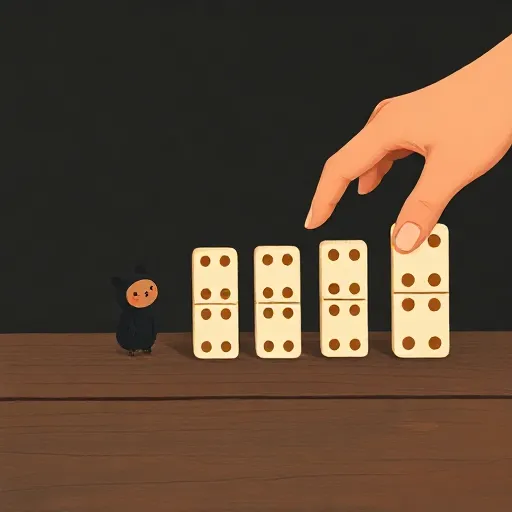
But when CTCs pop up, they sit outside that deterministic zone. The past no longer forces a single future. Instead, many different futures, some with different loops, are all possible. So you can’t say the machine deterministically caused the loops you see.
Maybe we can settle for a weaker idea: the machine is responsible if every possible extension of the deterministic region contains at least some CTCs. That would mean the earlier state forces loops to appear, even if the details aren’t fixed. Physicists also demand that the boundary where predictability ends—the future Cauchy horizon—be compactly generated. Roughly, if you trace the light rays that make up that boundary backward, they stay inside a finite region. It’s as if the seeds of the loops were planted in that finite spot.
In a model called Misner spacetime, before a certain time everything is ordinary, but then light cones “tip over” and loops eventually bloom. The horizon is compact, so it looks like the earlier state planted the seeds. Yet even that isn’t enough to prove causation, as we’ll see.
Hawking’s Chronology Protection: A Wall You Can’t Cross
Stephen Hawking (1942–2018) proved a famous theorem. If the future Cauchy horizon is compactly generated and if energy never becomes negative (a rule called the weak energy condition), then the starting partial Cauchy surface must be compact—that is, the universe must be closed, not infinite. In an open, infinite universe you can’t have a compactly generated horizon, so you can’t get a time‑machine scenario that way. Time machines are ruled out in an infinite cosmos.
What about a closed universe? Hawking showed that then the light rays on the horizon would have zero stretching and shearing. He took that to mean no observer could cross the horizon into the loop region. Even if loops formed, the operator could never reach them. The machine would be useless.
That’s a strong no‑go result for classical general relativity. But it depends on the weak energy condition, which some exotic kinds of matter might violate. And it assumes the horizon must be compactly generated, a condition whose necessity is still debated.
Krasnikov’s Sly Move: The Universe Without Loops

A deeper challenge comes from Russian physicist Sergei Krasnikov. He showed that for any spacetime that has CTCs and obeys local physical laws, you can build a larger spacetime—a maximal extension—that satisfies the same laws but contains no CTCs in the future of the original starting surface. Think of it this way: imagine your machine seems to make loops appear. But you could embed the whole deterministic region into a bigger universe that simply has no loops. That bigger universe is just as lawful. If that’s always possible, the machine didn’t really cause any loops; the loops in the original spacetime are just an illusion of having cut off the universe too soon.
The only escape is to add a “no holes” rule: the spacetime must be hole‑free, meaning you can’t artificially extend it by filling in missing points. But finding a hole‑freeness condition that works is tricky. Physicist Robert Geroch’s original definition even ruled out ordinary flat spacetime. Newer definitions might help, but it’s still an open question whether a reasonable no‑hole condition can rescue the idea that a time machine caused the loops. Without one, the whole concept of a Thornian time machine threatens to collapse.
Quantum Sneak‑Peeks: Loops in the Very Small

Maybe quantum physics changes the game. Quantum fields on curved spacetime can violate the weak energy condition, so classical no‑go results might not apply. But when physicists tried semi‑classical quantum gravity—feeding the average energy of quantum fields back into Einstein’s equations—a new obstacle appeared. The Kay‑Radzikowski‑Wald (KRW) theorem showed that at the chronology horizon the standard way to calculate energy breaks down; it becomes infinite and can’t be fixed. That means semi‑classical theory fails right where loops would form. We need a full quantum theory of gravity, like string theory or loop quantum gravity, to know what really happens.
Those approaches haven’t settled the question. Some versions may forbid CTCs; others might allow them in a quantum form. A different idea, causal set theory, builds spacetime from points connected by cause‑and‑effect links. By definition, no point can be its own cause—loops are simply impossible. So in that picture, time machines are ruled out from the start. The quantum story is still being written.
Why Thinking About Time Machines Matters
The hunt for time machines isn’t just a sci‑fi daydream. It’s tied to the cosmic censorship conjecture, the idea that physics prevents naked singularities and weird causal breakdowns from forming out of ordinary initial conditions. And it’s a powerful test for theories of quantum gravity—the kind that might one day explain the universe at the Planck scale, where space and time themselves might dissolve.
So the next time you wonder whether you could go back and change something, you’re really asking a question that probes the deepest laws of reality. Figuring out why time machines might be impossible could teach us what time, cause, and the universe are made of.
Think about it
- If you could build a device that created a time loop, and you then discovered a bigger universe that explained the loop without using your device, would you still say your machine caused the loop? Why or why not?
- Imagine a universe where time loops sometimes appear, but no single earlier state forces them to happen. Would you still call that universe predictable? What would “predictable” mean?
- If one candidate theory of quantum gravity bans time loops while another allows them, how would you decide which theory is more likely correct?