What If Causes Could Run Backwards in Time?
A Room Where Distance Didn’t Matter
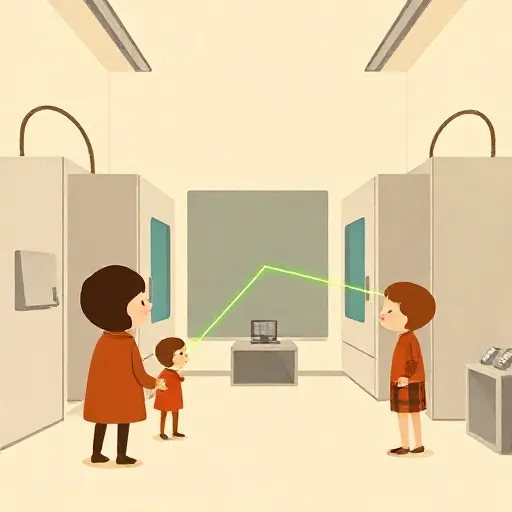
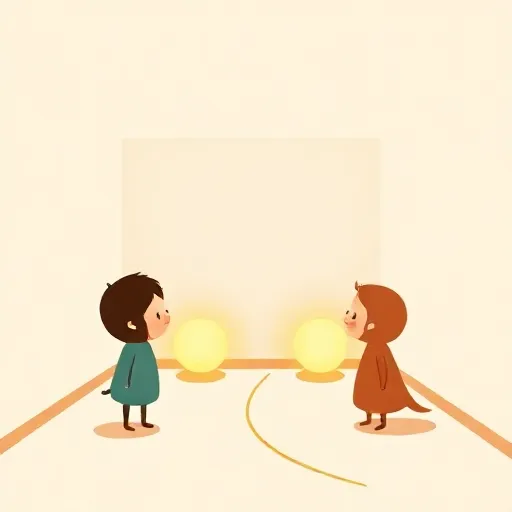
On a chilly morning in 1982, physicist Alain Aspect stood in a basement lab in Paris and watched a number flash on a screen. He and his team had just fired a laser into a crystal, splitting light into two entangled photons — tiny particles of light that were once connected. The photons sped off in opposite directions to detectors fourteen meters apart. When Aspect measured one photon’s polarization (the direction it vibrated), the other photon instantly seemed to match, no matter what angle he chose for the measurement. The two particles acted as if they were still talking to each other, faster than any signal could travel.
Einstein had called this “spooky action at a distance” back in 1935, and he hated it. He thought a complete theory of physics shouldn’t let a measurement at one place instantly affect something far away. Yet Aspect’s experiment, and many since, confirmed that the world really works this way. So how can two particles coordinate without sending a message through the space between them? Some researchers began to wonder: what if the message travels backward in time?
The Zigzag Idea: A Postcard to the Past
The idea that the future could reach back and nudge the present first crept into quantum physics in the 1940s. Back then, the American physicists John Wheeler (1911–2008) and Richard Feynman (1918–1988) were puzzling over a different problem: why an accelerating electron loses energy as it radiates. They proposed that when a charged particle shakes, it sends out waves that travel both forward and backward in time. Any absorber that finally swallows the wave later on fires an answering “advanced wave” that arrives at the particle exactly when it first moved. It felt as if the future absorber was tapping the electron on the shoulder at the moment of emission.
A French physicist, Olivier Costa de Beauregard (1911–2007), saw that this backward-in-time trick could answer Einstein’s spooky action problem. In 1947, he suggested that when you measure one entangled particle, a wave flashes back to the moment the pair was born, then forward to its twin. The influence never jumps across space instantly; it takes a zigzag route through time, like mailing a letter to the past that gets forwarded to the other particle. Costa de Beauregard’s own supervisor forbade him from publishing it at first, calling the idea too crazy. But by the 1950s Feynman’s diagrams had made time-reversed paths respectable, and the zigzag solution was out in the open.
Why Scientists Think Backwards Causes Make Sense
Why take such a wild idea seriously? The first reason is that it opens a loophole in a famous argument called Bell’s theorem. In 1964, John Bell proved that any theory that keeps the usual idea of cause-and-effect — where the future cannot affect the past — must either be nonlocal (allowing instantaneous action at a distance) or give up on local hidden variables (the idea that particles have definite properties before you measure them). But Bell’s proof quietly assumed that the choice of which measurement to make does not influence the particle’s earlier state. He assumed measurement independence. If a future measurement setting can retrocausally nudge the particle’s hidden state in the past, Bell’s argument no longer holds. You could have a theory where influences travel only along timelike paths (no faster than light) and still explain the spooky correlations. That prospect excites physicists who want to keep the universe local and law‑abiding.
A second motivation comes from time itself. The basic equations of quantum physics and the Standard Model of particle physics are time‑symmetric: they work exactly the same if you run the movie backwards. Yet in everyday life, causes always come before their effects. Where did the one‑way arrow come from? If the underlying laws don’t forbid it, some philosophers argue, backward‑in‑time causal influence should be possible at the deepest level of reality. In fact, if you assume that quantum states are something real and that experiments can be prepared and measured symmetrically, time‑symmetry seems to require retrocausality. Put simply, the world may not care about our habit of putting causes before effects.
The Handshake Through Time

The most fully built retrocausal picture is the transactional interpretation, developed by John Cramer (b. 1934) in the 1980s. Cramer borrowed Wheeler and Feynman’s old idea and applied it directly to quantum particles. In his picture, when a source — say, an excited atom — is about to emit a photon, it sends out an “offer wave” that ripples both forward and backward in time. When that wave eventually finds an absorber that can swallow the photon, the absorber fires back a “confirmation wave” that also travels both directions, arriving back at the source at the very instant of emission.
The source and absorber then perform a kind of invisible handshake, trading offer and confirmation waves again and again until the energy transfer is complete. From our time‑bound perspective, we only see the finished handshake: a single photon zipping from source to detector. But Cramer said the real action happens in a “pseudotime” that doesn’t line up with our ordinary clock. The wavefunction — the mathematical description of a quantum particle’s possible states — is the offer wave. What we call the “collapse” of the wavefunction is just the moment the last handshake grips. In this view, the universe is constantly sealing deals between past and future, and we only notice the final receipts.
But Can We Catch a Backwards Cause?

No idea this strange escapes sharp criticism. A classic worry is the bilking argument: if an effect happens before its cause, couldn’t you see the effect and then stop the cause? That would break the supposed connection. The philosopher Michael Dummett showed that this trap only works if you can know about the past effect independently of the future cause — and in quantum mechanics you often cannot. To check whether a particle really was influenced by a future measurement, you have to poke it, and that poking disturbs it so much that you ruin the very correlation you hoped to catch. The past state remains hidden, so bilking is impossible.
A deeper challenge is fine‑tuning. Retrocausal models must be arranged so that backward‑in‑time influences never let you send a readable signal into the past. If you could, you’d get paradoxes like telling yourself not to send the message. In the models, the backward effects always cancel out exactly — a bit like two equal but opposite forces that produce no movement. Critics argue that such perfect cancellation looks suspiciously like cheating, a mathematical accident. Defenders reply that nature’s laws might simply force this balance; it’s not an accident but a built‑in lock.
The toughest recent blow comes from a 2018 no‑go theorem. Philosophers Sally Shrapnel and Fabio Costa proved that even theories with exotic causal structures — including retrocausality — still have to be contextual. That means the outcome of a measurement still depends on the whole setup, not just on a particle’s pre‑existing properties. In other words, backwards causes don’t let you have a purely classical, pre‑determined world; strangeness survives. Retrocausality may soften some quantum puzzles, but it doesn’t turn them into ordinary physics.
Why This Still Matters to You
You have probably never felt a photon tugging on your past, but the hunt for retrocausality touches the deepest questions about the world you live in. If the future can truly nudge the present, then time is not a simple one‑way river. It might be more like a landscape where past, present, and future all exist together, and our feeling of “now” moving forward is just a limited view from inside. This idea could help physicists finally stitch together quantum theory and Einstein’s relativity into a single picture of the universe.
Young thinkers like you will inherit this puzzle. The debate over backwards causes is a reminder that even our most basic assumptions — that effects follow causes, that time flows forward — can be questioned. The philosophers and scientists who chase retrocausality are not sure they are right. But they suspect that to make sense of the tiniest pieces of reality, we may need to rethink the one rule that seems most obvious.
Think about it
- Imagine you get a letter from your future self that says “You will not mail this letter.” If you then decide not to send it, did the future cause you to choose that? What happens if you tear it up without reading it?
- If every event, past and future, were already fixed like frames in a movie, would the idea of “making a decision” still mean anything? Why or why not?
- Suppose a friend claims she can send a thought from tomorrow into your head today. What kind of proof would convince you it’s real backwards causation, not just a lucky guess?