Does Physics Need Cause and Effect, or Just Equations?
A Pebble and a Puzzle
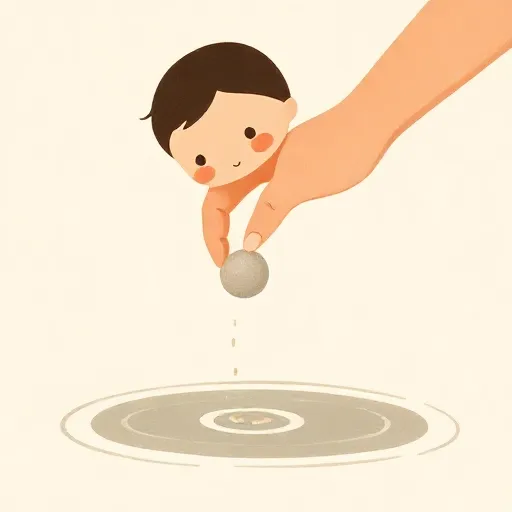
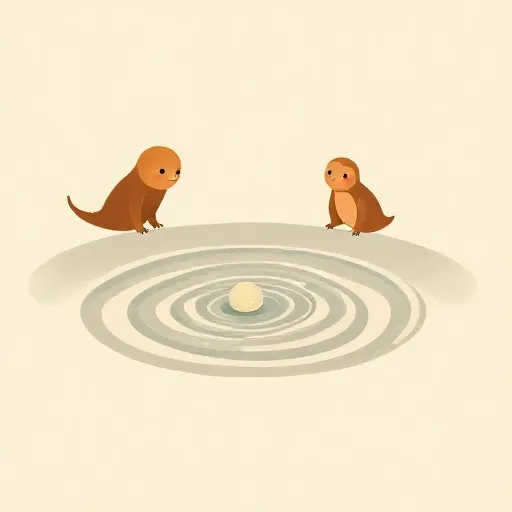
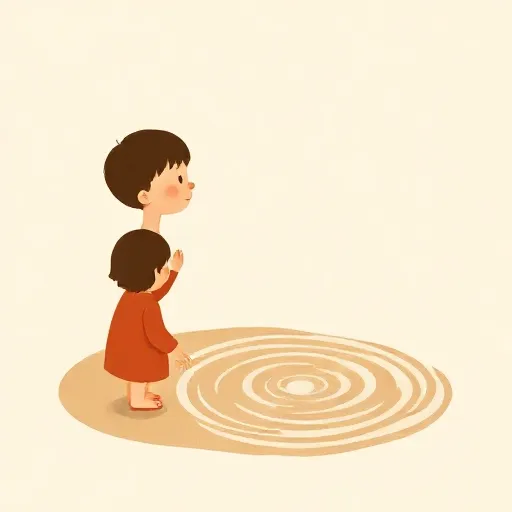
Imagine you’re standing by a pond on a warm afternoon. You toss a small pebble into the water. Instantly, ripples spread outward in perfect circles. To you, the pebble caused the ripples. That feels obvious.
But is it? Physics describes ripples with an equation — the wave equation — that is time‑reversal invariant: it works exactly the same whether time runs forward or backward. The math says a set of ripples could just as naturally shrink into a pebble. Physics doesn’t say which direction is cause and which is effect.
That puzzle sits at the heart of a debate that has been running for over a century. Some philosophers and physicists, most famously Bertrand Russell (1872–1970), argue that the very idea of cause and effect has no place in fundamental physics. Russell put it bluntly: in the motion of mutually gravitating bodies, there is nothing that can be called a cause and nothing that can be called an effect; there is merely a formula. Others push back, insisting that we can — and must — talk about causes even in physics. The argument is still unsettled.
Why Can’t Effects Come Before Their Causes?
Probably the most powerful challenge to causation in physics is the time‑asymmetry challenge. We all think causes happen before their effects. A broken window doesn’t cause a thrown rock. But many of the deepest laws of physics — like Newton’s laws of motion or the equations of classical electricity and magnetism — make no distinction between past and future. They work just as well in reverse.
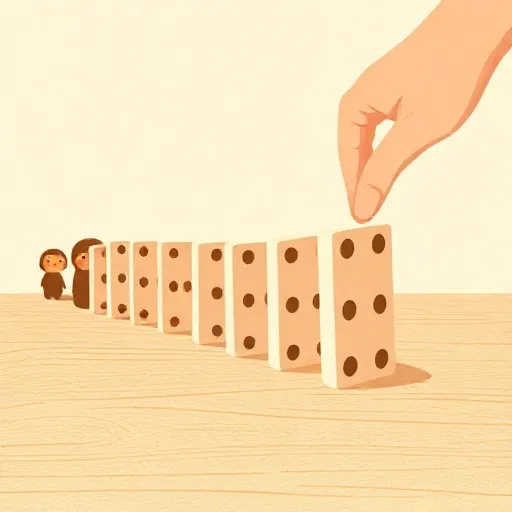
To see the trouble, think about a perfectly elastic collision between two billiard balls. If you know the balls’ positions and speeds right before they hit, Newton’s laws let you calculate exactly where they’ll go afterward. But if you know where they are after the collision, you can also work backward and figure out where they came from. The equations give no reason to say “the earlier state caused the later one” rather than the other way around.
Mathematically, you can describe a wave on a pond using something called a Green’s function — a tool that tells you how the system responds to a tiny disturbance. There are two ways to write that response: a retarded version, where a pebble drop at one moment sends ripples into the future, and an advanced version, where ripples from the future converge on the pebble. Both are correct solutions to the same equation. Physics itself doesn’t pick one as “the real causal story.”
If the laws don’t know which way time flows, how can they contain a one‑way causal arrow? Many philosophers think they can’t. That’s why Russell and others concluded that causation is a human habit of thought, not something written into the universe.
Same Cause, Same Effect — Really?
Another classic worry is the determinism challenge. For a long time, many people thought causation required a principle: same cause, same effect. In a deterministic world, if you know the state of a system right now, you can predict its exact future. If causes are supposed to determine their effects, then physics that turns out to be indeterministic (involving genuine randomness) seems to push causes out of the picture.
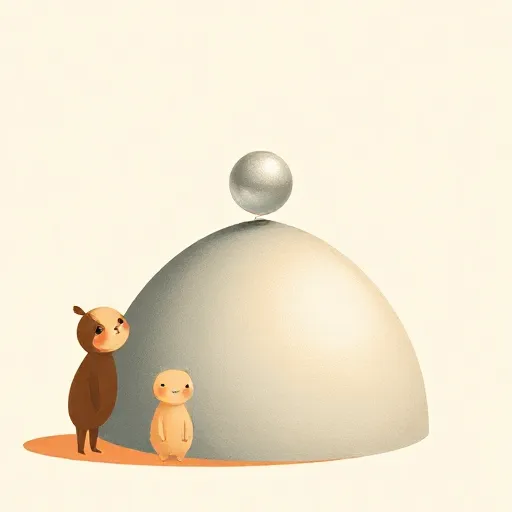
Quantum mechanics is famously probabilistic, but the problem appears even in Newton’s physics. The philosopher John Norton offered a striking example: imagine a marble perfectly balanced on a dome whose shape is described by a special curve. Newton’s laws allow the marble to sit at the apex forever — or, with nothing nudging it, to suddenly begin sliding down at some random moment and in some random direction. The equations have many solutions. Nothing in the set‑up tells you when or why the marble starts to move. There is no cause.
Some defenders of causation reply that true indeterminism doesn’t kill causation; it just forces us to think in terms of probabilistic causation — causes that raise the chances of an effect, rather than guaranteeing it. Others argue that such examples don’t actually belong to Newtonian physics if we properly add the right mathematical conditions. The debate remains open.
Can the Whole Universe Be the Cause?

Even if we accept determinism, another difficulty looms. When you say “the short circuit caused the fire,” you’re picking out one small, local event as the cause. But if you want to predict exactly when and how a fire will start, you need to know far more than the short circuit. You need the oxygen level, the temperature, the material of the walls, every tiny air current — ultimately, the entire state of the world in a huge region of space and time.
In physics, predicting a single event E requires specifying the complete state of the system on a whole “slice” of the past — the backward light cone of E. Nothing less will do. So if a cause is supposed to determine its effect, the cause ends up being the entire universe, not a tidy little event. Russell used this fact to argue that the slogan “same cause, same effect” is either trivially true (if you include everything) or false (if you try to isolate just a few factors).
Philosophers call this the dominant cause challenge. It suggests that picking out the cause is always a pragmatic, context‑dependent move — we highlight whatever factor is most useful for explanation or blame — and that physics itself cannot draw the line between causes and background conditions.
Fighting Back with Interventions and Conserved Quantities
Not everyone is ready to give up on causation. In recent decades, philosophers have built mathematically precise interventionist accounts of causation. The idea is simple: if you can intervene on a variable X (change it without touching anything else) and see a difference in Y, then X causes Y. James Woodward, a contemporary philosopher, and Judea Pearl (born 1936) developed formal systems — called structural causal models — that represent causes as arrows in a network, together with equations for how changing one thing ripples through the system.
These models capture something crucial about our practical grip on the world: they link causation to manipulation and control. Yet there’s a catch. A true arrow‑breaking intervention — one that completely severs all other influences on the variable you want to test — might be physically impossible, especially when we consider the universe as a whole. There’s no “outside” button to press.
Another approach ties causation directly to the laws of physics. Conserved quantity accounts, pioneered by Wesley Salmon (1925–2001) and refined by Phil Dowe (1962–2015), define a causal process as the world‑line of an object that carries a conserved quantity — like energy, momentum, or electric charge. A causal interaction is an intersection where such quantities get exchanged. So when a cue ball slams into another ball, the exchange of momentum is where the causal action happens. This keeps causation rooted in hard physics and supposedly escapes the vagueness Russell complained about. Critics point out, however, that fields (think electromagnetic fields) don’t have neat world‑lines, making the account less natural for much of modern physics.
Why This Still Matters: Your Causal Mind in a World of Patterns
You can’t stop thinking causally. When you say “I made the team because I practiced hard,” or when a doctor says “the virus caused the fever,” you reach for the language of cause and effect. It works. It lets you predict what will happen if you practice less, or if you take medicine. Even physicists, in their everyday work, talk about one particle “producing” another and about detectors “causing” clicks.
So what’s the real fight about? At bottom, it’s about whether cause and effect are baked into the universe or whether they’re brilliant tools our minds have evolved to keep us alive. If the fundamental laws are timeless, symmetric equations, then the world might be a vast, connected pattern with no built‑in arrow of causation. The arrow would come from something else — maybe from the fact that the universe started in a very special, low‑entropy state, which gives time a direction.
That doesn’t make your causal talk empty. It means that when you drop a pebble and watch the ripples, you are using a mental shortcut that’s so powerful it feels like reality itself. The philosophy of causation in physics isn’t finished yet. It goads us to ask whether the world truly contains causes, or whether cause is simply the most successful story we’ve ever told.
Think about it
- If the laws of physics treat past and future the same, why do you feel so sure that dropping a pebble causes ripples and not the other way around?
- Suppose a super‑computer knew every detail of your brain and could predict your every choice. Would you still say you caused your decisions?
- Can you imagine a science that never used the words “cause” or “effect”? What would it be like to explain a broken window or a thunderstorm without those words?