Was Theophrastus Just Aristotle’s Shadow, or Something More?
A School, a Giant Shadow, and a Question
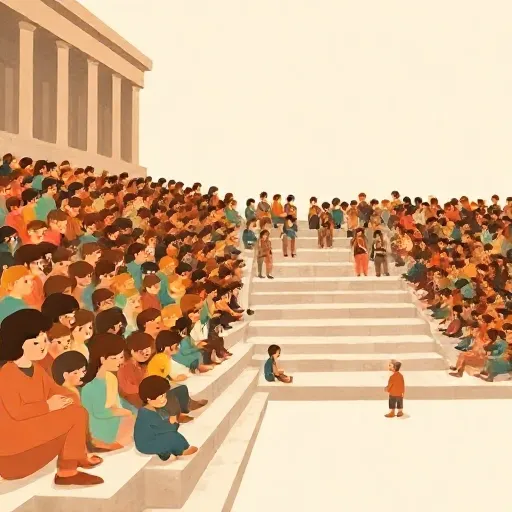
In 335 BCE, Aristotle founded his school, the Lyceum, just outside the walls of Athens. For over a decade, students walked its shady paths, discussing everything from the stars to the soul. When Aristotle died in 322, a quiet, careful colleague took over. His name was Theophrastus (c. 371–c. 287 BCE).
Theophrastus had been born Tyrtamus on the island of Lesbos. Aristotle nicknamed him “Theophrastus” — “divine speaker” — because of his graceful speech. He had studied with Plato, then followed Aristotle across the Aegean, and finally returned to Athens to help build the new school. For the next thirty-five years, he ran it so successfully that one ancient writer claims he once lectured to two thousand people at a time. Students included the comic playwright Menander and the politician Demetrius of Phalerum. When Athens turned hostile to the school, Theophrastus was even prosecuted for impiety and briefly forced into exile. Through it all, he kept the Lyceum going.
But here’s the puzzle that has divided scholars for centuries: Was Theophrastus just a loyal assistant, polishing Aristotle’s ideas and filling in gaps? Or was he an independent thinker who dared to push back against his teacher? Ancient voices disagreed. Boethius described him as a systematizer who ordered Aristotle’s doctrines. The Roman teacher Quintilian reported that Theophrastus “was accustomed to dissent” from Aristotle. The truth sits somewhere in between. Theophrastus never threw Aristotle overboard, but he constantly poked at weak spots, raised hard problems, and sometimes quietly shifted the whole picture.
He used an aporetic method — a style of inquiry that lays out puzzles and conflicting views without always giving a final answer, like a conversation that keeps inviting you to think deeper. He also loved gathering facts: strange fish, chameleons, perfumes, weather signs. For him, careful looking came before grand theories.
A Better Map of How We Think

If you’ve ever tried to prove something step by step, you know syllogisms — three-part arguments like “All humans are mortal; Socrates is a human; therefore Socrates is mortal.” Aristotle had mapped out these patterns carefully. Theophrastus, working with his colleague Eudemus of Rhodes, did more than tidy up. He rearranged some of Aristotle’s figures, added five new syllogisms, and drew sharper distinctions between singular and particular propositions.
Then he went further. Theophrastus introduced what are now called prosleptic syllogisms. These use a special kind of premise that says “Whatever holds of all A, that holds of all B.” It sounds like a tongue-twister, but it let him capture arguments that couldn’t be squeezed into Aristotle’s shapes. He also studied hypothetical syllogisms — “if…then…” patterns like “If it is day, then it is light; it is day; therefore it is light.” Some scholars think his work on these arguments, which resemble rules later called modus ponens and modus tollens, was an early step toward a logic of propositions, though he never built a full system.
In modal logic — the logic of possibility and necessity — Theophrastus quietly changed an idea Aristotle held. Aristotle had tied “possible” so tightly to “not necessary” that they overlapped; Theophrastus separated them. He also said that in mixed arguments, the conclusion must follow the weaker premise. If one premise says “maybe” and the other says “it must be,” the conclusion can only be “maybe.” That tidy rule, known as the peiorem rule, stayed influential for centuries. All this reveals a mind that wasn’t just copying. It was improving, expanding, and sometimes gently correcting a teacher’s favorite tools.
A Universe That Moves Itself

Theophrastus wrote a short, knotty book called Metaphysics. It doesn’t build a tidy system; it piles up puzzles. Why do first principles explain some things so well and leave others mysterious? What if nature isn’t always tidy? He pointed to unruly facts: unusually dry seasons, deer with absurdly large horns, mayflies that live a single day. If everything in nature happens for a purpose, what was the purpose there? He didn’t throw out teleology — the idea that things have final causes — but he urged caution. Sometimes, he suggested, many causes crash together, and asking for a single “why” might be a mistake.
Even bolder, Theophrastus seems to have stepped away from Aristotle’s great cosmic engine: the Unmoved Mover. Aristotle thought the stars moved because they longed for a perfect, changeless being outside the universe. Theophrastus replaced that picture with a single living organism. He used the word sunaphē — “connection” — to say that everything from stars to stones is bound together in a great, layered whole. The cosmos moves because its own parts have motion inside them, like a living body, not because they desire something outside. Scholars debate whether he completely abandoned the Unmoved Mover, but it’s clear he thought the universe needed less outside help.
He also raised trouble for Aristotle’s definition of place as the inner boundary of the surrounding body. If you carry a jar of water, the water’s place changes — but does the water itself? Theophrastus suggested that place might be better understood as a thing’s position inside an ordered whole, like a piece in a puzzle. Whether he offered a full alternative theory is still argued. What’s certain is that he refused to accept problems just because his teacher had.
The Plant Detective and the Family of Living Things

No area shows Theophrastus’s independence more clearly than botany. Aristotle wrote about animals; Theophrastus wrote the first systematic encyclopedias of plants. His two huge works, Enquiry into Plants and Plant Explanations, catalogued more than 550 species. He didn’t just list them. He studied their growth, reproduction, uses, and the effects of climate. He investigated wood, herbs, cereal grains, and the juices and resins that could be drawn from different plants. The history of botany begins with him.
His method was the same curious, fact-hungry approach he used everywhere. He wrote short treatises on sweat, fatigue, dizziness, and fish that hop onto dry land. He thought pneuma, a warm inner breath, ran through the body and linked physical and mental functions. He collected strange phenomena — chameleons changing color, octopuses blending in — not just to wonder at them, but to find explanations that fit each case, sometimes offering several possible causes instead of just one.
Perhaps most surprising was what he thought about animals. According to the philosopher Porphyry, Theophrastus believed there is a natural kinship (oikeiotēs) between humans and other animals. We share flesh, fluids, and sensations. He even claimed animals have a kind of reasoning (logismoi), which Aristotle explicitly denied. Because of that kinship, Theophrastus argued against animal sacrifice. Killing an animal to honor the gods, he said, is an injustice — it robs a creature of its soul and cannot be a proper way to show gratitude or reverence. This didn’t create a full theory of animal rights, but it pulled the line between humans and other living things much closer, turning ethics toward creatures we often treat as mere tools.
Why the Quiet Doubter Still Matters

Theophrastus never built a fortress of conclusions. Many of his writings end with “maybe” rather than “thus.” Yet his influence tunneled through centuries. Epicurus borrowed his principle that natural phenomena often need more than one explanation. Cicero mined his political and rhetorical works to bring Greek thought to Roman soil. Writers who recorded the opinions of earlier philosophers — the doxographers — relied so heavily on his careful summaries that much of what we know about thinkers like Democritus probably reached us through Theophrastus’s lost books.
During the Renaissance, his botanical treatises were translated and printed before many of Aristotle’s. His quirky little book Characters, a collection of thirty funny sketches of irritable types (the gossip, the flatterer, the superstitious man), became the seed of a whole literary genre and later inspired authors like George Eliot. Even today, scholars keep arguing about whether he was an underrated original mind or the greatest footnote writer in history.
But the real legacy is a question for you. What does it mean to carry on someone else’s ideas while still thinking for yourself? Theophrastus shows you can respect your teacher’s work and also push back, gently, with evidence and honest perplexity. He didn’t burn down the school. He just walked through the garden and noticed things everyone else had missed. In a world where we sometimes have to decide when to trust someone else’s answers and when to ask our own questions, that quiet stubbornness is a gift.
Think about it
- If a teacher you respect says something you suspect might be wrong, what would you do? How could you raise the question without being disrespectful?
- Theophrastus thought that sometimes “why” questions don’t have a single final answer — maybe an event just happened because many factors came together. Can you think of something in your life that seems to have no single reason? Does that bother you, or is it okay?
- Theophrastus argued that animals are our relatives and shouldn’t be sacrificed unjustly. Today we still debate using animals for food or experiments. What do you think makes the difference between treating an animal fairly and treating it unfairly?