Were Plato and Aristotle Really Enemies?
A Student Who Criticized His Teacher?

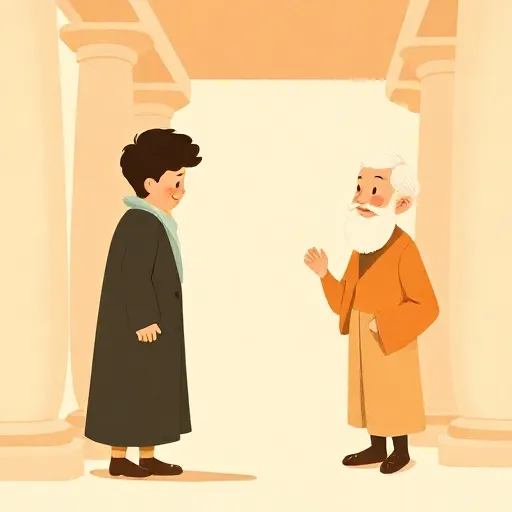
Imagine holding a letter from your closest friend, and in it they say, “Some people believe really foolish things — I don’t.” But then you realize they’re describing an idea you taught them. You would wonder: Did they suddenly turn against me? That is exactly the feeling many readers have when they move from Plato’s dialogues to Aristotle’s books. In one line Aristotle seems to be borrowing from his old teacher, and in the next he seems to be tearing that teacher down.
One philosopher in the sixth century CE refused to believe it. His name was Simplicius of Cilicia (c. 490–560 CE), and he spent his life showing that the two greatest Greek thinkers were secretly on the same side. Born on the southern coast of what is now Turkey, Simplicius first studied under Ammonius in Alexandria, and later under Damascius in Athens. He admired Proclus, the last great head of the Athenian school, calling him “teacher of my teachers.” But in 529 CE the emperor Justinian ordered that no one could teach philosophy or astronomy — a direct blow against the old pagan traditions. Simplicius and six other philosophers left Athens, hoping to find a perfect ruler at the Persian court. When the trip turned sour, a peace treaty let them return safely and to keep their own beliefs. After that, Simplicius poured everything into his enormous commentaries on Aristotle. His mission: to prove that Plato and Aristotle were not enemies, but allies.
The Secret Key: Surface vs. Spirit

How could anyone read Aristotle’s sharp objections and call them friendly? Simplicius had a special key. He thought every important text had two levels: the lexis (the surface, the letter) and the nous (the spirit, the deeper meaning). When Aristotle seemed to attack Plato, he was only poking holes in the surface meaning — the way someone might tease a friend to scare off a bully. The real point, the nous, was the same truth Plato had taught.
Simplicius laid out his ideal of a good commentator. That person needed a mind as big as Aristotle’s, a deep knowledge of all his works, and a habit of staying impartial. The commentator must not, Simplicius wrote, convict the two philosophers of discord by staring only at the lexis; instead, he must look toward the nous and track down the sumphônia — the harmony — that reigns between them on most points. He also insisted that a commentator could criticize Aristotle when necessary. But about Plato? Simplicius never once pointed out a flaw. For him, Plato was the one who had brought the truth to light.
To make sense of this, think of a text message that looks insulting but is really an inside joke. If you only read the words, you miss the affection. Simplicius believed that Aristotle wrote for busy, ordinary readers who might misunderstand Plato. By clearing away the apparent disagreements, Aristotle was actually protecting Plato’s ideas, not destroying them.
The Most Famous Critic: Alexander of Aphrodisias
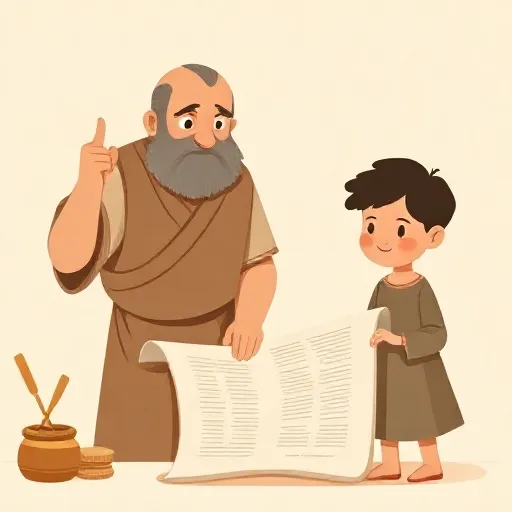
Not everyone accepted this. The sharpest voice against harmony came from Alexander of Aphrodisias (around 200 CE), the most famous ancient interpreter of Aristotle. Simplicius admired Alexander’s knowledge and called him the “most careful of Aristotle’s partisans.” But he was also deeply frustrated by him. Whenever Aristotle said something that looked like an attack on Plato, Alexander sided with Aristotle and hit Plato’s actual ideas — the nous — not just the surface.
Simplicius once wrote that Alexander “frivolously” contested the thoughts of the divine Plato and tried to refute not only the appearance of what Plato said, but the ideas themselves. He believed Alexander was so loyal to Aristotle that he forgot that Aristotle’s criticisms were only for show. On the other hand, some Neoplatonists, like Iamblichus, went too far in the other direction and claimed that Aristotle and Plato agreed on absolutely everything — even on the tricky theory of Forms. Simplicius steered a middle course: he would not make them identical, but he was certain they were companions. He was even willing to correct Aristotle when Aristotle really was mistaken, staying true to his own motto that truth is dearer than either philosopher.
Saving Philosophy in a Dangerous Time
Why did this matter so much to Simplicius? By his day, the old pagan world was crumbling. After Christianity became the official religion, the emperor’s ban in 529 was meant to silence non‑Christian teachers. A Christian philosopher named John Philoponus made things worse. He knew the Greek books inside out and argued that the harmony idea was a pure fiction. Philoponus pointed out that Aristotle’s refutations were aimed straight at Plato’s own teachings, not at misunderstandings. If he was right, the whole Greek tradition was full of contradictions — and that was exactly the criticism many Christians used to dismiss it.
Simplicius fought back in his commentaries, not by shouting, but by carefully rebuilding the lost harmony. He also saw this work as a kind of worship. At the end of his commentary On the Heavens he calls the whole book a “hymn” to the creator god. For him, studying physics and the structure of the world was a way to purify the soul and draw closer to the divine. Philosophy was not a cold subject; it was a way of life — a path that led, step by step, through amazement at nature all the way to love, truth, and faith. In a time when practicing the old rituals was illegal, the commentaries became a hidden temple.
How Simplicius’s Commentaries Changed History

Simplicius’s dense works did something remarkable: they became a treasure chest of older philosophers. Because he quoted his predecessors at length, he preserved entire chunks of thinkers whose books would otherwise be lost. Without him, we would know far less about Anaximander, Parmenides, or Empedocles — he alone saved about two‑thirds of the direct quotes we have from those Pre-Socratics.
In the Middle Ages, a Dominican friar named William of Moerbeke translated several of Simplicius’s commentaries into Latin. That allowed thinkers like Thomas Aquinas to read them. Thomas found in Simplicius a way to describe Aristotle as the master of the natural world and Plato as the master of things beyond nature — two perspectives that could live together. The idea of a harmony between the two giants rippled through the Renaissance and into the Arabic tradition. Scholars argued about it for centuries. Some accepted it; others pushed back. But the conversation itself was powered by Simplicius’s patient attempt to read old texts with generosity.
Reading Between the Lines Today

You probably aren’t planning to write a commentary on Aristotle tomorrow. But you will run into moments where someone says something that seems to attack a person or an idea you care about. It could be a friend, a text message, or a heated online debate. Simplicius offers you a quiet challenge: pause before you decide that two voices are enemies. Ask whether the words you hear are only the surface, and whether a deeper, friendlier meaning might be hidden underneath.
That doesn’t mean pretending all disagreements are fake. Some differences are real and important. But the habit of looking for the nous — the spirit behind the letter — can keep conversations alive that would otherwise die. When you pick up an old book, or listen to a point of view that seems jarring, you are taking a step into a tradition that Simplicius helped save: the long, careful work of finding harmony without erasing what makes each thinker unique.
Think about it
- If you found a note from your best friend that seemed to make fun of your ideas, how could you check whether they were really angry or just using a private joke you didn’t catch?
- Simplicius believed that many apparent disagreements melt away when you look beneath the words. Do you think every clash of opinions has a hidden harmony, or are some divides too big to bridge?
- Imagine a historian in a thousand years finds an online argument between two modern voices. What clues could help them decide whether the fight was about real ideas, or just about words?