
Do Words Really Make Things Happen? The Philosophers Who Say Yes
The Day You Said “I Do” (or Didn’t)

Imagine a wedding. The couple stands at the altar, everyone is holding their breath. Then the officiant says, “I now pronounce you married.” Before those words, they were not married. After, they are. The words themselves didn’t describe a change — they made it happen.
This is puzzling. Normally, we think of words as describing reality: “The sky is blue” is true if the sky happens to be blue. But “I now pronounce you married” doesn’t seem to be describing something that already exists. It’s more like pushing a button that changes the world.
Philosophers call this kind of act a speech act. It’s not just any talking—whispering nonsense or saying “hello” to your cat isn’t a speech act. A speech act is when you do something purely by meaning something in a certain way: promising, betting, ordering, asking, thanking. The British philosopher J.L. Austin (1911–1960) was the first to really put this puzzle on the map. He noticed that many sentences that look like statements are actually doing something entirely different. And that observation opened up a whole new way to think about language, power, and even social justice.
What’s Really Going On: Force vs. Content

Take the sentence “The door is shut.” You can use it to assert a fact (if you just noticed it), to ask a question (“Is the door shut?”), or to command someone (“Shut the door!”). The basic propositional content — that the door is closed — stays the same. What changes is the illocutionary force: the kind of act you’re performing.
Austin and later philosophers like John Searle (1932–) argued that every speech act has two layers. The content is the idea being communicated. The force is what you’re doing with that idea. The Finnish philosopher Erik Stenius (1911–1990) offered a handy analogy from chemistry. A radical is a set of atoms that can’t exist on its own, like a bunch of carbon and hydrogen atoms waiting to be part of something bigger. A functional group is how those atoms are arranged in a compound, and that arrangement gives the compound its special properties. In the same way, content is like the radical — inert by itself. Force is the functional group — it determines whether you’re making an assertion, a question, or a command.
This distinction explains something weird: you can’t tell just from hearing someone’s words what speech act they’re performing. If you overhear “You’ll be more punctual tomorrow,” is that a prediction or a threat? You need context, tone, and the relationship between the speakers. The force isn’t stamped on the sentence itself.
When Things Go Wrong: Misfires and Abuses

Not every attempt at a speech act succeeds. Austin catalogued the many ways they can go haywire. A misfire is when the act fails completely. You can’t christen a ship “The Noam Chomsky” if you’re just a random person on the dock — you lack the authority. You can’t bet someone a hundred dollars on the election if they say “No thanks” — the bet requires their uptake, their acceptance.
Then there are abuses: the act happens, but something is still off. If I say “I promise to meet you for lunch” with zero intention of showing up, I’ve still made a promise. But that promise is insincere. Sincerity is a felicity condition — a requirement for the act to be done properly, not just to fire at all. As Austin put it, a speech act can go well (felicitous) or poorly (infelicitous) in dozens of ways, and each type of act — promising, appointing, apologising — has its own checklist.
The American philosopher H.P. Grice (1913–1988) later argued that even beyond conventions, what makes a speech act work is the speaker’s intention and the hearer’s ability to recognize it. If you try to promise but nobody grasps your intention, the promise doesn’t take hold. We’ll come back to that.
Two Ways Words Match the World

Imagine a husband sent to the grocery store with a shopping list. Unbeknownst to him, a detective trails him, making her own list of what he buys. At the checkout, the two lists are identical: milk, bread, eggs. But their roles are opposite. The husband’s list has world-to-word direction of fit: the groceries are supposed to match the list. The detective’s list has word-to-world direction of fit: her list is supposed to match the groceries.
Speech acts have direction of fit too. Assertions and predictions aim to describe reality (word-to-world). Commands and promises aim to shape reality (world-to-word). When you say “Close the door,” the world is supposed to change to match your words. When you say “The door is closed,” your words are supposed to match the world.
This idea, developed by Elizabeth Anscombe (1919–2001) and later Searle, helps sort speech acts into types. But not all acts fit neatly. Thanking someone or cheering “Go team!” doesn’t seem to have either direction in an obvious way. Some philosophers call this a “null” direction of fit. Still, the core insight stands: different speech acts relate to reality in fundamentally different ways.
The Hidden Meaning: How Intentions Shape What Words Do
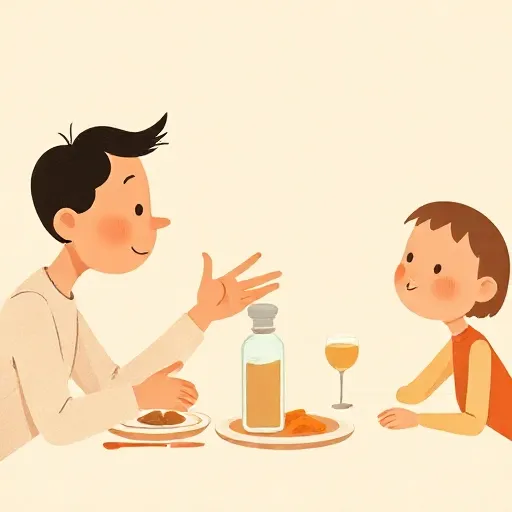
Why do you understand “Can you pass the salt?” as a request, not as a quiz about your arm length? This is where speaker meaning comes in. Grice distinguished between natural meaning (clouds mean rain) and the kind of meaning people create when they communicate. For speaker meaning to happen, you need more than just an intention to get someone to believe something. You need what Grice called a reflexive communicative intention: you intend for your hearer to recognize your intention, and you intend that this recognition is part of what produces the effect.
Imagine you secretly plant a handkerchief at a crime scene to make the police think the owner is guilty. You intend to influence their beliefs, and you even intend that they recognize your intention? No — you hope they don’t see through the trick. That’s not speaker meaning. Now imagine teasing a friend by leaving a clue so obvious that they’re meant to catch you in the act. That’s getting closer. Genuine speaker meaning requires overtness: you’re wearing your intention on your sleeve, and you want the other person to see it.
This idea of overt commitment shows up in how speech acts bind us. When you assert something, you open yourself to the challenge “How do you know?” You take on a responsibility. When you merely guess or conjecture, you’re still liable to being wrong, but the burden is lighter. Different forces come with different norms — rules about what the speaker can rightfully be asked and how they must respond. The force isn’t an extra ingredient sprinkled on top of content; it’s a pattern of accountability.
Why This Matters: Who Gets to Speak?

So far we’ve described a tidy world where every speaker can just perform speech acts at will. But real life is messier. The philosopher Rae Langton (1961–) and others have argued that social patterns can deprive whole groups of people of their ability to perform certain speech acts — a phenomenon called illocutionary silencing.
Consider refusing. Refusing an unwelcome advance is a speech act. But if a culture teaches large numbers of people that “no” doesn’t really mean no — that it’s just a script or a formality — then the refusal misfires. The would-be refuser’s words are still meaningful, but the act of refusal doesn’t take hold because uptake is systematically denied. In extreme cases, a person might be physically able to say the words but unable to make the speech act happen. This isn’t a failure of intention on the speaker’s part; it’s a failure of the audience to grant the act its proper force.
A similar mechanism operates in dogwhistling. A politician says “I oppose Dred Scott,” a Supreme Court decision about slavery. To most listeners, that sounds like an anti-racist statement. To a small “in‑the‑know” audience, it is also a code for opposing abortion rights, because a certain legal argument connects the cases. The speaker manages to mean two different things to two different audiences, and one of those meanings is deliberately hidden. This challenges the idea that communication must be completely overt and shows how speech acts can be used to manipulate public conversation.
None of this means speech acts are hopelessly broken. It means the tools Austin and his successors gave us — force, felicity, uptake, speaker meaning — help us see clearly how language can both empower and disempower. The next time you say “I promise” or hear “I now pronounce you,” you’re not just watching words fly through the air. You’re watching a delicate machine of commitment and recognition clicking into place — or failing to.
Think about it
- If you whisper “I bet you my lunch” to a friend on a crowded bus and they don’t hear you, have you made a bet? What would need to change for that bet to count?
- Could someone be perfectly sincere about a promise but still fail to commit themselves because the promise itself is impossible to keep? Why or why not?
- If a whole community gradually stops treating a certain group’s orders as real orders, at what point would you say those people have lost the ability to command — not just the permission, but the actual power of speech?