What Do You Really Mean? The Secret Life of Words
You Say You’re Busy, but What Are You Really Saying?
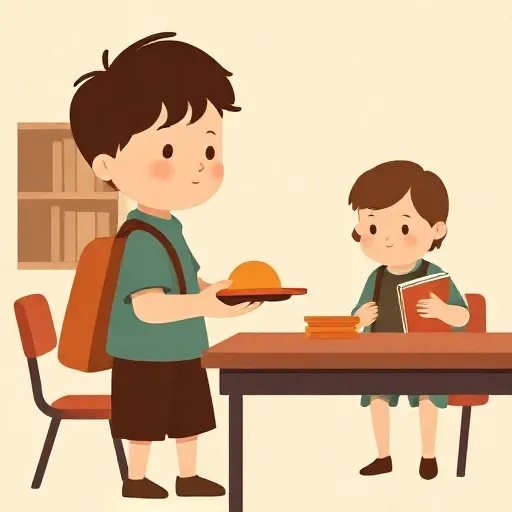
You text your friend: “Want to grab pizza after school?” She replies, “I have a huge history project due tomorrow.” You don’t reply “So, is that a yes or a no?” You understand instantly: she can’t come. But how did you know? She never typed the word “no.”
This everyday magic is what philosophers of language call pragmatics — the study of how we use language to do more than just state facts. Words have dictionary meanings, but when we talk to each other, we rely on a hidden system of shared rules, intentions, and context to figure out what someone really means. Without pragmatics, every conversation would be a guessing game. With it, we can promise, joke, warn, and politely refuse without ever saying it directly.
In the mid‑20th century, two philosophers kicked off a revolution in how we think about talk. J. L. Austin noticed that words don’t just describe the world — they act in it. H. P. Grice then showed that we constantly mean more than we literally say, and we all follow invisible rules to decode each other. Their ideas still shape how linguists, psychologists, and even computer scientists think about communication.
Austin: When Words Are Actions

J. L. Austin (1911–1960), a British philosopher, began with a simple observation. Look at a sentence like “I promise to pay you back tomorrow.” It isn’t just true or false like “The sun is a star” is. When you say “I promise,” under the right conditions, you actually do something — you make a promise. The words themselves perform the act. Austin called such utterances performatives, as opposed to constatives (statements that just describe facts and can be true or false). A classic example is saying “I do” at a wedding: those two words, in that setting, actually marry you.
Austin soon realized the line between performatives and constatives was blurry. Even a plain statement like “There’s a scary dog over there” can be a warning. So he developed a three‑part picture of what happens when we speak. Every speech act involves a locutionary act (the basic act of saying words with a certain meaning), an illocutionary act (the force of what you’re doing — asserting, promising, ordering, warning), and a perlocutionary act (the effect on the listener — scaring, persuading, flattering). When you say “Could you pass the salt?” the locution is a question about ability, but the illocution is a polite request, and the hoped‑for perlocution is someone handing over the salt.
Austin’s student John Searle expanded this into a full theory of illocutionary acts, sorting them into five big families: assertives (claiming something is true), directives (getting someone to do something), commissives (committing yourself to do something), expressives (sharing a feeling), and declarations (changing reality just by speaking, like “You’re fired!” or naming a ship). To promise, for instance, you have to sincerely intend to do something, and the listener has to understand that you’re taking on an obligation. The key idea: the meaning of an utterance is not just its literal content, but the action it performs, and that depends on shared social conventions.
Grice: How We Read Between the Lines

H. P. Grice (1913–1988) was fascinated by the gap between what our words literally say and what we intend to communicate. He called the extra meaning an implicature. Imagine this scene from Grice’s own work: A and B are chatting about their friend C, who works at a bank. A asks how C’s job is going. B replies, “Oh, fine, I think. He likes his coworkers, and he hasn’t gone to prison yet.” Literally, B just said C hasn’t been jailed so far. But we immediately pick up a darker message: C might be the kind of person tempted to steal from the bank, and B is hinting at that. That’s an implicature.
How do we jump from the literal words to that extra meaning? Grice argued that conversation runs on a basic understanding he called the Cooperative Principle: make your contribution fit the purpose of the talk exchange. This principle unfolds into a set of maxims — guidelines we all follow, usually without thinking:
- Maxim of Quantity: Give just the right amount of information — not too little, not too much.
- Maxim of Quality: Try to be truthful; don’t say things you believe are false or lack evidence for.
- Maxim of Relation: Be relevant.
- Maxim of Manner: Be clear — avoid obscurity and ambiguity, be brief and orderly.
When someone seems to violate a maxim, we don’t assume they’re crazy. We search for a deeper meaning that makes sense given the shared goal. In the banker case, B’s mention of prison seems irrelevant at first (breaking the Maxim of Relation). But if we assume B is still being cooperative, we figure out that B must be thinking C is potentially dishonest — and wants us to realize that, too. The implicature is calculated in a flash: B said p; there’s no reason to think B’s not cooperating; B wouldn’t say that unless B thought q; B knows I can figure that out; so B meant to communicate q. This reasoning is usually unconscious, but it’s how we navigate subtle hints, irony, and metaphor.
Importantly, implicatures are cancelable — you can add “but I didn’t mean to imply that” and the extra meaning disappears. They are also non‑detachable: if you rephrase the same content in different words, the implicature usually sticks, unless the new wording itself triggers a different inference.
The Secret Rules of Conversation
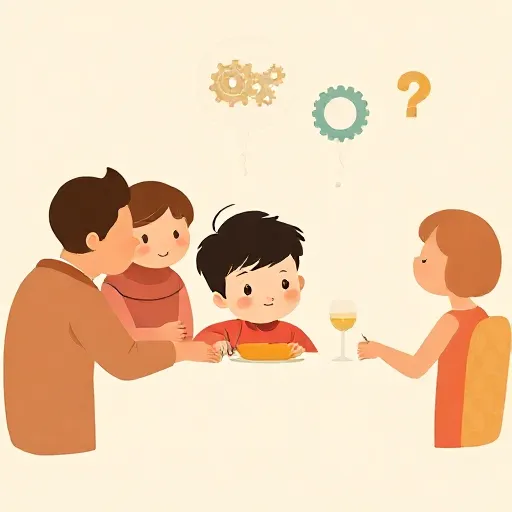
These maxims aren’t laws that everyone obeys perfectly; they’re more like the background expectations that make communication possible. When someone says “Some of the cookies are left,” we infer that not all of them are, because if they were all left, a cooperative speaker would have said “All” (Quantity). When they say “It’s a bit chilly,” we take it as a request to close the window — that’s the implicit relevance. Even toddlers pick up on these patterns.
Grice’s big insight was that meaning is not just a code beamed from one brain to another. It’s a shared project of intention‑recognition. The speaker intends to produce a belief or an action in the listener, and the listener recognizes that intention. That’s why a promise or a hint feels different from a puzzle: you know there’s an intention aimed at you. And it’s why sarcasm works: “Great job,” said with a flat tone after you spill juice, is recognizable precisely because it flouts the Maxim of Quality — you’re not being truthful literally, but the listener catches your real attitude.
Philosophers after Grice, such as Dan Sperber and Deirdre Wilson (developers of Relevance Theory), built on the idea that our minds are tuned to maximize relevance with the least effort. They argued that all communication — from resolving what “he” refers to, to catching a hint — runs on the same inferential machinery: we’re constantly hunting for what matters most and filtering out noise.
Why It Matters: The Hidden Game of Talk

So why should you care about pragmatics today? Because you use it every moment. When you reply “Cool” to a friend’s story, you might really mean “That’s amazing!” or “That’s boring, let’s move on” — and your tone and the situation decide which. When a politician says “We’re looking into it,” the implicature is often that nothing is being done, even though the literal words promise action. Advertisements, too, rely on implicatures: “Clinically proven to reduce wrinkles” doesn’t say it will make them vanish, but many people infer that.
Understanding pragmatics gives you a superpower: you become a better listener and a more careful speaker. You can spot when someone is dodging a question, or when a friend is upset but not saying so. You also learn that meaning is never purely in the words; it’s built together by people in context. That’s a profound truth about how we connect — we are always doing things with words, and we need each other’s minds to make sense of it all.
Next time someone says, “I’d love to, but I have to wash my hair,” you’ll know: they just performed a polite refusal, following rules that have been chiseled into our social brains over millennia. And you’ll get the message, without a single “no.”
Think about it
- Someone says “You’re really good at that” after you make a silly mistake. How do you know they mean the opposite? What if the same words were said after you did something impressive — would the meaning change? Why?
- Imagine a world where everyone always said exactly what they meant, no hints or sarcasm allowed. What would be easier, and what would be harder, about living in that world?
- Can you think of a time when you meant something very different from what you actually said? What clues did you expect the other person to use to figure it out?