How Many Things Are on Your Desk?
The deck of cards puzzle
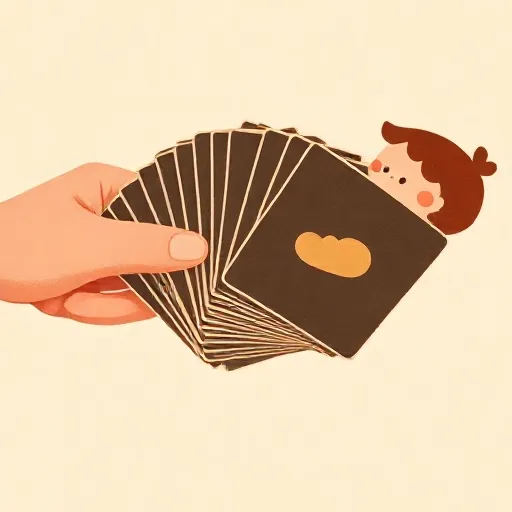
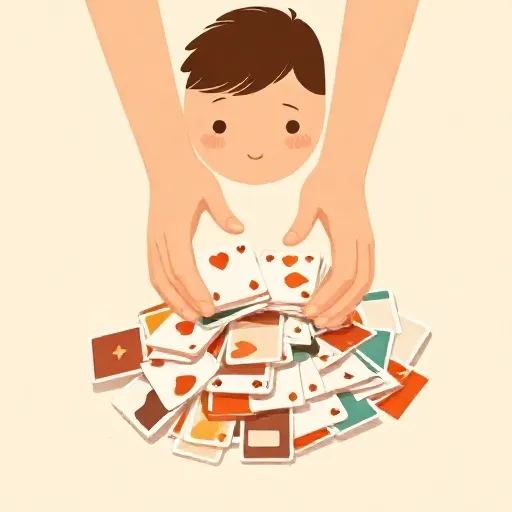
You hold a standard deck of cards in your hand. How many things are you holding? You might say one thing: a single deck. But there are also 52 paper cards, each a separate thing. Are you holding 1 thing or 52 things? Both answers feel correct, and they depend entirely on what—exactly—you decide to count. That small word “what” is the start of a big philosophical idea.
Philosophers call words that tell you what kind of thing you are counting a sortal. The term was invented by John Locke (1632–1704) in 1690, drawn from the word “sort.” A sortal is a word like “deck,” “card,” “cat,” or “mountain.” These words supply a criterion of identity —a rule for when two appearances are the same thing, and when they are different. Without a sortal, counting falls apart. If you try to count “things” without specifying the kind, you might end up counting the same stuff dozens of ways and never finish.
This sounds like wordplay, but it has real bite. The problem of how we divide the world into countable, trackable objects runs through centuries of philosophy, from ancient Athens to modern psychology labs.
Why “stuff” isn’t enough
In the 1670s, the philosopher Baruch Spinoza noticed that you can’t count a penny and a dollar together until you call them both “coins.” Two centuries later, the mathematician Gottlob Frege (1848–1925) made the same point with a sharper edge: something can be counted as one deck or as fifty-two cards, depending on the sortal you use. Frege argued that numbers themselves are objects, and that we need a sortal concept like “deck” or “card” before a number can get a grip on reality.
Not all nouns are sortals. Mass nouns like “water,” “gold,” or “rice” don’t count things — they measure stuff. You ask “how much water?” not “how many waters?”. Sortals, by contrast, are typically count nouns: “dog,” “planet,” “idea.” But the boundary isn’t sharp. Some words, like “chicken,” can be either: you count the chickens in the yard, but you measure the chicken on your plate.
This distinction matters because many everyday words look like sortals but fail the counting test. Philosopher P.F. Strawson (1919–2006) introduced the modern use of “sortal” in 1959, defining a sortal universal as a word that supplies a principle for distinguishing and counting individual things. But he and later thinkers argued that words like “object,” “thing,” or “red item” are not genuine sortals — even though they are grammatically count nouns. Ask “how many red things are on the shelf?” and you might get an infinite answer, because any part of a red thing is also a red thing. Sortals, in contrast, divide their reference cleanly: a part of a cat is not a cat.
The river and the water: identity puzzles

Once you accept that sortals control counting, a wilder claim appears: sortals might also control identity itself. In the 1960s, philosopher Peter Geach (1916–2013) argued that identity is always relative to a sortal. There is no such thing as “being the same” plain and simple; you are the same what? Geach’s famous example: a river and the water in it. The water flowing past a town this afternoon is the same water as the water that flowed past this morning—but it is not the same river, because a river is defined by its channel, its source, its course. You might say the same bronze is first a statue of Lincoln, then melted and recast as a statue of Caesar. Same bronze, different statue.
Geach’s relative identity thesis stirred a major fight. W.V. Quine (1908–2000) replied that there is only one unqualified identity relation. In cases like the statue, Quine would say the bronze is not identical to the statue at all; it constitutes the statue but is a different object. The bronze survives melting; the statue does not. So the two statements (“same bronze,” “different statue”) aren’t really about the same thing, and no relative identity is needed. Most philosophers today lean toward Quine’s side, but the debate remains open, especially in areas like the puzzle of the Christian Trinity (three persons, one substance) or in biology, where an organism’s parts are fully replaced over time yet we still call it the same animal.
A weaker version of the sortal-dependence idea is widely accepted. Even if identity is not relative, the criteria for being the same thing clearly vary by kind. The identity of a set depends on its members; the identity of a cat depends on its continuous life. You don’t check whether your friend is the same person as last year by counting their atoms—you’d get the wrong answer. So sortals carry persistence conditions: rules for how a thing of that kind can change and still exist.
Kittens, cats, and hidden essences

Some sortals stick with a thing for its whole life; others are temporary. Philosopher David Wiggins (b. 1933) drew an important line between substance sortals (like “cat” or “human”) and phase sortals (like “kitten” or “student”). A cat ceases to be a kitten after it grows, but it doesn’t go out of existence. The substance sortal answers the question “What is it?” all the way through.
Wiggins and others pushed deeper. They argued that every individual has an essence — a core what-it-is that determines its persistence. This is called essential sortalism: you are essentially a human, and if you stopped being a human, you would cease to exist entirely. Not all philosophers buy essentialism. Some point out that species themselves may not have crisp essences (ring-species and interbreeding puzzles muddy the biological picture). Others think essentialism works at the individual level even if species are blurry — a particular whale is necessarily a whale, even if the category “whale” has fuzzy edges.
Beyond biology, the same idea runs into trouble with artifacts. Does a car crushed into a metal cube still exist as a car? If you rebuild a garage into a treehouse, is it the same building? Wiggins tried to locate “ultimate sortals” — the most fundamental kind-words that cannot be further broken down — but his system proved murky. As a result, the search for exactly which sortals are the deepest remains unsettled.
Sortals in your mind
Philosophers aren’t the only ones puzzling over sortals. Developmental psychologists have found that babies as young as a few months treat the world as made up of bounded, persisting physical objects — a proto-sortal concept. Researchers like Fei Xu argue that the concept of a physical object works like an early sortal, letting infants track things through time and space before they learn words like “cup” or “ball.” Later, language sharpens those categories, allowing children to master finer sortals like “dog” versus “cat.”
Some experiments suggest that children are natural essentialists: they assume that categories like “tiger” or “gold” have hidden inner natures that explain why things look and behave as they do. This doesn’t mean they know what the essence is; it means they expect there to be one. That expectation might be built into how we learn sortals.
Critics push back. Maybe what looks like sortal tracking in infants is really just perceptual attention to edges and motion — not a concept of kind. And if animals can individuate objects without language, then sortals might not require a full conceptual framework. But the overlap between philosophical theories of sortals and the cognitive science of object perception keeps both sides talking.
Why counting matters
You might never think about sortals again after reading this. But every time you count something — coins, books, people in a room — you rely on a sortal to carve the world at the joints. When you argue with a friend about whether a remixed song is “the same song,” you’re doing philosophy. When you wonder if you’re the same person you were at age five, you’re reaching for a criterion of identity.
Philosophers disagree on almost everything about sortals: what they are (concepts? words? real universals?), whether identity is relative, whether essences exist. That’s not a weakness. It’s a sign that the simplest act of pointing at something and calling it one thing conceals a huge structure of thought — one we are only beginning to understand.
Think about it
-
Imagine you have a pile of sand. You move one grain to a new spot. Keep doing that grain by grain. At what exact moment does the pile stop being “the same pile”? Is there a fact of the matter, or does the answer depend on what you decide to call a pile?
-
If you upload your memories and personality into a robot body, is the robot you? What sortal would you use to decide — “person,” “mind,” “biological human,” something else?
-
Can you invent a situation where counting something correctly gives two different numbers, both right, just because you switched sortals? What’s an example from your own life?