
Is That Desk Really One Thing, or Just a Swarm of Atoms?
What Makes a Thing a Thing?

Run your hand across the desk in front of you. It feels solid. It feels like one thing. But science tells a different story. The desk is made of particles — atoms and molecules — with mostly empty space between them. So what is really there? A single object called a desk? Or just a bunch of tiny things arranged desk‑shaped?
That is the puzzle at the heart of the philosophy of ordinary objects. An ordinary object is something you naturally point to in everyday life: a desk, a dog, a stone, a tree. Philosophers who defend conservatism say those ordinary objects exist — the world really does contain desks and dogs. Other philosophers are revisionary. Some are eliminativists: they deny that ordinary objects exist at all. There are no stones, no tables, no people (or maybe only people). Others are permissivists: they agree that desks exist, but they also think there are many more objects than you ever dreamed of — objects like half‑a‑dog fused with half‑a‑turkey, or objects that wink out of existence the moment they leave a garage. Both groups think common sense needs fixing; they just disagree about how.
The central issue is composition: when do some smaller things team up to form a new, larger thing? For example, when do a bunch of atoms compose a stone? The disagreement runs deep. Let’s walk through the main arguments and see why something as simple as pointing at a desk can open up a storm.
When Does a Pile Become a Stone?
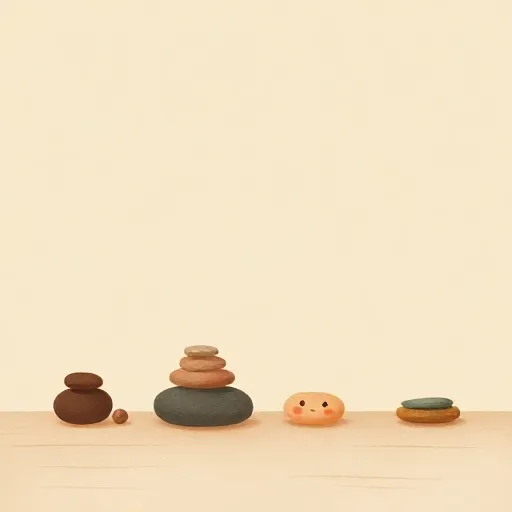
Start with a single atom. That is not a stone. Add a second atom. Still not a stone. Keep adding atoms one at a time. At some point you have something that looks like a stone. But can you ever point to the exact atom whose addition suddenly turned a non‑stone into a stone? It seems impossible. And if no single added atom makes the difference, then you never cross the line. The conclusion? There are no stones.
This is called a sorites argument. (Sorites comes from the Greek word for “heap” — the same puzzle works for heaps of sand.) The argument can be aimed at almost any ordinary object: a mountain, a table, a dog. If you accept it, you land in eliminativism.
One famous reply says that words like “stone” are vague. There is no sharp boundary because there are borderline cases where it is neither clearly true nor clearly false that the thing is a stone. The sentence “That is a stone” can be true in some ways of making the word precise, false in others. So we can still say “There are stones” without needing a sharp cut‑off.
But that move faces a fiercer challenge, known as the argument from vagueness. Suppose you slowly bring a hammer head toward its handle. At first there is no hammer — just two separate things. Eventually they are attached, and you have a hammer. So composition happens sometimes. If it happens, there must be a moment when it goes from not happening to happening. That moment either has a sharp boundary or a vague boundary. A sharp boundary seems absurd — a fraction of a millimeter can’t be what makes a hammer exist. A vague boundary, however, would mean it is indeterminate how many objects exist. At that moment, it would be neither true nor false that there is a hammer, so it would be indeterminate whether there are two things (head and handle) or three (head, handle, and hammer). But is it really possible for the world to be fuzzy about how many things exist? Many philosophers think not, because you can state the number using precise words: “There are exactly two concrete objects.” If that sentence is neither true nor false, something has gone badly wrong.
So the argument forces a dilemma: either composition always occurs (any collection of things makes a further object — universalism) or composition never occurs (nothing ever makes a larger object — nihilism). Common sense lies in the middle, but the argument says the middle cannot stand.
Eliminativists often embrace nihilism. The philosopher Peter van Inwagen (born 1942) once defended the view that there are no composite objects at all — only tiny, partless simples arranged as if there were tables and dogs. Later he made an exception for living organisms, a view called organicism, so that at least you yourself exist. Others, like Peter Unger (born 1942), accept that there are big composite objects filling up space, but they deny that any of them count as ordinary things like tables or stones. They are eliminativists about ordinary kinds, not about composites altogether.
The Statue and the Lump of Clay
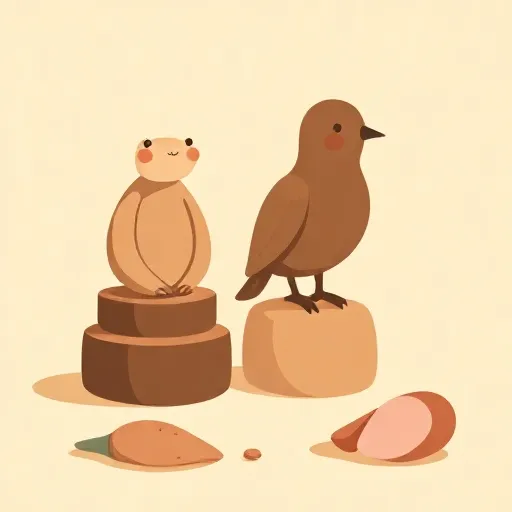
Imagine a clay statue of a bird called Athena. Call the lump of clay that makes it up Piece. Right now, Athena and Piece have exactly the same location, the same weight, the same parts. Yet they seem to have different life stories. If you flatten the statue with a hammer, Athena the bird is destroyed — there is no statue anymore. But Piece, the clay, seems to survive being squashed. So Athena and Piece differ in what they can survive.
That sets up a puzzle. If two things are truly identical, they must share all the same properties (that’s Leibniz’s Law). Since Athena can’t survive flattening and Piece can, it looks like they are not identical. But how can two objects be in exactly the same place, made of exactly the same stuff, yet be two?
Some philosophers, pluralists, bite the bullet: the statue and the clay are two distinct objects that coincide. That solves the puzzle, but it raises a new one: why do they have different survival conditions if they are made of the very same particles? This is the grounding problem. Critics say there is nothing to explain the difference.
Other philosophers, monists, insist Athena and Piece are identical and deny that they have different properties. One monist idea is phasalism: being a statue is just a temporary phase of the clay. When you flatten it, Piece (which is also Athena) survives, but simply stops being statue‑shaped. Another monist idea says dominant kind: when an object belongs to multiple kinds, the kind with the stronger conditions “wins.” Because statue is the dominant kind, Piece cannot survive flattening after all; the clay goes out of existence the moment the statue is destroyed.
This debate matters because almost any ordinary object is made of some material stuff. If the statue and the clay can come apart like this, then your desk and the wood that makes it up might be two things, not one. Some eliminativists, tired of the whole mess, simply deny that statues (and perhaps pieces of clay) exist at all. If there is no Athena, there is no puzzle.
One Desk or a Thousand?
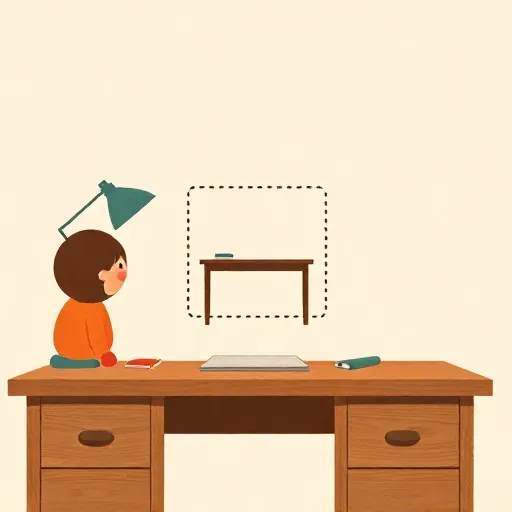
Take the desk in front of you. Now imagine a second object that is exactly like the desk but missing one single molecule right at the surface. Call the original hunk of wood Woodrow and the slightly smaller one Woodrow‑minus. Woodrow‑minus looks like a desk, is shaped like a desk, and has a flat writing surface. If Woodrow is a desk, shouldn’t Woodrow‑minus also be a desk? But if both are desks, then you have two desks in the same spot — and by the same reasoning, you’d have as many desks as there are surface molecules you could leave out. That seems absurd. Yet the intuition that both hunks are equally good candidates for deskhood is strong. This is the problem of the many.
One solution says that being a desk is a maximal property: it can belong only to the largest thing of its kind in a place. Since Woodrow is larger than Woodrow‑minus, Woodrow is the desk and Woodrow‑minus is not, even though Woodrow‑minus would be a desk if the larger one didn’t exist. This respects the idea that there is exactly one desk.
Another solution comes from the pluralist view about constitution. The desk is not identical with any hunk of wood at all. Rather, the desk is constituted by Woodrow, but it is not the same object as Woodrow. Woodrow‑minus is not a desk because it does not constitute the desk; only the larger hunk does. So again, exactly one desk exists.
Things get trickier when we add vagueness. Suppose the molecule is only barely attached, so it is a borderline part. Then it is indeterminate whether Woodrow or Woodrow‑minus constitutes the desk. Some pluralists say that still there is exactly one desk — it is just indeterminate which hunk constitutes it. That lets them hold the line against the many‑desks conclusion.
The problem of the many shows that tiny puzzle pieces about parts can multiply quickly. Permissive views about parts — for instance, the idea that every sub‑region of a thing contains a part — would make the explosion of objects enormous, and many philosophers find that highly uncomfortable.
Why It Still Matters: Ships, Bikes, and You

These arguments are not just about desks and statues. They sneak into how you think about everything that changes over time. A famous example is the Ship of Theseus. The ancient ship had its planks replaced one by one until no original wood remained. Later, someone collected all the discarded planks and rebuilt a ship exactly like the original. Which one is the real Ship of Theseus? It seems there is no fact of the matter — and yet we feel there should be.
You face a tinier version of this puzzle when you swap the wheels on your bike, or when a cloud shifts its shape. If your body replaces nearly all its cells over years, are you still the same person? (That’s a question for another day, but it starts right here, with ordinary objects.)
So why does this debate matter if you can still sit at your desk and do your homework? Because it forces you to ask what makes anything that thing. Are objects just convenient labels we slap on clouds of atoms? Could there be hidden objects all around us that we simply never learned to notice? The next time you point at something and say “that’s a rock,” you are taking a stand in a fight that has run for centuries — often without anyone realizing it.
Think about it
- If you replace every part of your bicycle over a year, is it still the same bike? What if someone reassembles the old parts into a bike — which one is your original?
- Imagine a cloud that constantly loses and gains water droplets. Is there a moment when it stops being the same cloud? Is there a right answer?
- Suppose a scientist tells you that tables are just collections of particles and there is no “table” beyond that. Would you stop believing in tables? Why or why not?