

Is a Table Really a Table, or Is It All Just Sounding Smart?
The Argument in the Living Room

Imagine two friends, Maya and Leo, standing in a living room. Maya taps the wooden coffee table in front of them. “This is obviously a table,” she says. “I can put my drink on it.” Leo shakes his head. “All I see are millions of tiny particles—atoms, or whatever—arranged in a flat rectangle. There’s no extra ‘table’ thing sitting on top of the particles. You’re just seeing a bunch of simple pieces.” Maya rolls her eyes. “That’s ridiculous. You’re just trying to sound clever.”
This is more than a silly fight. Philosophers have had exactly this kind of debate for centuries. The question is known as the composite-object question: do objects with proper parts—like tables, cats, and rocks—really exist, or are there only the tiniest parts that we describe as a table? But here’s the twist. Some philosophers say the real problem isn’t about tables at all. They think the entire argument is somehow wrong—that Maya and Leo aren’t actually disagreeing about the world. They might be using words differently, or the question might have no true answer, or one side might be stating something so obvious it’s not worth arguing about. The study of what is wrong with a metaphysical question—and whether anything is wrong at all—is a branch of thinking called metametaphysics. And it asks: are our deepest debates about reality, or are they just fancy wordplay?
Two Levels of Realism: Tables vs. Questions
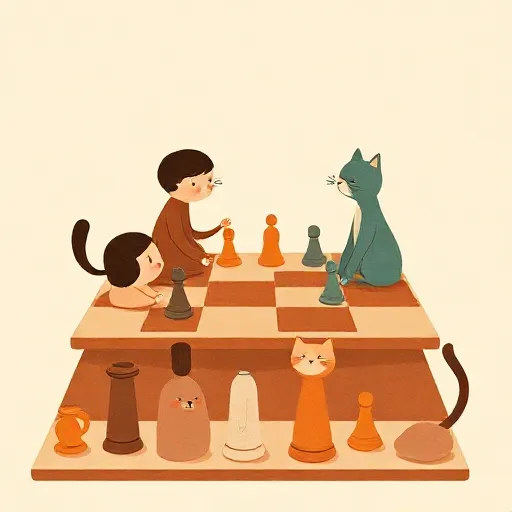
Before we can decide whether the argument is broken, we need to keep two different kinds of realism apart. This can feel like keeping two floors of a building straight.
On the ground floor, you have realism about tables (or realism in metaphysics). A realist about tables says, “Yes, composite objects like tables really exist.” The opposite view is called nihilism—the idea that only simple, part-less objects exist, and tables are just a useful fiction. That’s the fight between Maya and Leo.
On the upper floor, you have realism about the question itself. A realist about the composite-object question believes it is a deep, important puzzle about reality, with a true answer that isn’t obvious and doesn’t depend on how we talk. An anti-realist about the question claims that something is wrong with it: maybe the question is trivial, maybe it’s just a verbal mix-up, or maybe there’s no fact of the matter at all. The surprising insight of metametaphysics is that you can be a realist about tables but an anti-realist about the question. You might say, “Obviously tables exist, that’s a boring fact—this whole debate is a waste of time.” And you could be a nihilist who thinks reality has no tables, yet still be a thoroughgoing realist who believes the question is a profound discovery about the universe. The first floor and the second floor don’t have to agree.
Trivialism: The Answer You Already Knew

The first kind of anti-realism is trivialism. A trivialist thinks that a metaphysical question does have a clear answer, but that the answer is utterly boring—like the fact that all bachelors are unmarried. It is settled not by deep facts about hidden reality, but by the meanings of our words plus everyday observations nobody disputes.
Consider the composite-object question. A trivialist view called Trivialist Tableism says this: we all agree that there are simples arranged tablewise—that is, tiny particles stuck together in a table shape. Even nihilists don’t think we are hallucinating when we look at a table; they just think what we are seeing is a swarm of simples, not a single extra object. Now, the trivialist adds a claim about language: in ordinary English, the sentence “There is a table” is already true whenever there are simples arranged tablewise. So the existence of tables is guaranteed by the arrangement of particles we can see with our own eyes. The question becomes as exciting as asking whether a triangle has three sides.
Philosophers like Rudolf Carnap (1891–1970), Amie Thomasson (21st century), and Eli Hirsch (late 20th–early 21st century) have defended views like this about tables, numbers, and other puzzling things. On their picture, the controversial work is always being done by a hidden claim about what our words mean—not by a discovery about the universe. To them, Maya is right, but only because her language makes the sentence trivially true. The fight isn’t a fight at all; it’s more like two people who think they are arguing about whether a circle is round.
Mere-Verbalism: When Your Dictionaries Don’t Match

A second kind of anti-realism is mere-verbalism. This view says that a metaphysical debate is merely verbal: the two sides talk past each other because they mean different things by the same sentence, and in each person’s own private language the answer is obvious.
Imagine Jack and Jill at a bar arguing about whether the green drink is a martini. They agree on every worldly fact: the glass is V-shaped, the liquid is vodka and green apple liqueur. But Jill thinks “martini” means a drink made of gin and a splash of vermouth, so she says “No.” Jack thinks “martini” means any alcoholic drink in a V-shaped glass, so he says “Yes.” The argument looks real, but when you translate it into each person’s private dictionary, it vanishes.
Now apply this to a metaphysical question like the temporal-ontology question: do dinosaurs exist? Most of us say “No, they’re extinct.” But some philosophers who defend eternalism say that past, present, and future objects all exist equally—so dinosaurs do exist, just not now. A mere-verbalist might say that each side is unknowingly speaking a different language. In what we could call Presentese, the sentence “Dinosaurs exist” is a present-tense claim that is obviously false. In Eternalese, the same sentence is a tenseless claim that is obviously true (it means “dinosaurs existed, exist, or will exist”). If this is right, then the whole debate between presentists and eternalists is just Jack and Jill all over again. The dispute isn’t about reality; it’s about which private dictionary you’re using.
Many thinkers, including Hilary Putnam (1926–2016) and Jared Warren (21st century), have built mere-verbalist positions. They do not say that nothing is real. More precisely, they claim that there is no non-verbal debate to be had—any attempt to argue will collapse into talking about words, or about which words we should adopt, rather than about the fabric of the world.
Non-Factualism: No Answer at All

The third form of anti-realism is non-factualism. While trivialists say the answer is obvious and mere-verbalists say the sides are using different dictionaries, non-factualists say there is simply no fact of the matter about the correct answer. The question is like asking, “Is the present king of France bald?” when there is no present king of France. The sentence isn’t quite true and isn’t quite false—it just doesn’t latch onto anything.
One way to arrive at non-factualism is to argue that the language that should matter for the debate is so imprecise that the crucial sentences lack truth values. For instance, a non-mere-verbalist non-factualist about the composite-object question might say: to decide whether tables really exist in a substantive, non-trivial way, we would need to know whether an “extra fact” beyond the arrangement of simples is there—but no one can say what that extra fact even is. The question becomes hopelessly blurry.
Alternatively, a mere-verbalist non-factualist thinks that multiple equally good languages give different answers, and none is more correct than the others. For example, if Presentese and Eternalese are both perfectly reasonable ways to talk, and neither is the uniquely right language for asking the dinosaur question, then there is no single fact about whether dinosaurs exist; it just depends on which language you pick. Philosophers such as Mark Balaguer (born 1960s) have used arguments like this to suggest that many classical metaphysical puzzles lack a fact of the matter altogether.
The Pushback: Why This Matters
Are anti-realists right? Many metaphysicians push back hard. Ted Sider (21st century) argues that some concepts “carve nature at its joints”—that is, they match the real structure of the world. If the word “exists” is one of those joint-carving terms, then only one meaning is metaphysically privileged, and the debate is genuine. Another objection, often called the collapse argument, says: once you admit that “Tables exist” is true in one of the alleged languages, then tables really do exist, no matter what the other language says. The anti-realist’s claim that nothing is at stake collapses.
Perhaps the most vivid challenge is the Substantialese objection. Even if an anti-realist can invent a tidy language where the answer is trivial, we can always invent a different language—call it Substantialist-Compositese—where the question is hard and substantive. Why think the trivial language is the one that matters? When we ask whether tables exist in some deep sense, aren’t we trying to ask the hard version? If so, anti-realists have dodged the question rather than answered it.
These disputes matter far beyond academic philosophy. You probably argue with friends about whether a hot dog is a sandwich, or whether a virtual sword in a video game is “real.” Sometimes those fights are about the facts; sometimes they are just about the fuzzy edges of words. Knowing the difference can stop a pointless argument and turn it into a real conversation. At the same time, if we treat every disagreement as mere wordplay, we risk ignoring genuine discoveries about the world. The fight between realism and anti-realism about metaphysical questions is, at its heart, about learning when our arguments are worth having—and when they are simply a sign we’ve been speaking different languages all along.
Think about it
- If two people argue about whether a hot dog is a sandwich, could both of them be right? What would have to be true about their definitions for that to happen?
- Imagine a scientist says that dinosaurs do not exist because they are extinct, and a philosopher says that dinosaurs exist outside of time. Are they actually disagreeing about the same thing? How could you test that?
- If it turned out there is no fact of the matter about whether numbers exist, would that change how you use math? Why or why not?