Is a Number a Real Thing? The Fight Over What Objects Are
The Table, the Brownness, and the Big Question
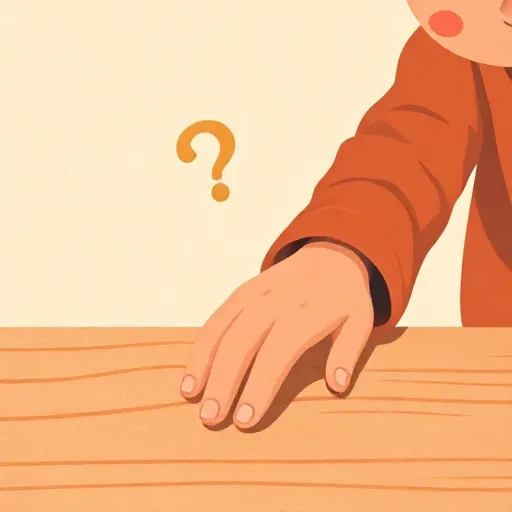
You point at the kitchen table. “That’s a thing,” you say. No one argues. But then you point at the table’s brown color. Is brownness a thing too? And what about the number three, or the idea of justice — can you point at those? You have just stumbled into one of philosophy’s oldest puzzles: the Contrast Question. If objects exist, what are they contrasted with? Are there non-objects? The debate has sharpened thinkers’ views about what exists and even about what it means to be a “thing.”
The Umbrella View: Everything Is an Object

Some philosophers think the Contrast Question has a quick answer: there is no contrast. On the Umbrella View, “object” picks out the single most general category — absolutely every item that exists. Bertrand Russell (1872–1970) used the word “term.” P.F. Strawson (1919–2006) favored “individual.” E.J. Lowe (1950–2014) spoke of “thing” or “entity.” Ernst Tugendhat (1930–2023) said “something.” Despite the different labels, they all shared a conviction: there is a category so wide that anything you can mention — a man, a moment, a number, a class, a chimera — falls into it.
The Umbrella View blends a metaphysical claim (there really is a maximally general category) with a semantic claim (the word “object” picks it out). Disputes about the semantic part can be just about words. But the metaphysical part is not merely verbal: it asks whether reality itself comes with a single all-inclusive category. One consequence is that “object” cannot be broken down into simpler pieces; it is a primitive notion, like “point” in geometry. A second consequence is that anything that can be referred to or thought about is an object — a connection that many Umbrella Viewers find natural.
Skeptics push back. If “object” covers everything, it has no contrast, and a category without a contrast seems useless for carving up the world. Worse, talking about “literally everything” can lead to logical paradoxes. So even if the word could be used that way, it may not be wise.
Objects and Properties: Drawing a Line
If the Umbrella View is wrong, then objects have a genuine complement. The most popular candidate is properties. There are things, and there are ways those things are. A tree is a thing; being tall is a way the tree is. This intuitive distinction feels like a deep divide, and philosophers have spelled it out in several ways.
One strategy looks at language. In a simple sentence, objects are what subject terms refer to (“the table”), and properties are what predicates express (“is brown”). Russell, following Aristotle, thought this logical difference pointed to a real difference in the world.
Another strategy appeals to space and time. Objects exist in space and time; you can find them somewhere. Universals — properties like redness — are not located anywhere at all. Or consider multiple location: an object can be wholly present in only one place, but one and the same property (being spherical) can be wholly present in many balls at once.
A third idea draws on the Identity of Indiscernibles: if two things share all the same properties, they are identical. Many philosophers doubt this holds for objects — two exactly similar spheres seem possible. But it seems right for properties: if two property-instances share all the same features, they are the very same property.
Other proposals contrast objects as concrete (material, causal) with properties as abstract; or treat objects as sense-perceptible while properties cannot be seen; or claim that properties are instantiated but objects are not. Each proposal has strengths and puzzles. Strawson noted that when you see a bacon, you also see its color, so dividing perception cleanly is awkward.
A smaller group of thinkers sees the real contrast not as objects vs. properties but as objects vs. subjects. A subject is a you — a conscious experiencer. On this picture, you are not an object; a rock is. Some add that subjects can also be objects of experience, so the divide is not exclusive.
Does Anything Exist at All? Extreme Answers
The Extension Question asks: which things, exactly, are objects? If the Umbrella View is right, the answer is simply “everything.” But many philosophers think the answer is narrower or even more startling.
At one extreme sits existence nihilism: there are no objects at all. How could anyone believe that? Nihilists like John Hawthorne (b. 1964) and Andrew Cortens offer a tool: sentences that look as if they are about objects (“There’s a computer here”) can be paraphrased away into object-free talk (“It is computering here”). If every ordinary claim can be translated into a language that never refers to objects, maybe objects are not needed. Dasgupta adds that objects are physically redundant and empirically undetectable, so the simplest theory drops them.
At the opposite extreme is existence monism, defended by Terry Horgan (b. 1942) and Matjaž Potrč (b. 1953). Only one concrete object exists — the entire cosmos, which they call the “blobject.” The blobject has many properties spread across space and time, but no genuine parts. Common-sense talk about chairs and trees is still true, but not because there are many objects; truth is an indirect correspondence with the whole world. A classic objection, voiced by Russell, is that multiple things just seem overwhelmingly obvious — so an argument for monism must rest on a premise less plausible than the ordinary belief in many things.
Most people are existence pluralists: there are many things. But then the Extension Question becomes about which of the many things count as objects. A common place to start is ordinary objects — bees, erasers, pillows, boats, the stuff we normally point to. Another route is the Special Composition Question: when do some things compose a further object? Answers range from “only when they’re in contact” to “only when they’re caught up in a life” to “never” (mereological nihilism) and “always” (universalism).
What Are Objects Made Of? Bundles, Blobs, and Bare Pegs
Turn now to the Nature Question: supposing objects exist, what are they like? One approach is to say what objects do. Being an object might just be being something that can be referred to, or something that can be quantified over — an item that variables can range over in logic. Peter van Inwagen (b. 1942) once defined a thing as anything that can be referred to by a third-person singular pronoun.
A deeper approach asks what objects are, not just what they do. Here, theories split into constituent ontologies (properties are parts of objects) and relational ontologies (properties are not parts).
On the bundle theory, an object is nothing but a bundle of properties held together by a special tie (compresence). If the properties are immanent universals or tropes, the object just is that bundle. A challenge: if all you have are properties, what makes a bundle a single thing rather than a collection?
Bare particularism adds an extra ingredient: besides properties, every object contains a bare particular — a featureless peg that instantiates the properties and also individuates the object. Two exactly similar blue spheres are two because each has its own bare particular, not because their properties differ. David Armstrong (1926–2014) defended such a view. Hylomorphism, an older theory, similarly splits objects into matter and form.
Relational ontologists reject all this internal machinery. On their “blob” view, objects have no property-parts at all; properties are external. Platonism about universals fits here: the object is a blob that stands in an instantiation relation to properties in a separate realm. Class nominalism also treats properties as sets of possible objects, so having a property is just set-membership — an external relation, not a part.
Why the Fight Over Objects Still Matters

You might wonder: why should I care whether numbers, colors, or even I myself count as objects? The answer surfaces in everyday thought. When you say, “I have an idea,” are you claiming that an idea-object exists? If a scientist describes gravity as a force, is gravity an object, a property, or something else entirely? The way you answer shapes what you treat as real.
The debate also affects how you see yourself. If the subject–object divide is taken seriously, you are not just another thing — you are a experiencer, a you. But if the Umbrella View holds, you are an object among others, though a very special one. Neither answer is obviously correct, and philosophers continue to argue.
So the next time you point at a table and call it a thing, you might pause. Is it an object, a bundle of properties, a blob? The question has no final answer yet, but wrestling with it sharpens your picture of reality — and that is what philosophy does best.
Think about it
- If you could replace every sentence that mentions objects with a sentence that talks only about stuff happening (“It is raining,” “It is tabling here”), would you still believe in objects? Why or why not?
- Could there be two objects that are absolutely identical in every way, yet still be two? If not, what makes them distinct?
- Are you an object? Think of a reason someone might say yes and a reason someone might say no.