Is One Grain the Difference Between a Heap and Just a Pile?
A Day at the Beach and a Vanishing Heap
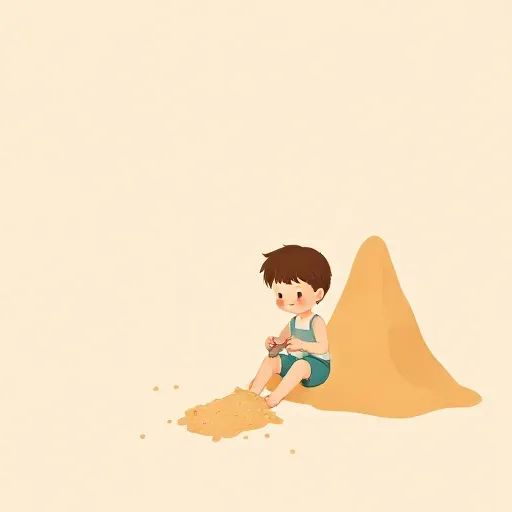
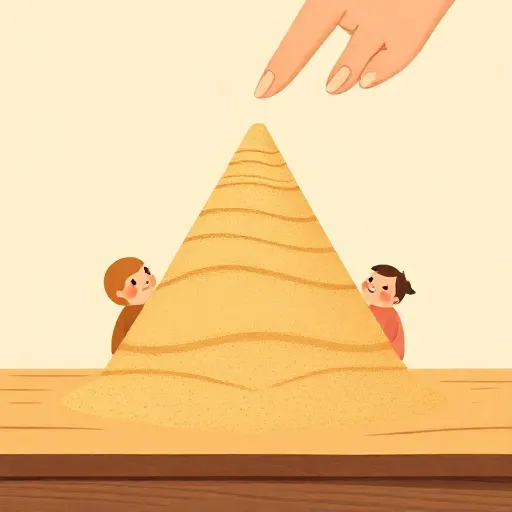
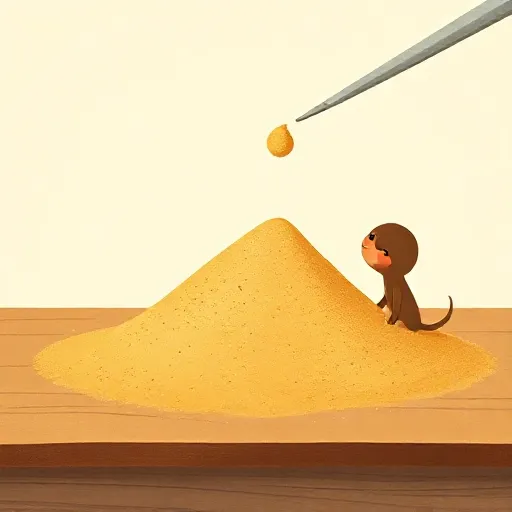
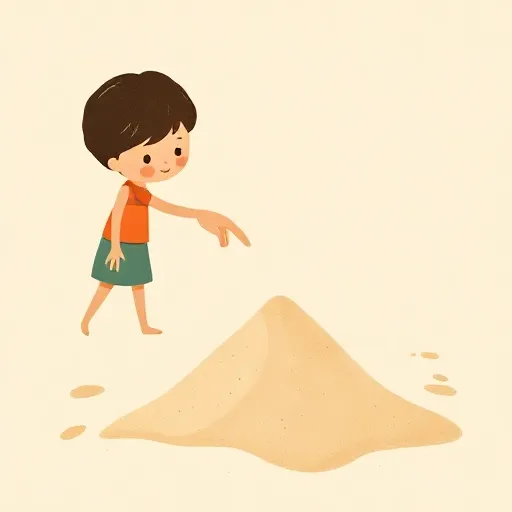
You’re at the beach, piling up sand into a perfect little mountain. It’s definitely a heap. An older kid walks by, scoops one grain from the top, and asks, “Still a heap?” You say, “Of course.” He removes another grain. “Heap?” “Yes.” And another. Grain by grain, he carries on. Eventually you’re staring at a thin scatter of sand on the ground. At some point you stopped calling it a heap — but when? No single grain felt like the one that made the difference.
That, in a handful of sand, is the sorites paradox. The name comes from the Greek word soros, meaning ‘heap.’ Ancient philosophers used it as a two-thousand-year-old trap. The puzzle isn’t just about sand. It sneaks up on any word with fuzzy edges — tall, old, rich, bald, blue — and asks: where exactly does the word stop?
The Paradox in Slow Motion: How Logic Unravels
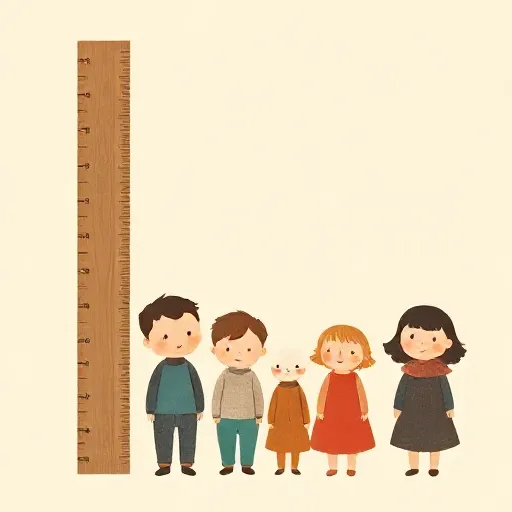
The paradox was probably invented by the Megarian philosopher Eubulides (4th century BCE). Later, Greek skeptics used it against Stoic philosophers who claimed knowledge was solid and precise. The puzzle works because vague words have a property called tolerance: if the word applies to one thing, and you make a change so tiny that nobody could notice the difference, the word seems to apply just as well to the next thing.
To see the trap, imagine a line of a thousand men, sorted by the number of hairs on their heads. The first man has one hair — he is bald. Now reason like this:
- If a man with 1 hair is bald, then a man with 2 hairs is bald.
- If a man with 2 hairs is bald, then a man with 3 hairs is bald.
- …and so on, through every number of hairs.
You would be forced to conclude that a man with 10,000 hairs is bald — which is clearly false. You started from a true claim and moved by tiny, seemingly safe steps, yet you ended up in nonsense. The argument uses nothing fancier than modus ponens (if p then q; p is true; therefore q is true) repeated over and over. But somewhere along the line, a step must be wrong.
Another version, sometimes called the forced march sorites, lets you walk down the line yourself. You must classify each person as “bald” or “not bald” as you pass. You’ll say “bald” for person 1, and also person 2, because they’re almost identical. Eventually you’ll reach a person where you want to switch — but how can you suddenly draw a line between two heads that look the same to you?
The Epistemic Escape: The Line is There, We Just Can’t See It
One way out is to insist that vague words do have sharp boundaries; we’re simply ignorant of where they are. This view, called epistemicism, goes back at least to the ancient Stoic Chrysippus (3rd century BCE) and has been revived in our time by philosophers like Timothy Williamson (born 1955) and Roy Sorensen (20th–21st century). On this story, somewhere in the hair-series there is a least hairy number that is not bald — but we can’t ever know which number it is.
Why can’t we know? Williamson says that our knowledge of vague words is inexact and governed by a margin for error. If you know this patch of the sky is blue, then any patch that looks exactly the same must also be blue — otherwise your judgment would just be a lucky guess, not real knowledge. In the fuzzy border zone between blue and green, you can’t know which patches are still blue, even if some secretly are. So you can never correctly point to the exact boundary, even though it exists.
This view has an appealing simplicity: it keeps logic completely classical, with every sentence either true or false. But it asks you to swallow a hard pill: the boundary of “heap” is as sharp as a knife, yet will forever escape you. Some philosophers find that so counterintuitive it seems to multiply mysteries. After all, if the boundary is fixed by the way we use words, and our use never draws a line, how does the line get there?
Supervaluationism: When Truth Has Gaps
Many other philosophers think vagueness is a genuine feature of meaning, not just ignorance. One popular family of views is supervaluationism, developed by Kit Fine (born 1946) and defended by Rosanna Keefe (20th–21st century), among others.
Instead of a single sharp meaning, a vague word is thought to be indecisive — there are many different ways it could be made precise, all of them equally acceptable. Each way is called a precisification. On one precisification, “bald” stops at 500 hairs; on another, at 1,000; on another, at 3,472. None of these is the “right” one, but all are permissible given how we actually use the word.
A sentence is super‑true if it comes out true on every acceptable precisification. “A man with 1 hair is bald” is super-true; “A man with 10,000 hairs is bald” is super-false. In the penumbral middle zone, some sentences are neither super-true nor super-false — they are borderline. So truth‑value gaps appear.
This solves the sorites paradox handsomely. The major premise — “for every n, if n hairs is bald then n+1 hairs is bald” — is not super-true. In fact, it is super-false, because on every precisification there is some sharp cut-off. Yet no single conditional premise is false by itself; the false universal premise is true only as a statement about the whole series.
Here’s the catch: supervaluationism keeps the law of excluded middle. “Either he is bald or he is not bald” is super-true in every borderline case. But neither side of the or is individually super-true — a strange result that troubles some philosophers. It also forces you to accept that “There is an n such that n hairs is bald and n+1 is not” is super-true, even though no particular n makes the sentence super-true. The cut-off exists, but you can never put your finger on it. Whether that’s a satisfying picture is hotly debated.
Truth Comes in Degrees: Could You Be 0.7 Bald?
Not everyone is comfortable with truth‑value gaps. Degree theories take a different path: truth itself comes in amounts, not just on/off switches. Inspired by fuzzy logic, these views say a statement can be true to degree 0.8, or 0.3, or any real number between 0 and 1. “John is bald” might be true to degree 0.95 when John has a few wisps, and to degree 0.05 when he’s got a full head of hair.
On this approach, the tiny steps of the sorites argument don’t preserve perfect truth. The conditional “If a man with n hairs is bald, then a man with n+1 hairs is bald” is true to a very high degree — say 0.999 — but not perfectly true. When you chain a thousand such nearly-true steps, the accumulated sliver of untruth can bring the final conclusion below the threshold for assertion. So the paradox doesn’t force an absurd result.
Degree theories face their own challenges. It’s not obvious what a “degree of truth” actually means in the world, or why one patch deserves 0.7 truth while another deserves 0.72. And many everyday concepts, like “reddish”, involve multiple dimensions — hue, brightness, saturation — that don’t line up in a simple ranking. Nevertheless, degree theorists think that truth really does come in shades, much like colour itself.
Why It Still Matters: Fences, Laws, and Growing Up
Sorites puzzles don’t live only in philosophy classrooms. Every time society draws a sharp line across a fuzzy reality, the heap paradox is hiding in the background. A speed limit of 50 km/h treats 50.1 differently from 49.9, even though the two speeds feel almost identical. You become a legal adult at the stroke of midnight on your 18th birthday, as if adulthood arrives in a single second. When is a tomato ripe enough to eat? When does a patch of sky stop being blue and become violet?
The sorites paradox shows that our language — and our logic — isn’t built for infinitely gradual change. If we try to force sharp boundaries, we risk lying about the world. But if we throw away all boundaries, we can’t talk at all. Philosophers have responded by inventing new kinds of logic, rethinking how truth works, or accepting that some mysteries are just built into meaning.
And there’s a twist: even words like “borderline” and “vague” turn out to be vague themselves. That’s called higher‑order vagueness. If you think there’s a sharp line between the definite heaps and the borderline ones, you face a new sorites all over again. The paradox keeps climbing. Understanding it doesn’t just settle an old riddle — it sharpens how you think about every rule, every category, and every fuzzy line we draw in the sand.
Think about it
- If you had to pick a precise number of grains that makes a heap, what number would you choose, and how would you convince a friend it’s the right one?
- Is it fair to punish someone for driving at 50.1 km/h but not at 49.9 km/h, when neither driver can feel the difference?
- Imagine a word that everyone uses perfectly but nobody can state its exact boundary. Does that word still mean something definite?