
Can a Statement Be Half-True?
The Paradox That Broke True-or-False

Imagine a single grain of sand. Does that one grain make a heap? Clearly not. Add another grain — still not a heap. Keep adding, one grain at a time. Eventually you have a huge pile, and it’s definitely a heap. But exactly which grain made the switch? Was it grain 1,347? Grain 9,542? You can never point to the tipping point. This is the Sorites paradox (from the ancient Greek word for “heap”), and it has been annoying philosophers for over two thousand years.
Classical logic treats every statement like a light switch: on or off, true or false. The sentence “this pile is a heap” would have to flip from false to true at some grain count. But the world doesn’t work that way. “Heap,” “tall,” “bald,” and thousands of other words are vague — they don’t have sharp boundaries. If you try to force them into only two truth values, paradoxes like Sorites pop up. Philosophers and mathematicians realized they needed a whole new way to think about truth.
A Third Truth Value: Possible, Undefined, or Half-True

The Polish logician Jan Łukasiewicz (1878–1956) was the first to take this idea seriously. In 1920, while trying to understand words like “necessary” and “possible,” he realized that ordinary true/false logic couldn’t capture them. So he invented a third truth value — a middle option that meant “possible.” Suddenly a statement could be neither completely true nor completely false; it could sit in between.
Łukasiewicz built a whole logical matrix for his new three-valued logic. A matrix is just a list that fixes (1) the set of truth values, (2) the rules (called truth degree functions) for how connectives like “and” and “if‑then” behave, and (3) which truth values count as designated truth degrees — the ones that a valid argument has to preserve, like how classical logic preserves “true.” In Łukasiewicz’s system, the only designated degree was the full truth, but you could still reason with those in‑between possibilities.
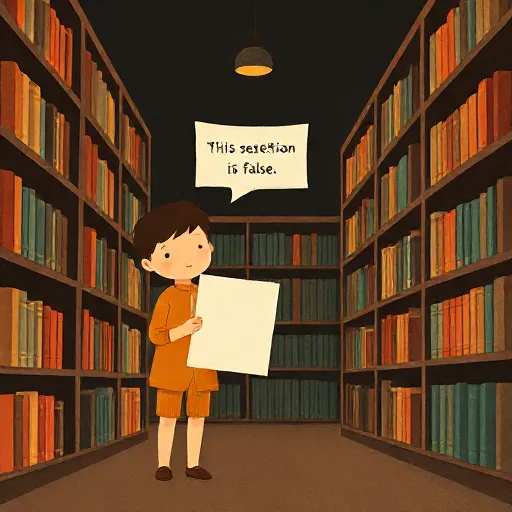
Soon other thinkers found uses for a third truth value. The American mathematician Stephen Kleene (1909–1994) used a third value for “undefined” when a computer program crashes partway through a calculation. The Russian logician Dmitrii Bochvar (1904–?) added a third value for “meaningless” statements to handle paradoxes like “this sentence is false.” Different three‑valued systems gave different answers to the same question, but they all agreed on the big idea: truth is not a two‑color checkerboard.
From Three to Infinity: Real Numbers as Truth Degrees

Once you admit a third truth value, an obvious question follows: why stop at three? Łukasiewicz himself soon expanded his system into an infinite number of truth values. Instead of just 0 and 1, or 0, ½, and 1, his new logic used every real number between 0 and 1 as a possible truth degree. 1 still meant completely true, 0 completely false, and 0.37 meant “37 percent true.”
This infinite‑valued system, called Łukasiewicz logic, had simple mathematical rules. The degree of “A and B” was the greater of 0 and (A + B − 1). “A or B” was the lesser of 1 and (A + B). Negation was just 1 minus the truth degree. An implication A → B was the minimum of 1 and (1 − A + B). These functions behave in familiar ways at the edges but blend smoothly in the middle.
Another family of infinite‑valued logics came from Kurt Gödel (1906–1978). In 1932, Gödel was trying to prove that intuitionistic logic — a different non‑classical system — could not be described with finitely many truth values. Along the way he created the Gödel logics, where “and” is the minimum value, “or” is the maximum, and “not” jumps directly from 0 to 1 with no shades in between. Gödel’s implication is special: if A ≤ B, then A → B is 1; otherwise it simply equals B.
These systems also had quantifiers like “for all x” and “there exists an x.” Their truth degrees were the infimum (the greatest lower bound) and supremum (the least upper bound) of all the individual cases — much like classical logic’s “for all” checks every object, but here you take the lowest truth degree in the lot.
When Truths Are Built from Algebra: T‑Norms and Fuzzy Logic

The explosion of fuzzy set theory in the 1980s pushed many‑valued logic further. Researchers wanted a general recipe for the “and” connective in infinite‑valued systems. That recipe is called a t‑norm — a binary operation on the interval [0,1] that is associative, commutative, non‑decreasing, and treats 1 as a neutral element (you don’t lose truth when you combine something with complete truth). In plain terms, a t‑norm is a rule for combining two truth degrees and getting a combined degree that never exceeds either one.
Different t‑norms give different flavors of logic. The Łukasiewicz t‑norm is u & v = max(0, u + v − 1). The product t‑norm is just ordinary multiplication. The Gödel t‑norm is the minimum of the two numbers. Each t‑norm creates its own implication connective through a residuation condition: a → b is the largest value z such that the t‑norm of a and z is still less than or equal to b.
Logicians have managed to axiomatize many of these t‑norm based systems. Petr Hájek (1940–2016) gave a complete set of axioms for BL, the logic of all continuous t‑norms, and later work by other mathematicians showed how to add a few extra axioms to capture exactly the logic of a single, specific continuous t‑norm. Behind the scenes, the algebraic structures that play the same role for many‑valued logics as Boolean algebras play for classical logic are MV‑algebras, Heyting algebras, and other varieties — but that’s a story for another day.
Four Truth Values: The Logic of Conflicting Information

Sometimes adding extra truth values isn’t about vagueness at all — it’s about ignorance and contradiction. In 1977 the philosopher Nuel Belnap (1930–) introduced a four‑valued system for handling information retrieved from a database. Suppose you ask a computer whether a fact is in its records. The answer might be:
- You get only “yes” (the fact is known to be true).
- You get only “no” (known to be false).
- You get both “yes” and “no” (conflicting information).
- Or you get neither (no information at all).
Belnap’s four truth degrees aren’t numbers — they’re sets: {True}, {False}, {True, False}, and ∅ (the empty set). The connectives work in a component‑wise way: “A and B” takes the infimum under a truth ordering, but there’s also a separate information ordering that puts conflicting information at the very top, because knowing the data says both “yes” and “no” is more informative than knowing nothing.
This system turned out to be a product of two copies of classical logic: one copy tracks whether there’s positive information for a claim, the other tracks whether there’s positive information against it. It’s been used in computer science, where databases and networks often have to handle partial or contradictory information gracefully. More recent work by Heinrich Wansing and Y. Shramko has even expanded the idea to 16‑valued systems for networks of knowledge bases.
Why It Still Matters: From Ancient Puzzles to Your Pocket

So why does all this matter to you? Return to the heap paradox. Many‑valued logic offers a clean solution. Instead of insisting that premise (ii) — “adding one grain never turns a non‑heap into a heap” — is completely true, we give it a truth degree very close to 1, like 0.999. At each grain, the truth of “this is not a heap” drops microscopically. After thousands of grains the degree has crept down to near‑zero. The conclusion never hits a sharp false; it just fades out, which matches how we actually use the word “heap.”
Beyond paradoxes, many‑valued logic hides inside modern technology. Engineers design memory cells and circuits with more than two stable voltage states — three, four, or eight levels — to store data more densely; these are natural homes for many‑valued switching. Artificial intelligence uses fuzzy logic to handle vague commands like “slow down a bit” or “it’s fairly warm.” Expert systems that diagnose illnesses or recommend routes blend degrees of evidence, not just yes/no answers. And databases that pool information from many sources have to cope with contradictory records, exactly the kind of thing Belnap’s four‑valued logic was built for.
The real lesson, though, is about everyday life. The world rarely gives you perfect binary choices. How tall does someone have to be to count as tall? How many hairs can you lose before you are bald? At what temperature does “warm” become “hot”? Many‑valued logic is a way of thinking that accepts these blurry edges instead of pretending they don’t exist. It’s a reminder that truth can come in degrees — and that sometimes, the best answer really is “sort of.”
Think about it
- If you had to rate “it’s cold outside” on a scale from 0 to 1, what number would you pick for 12°C? What about 18°C? Is there a single exact number, or does everyone choose differently?
- Could a computer that uses four truth values (like Belnap’s) make fairer decisions than one that only uses true/false? Think of an example where conflicting information matters.
- Your friend says “that movie is good” and you think it’s only okay. How could you use the idea of truth degrees to describe your disagreement without just saying “you’re wrong”?