

Can You Know Your Own Thoughts? The Twin Earth Puzzle
A Strange Planet Where Nothing Is Quite What It Seems

Imagine there’s a planet called Twin Earth. It looks exactly like ours. The trees, the cities, the people — even their conversations and memories — match Earth perfectly. But there’s one hidden difference: the clear liquid everyone calls “water” isn’t H₂O at all. Instead, it’s a different chemical, something scientists label XYZ. It tastes, looks, and splashes just like Earth water. No ordinary person could tell them apart.
Now picture Oscar, an Earthling, and his Twin Earth double, Twin Oscar. They’re identical in every way inside their heads — same brain states, same feelings, same life story. Oscar points to a glass and says, “Water is refreshing.” Twin Oscar points to his own glass and says the exact same words. But Oscar is talking about H₂O, while Twin Oscar is talking about XYZ. So do their words mean the same thing? Many philosophers think they don’t. And if they don’t, something surprising follows: the meaning of what you say and think doesn’t just come from inside your skull. It partly depends on what’s actually around you in the world.
This thought experiment, dreamed up by Hilary Putnam (1926–2016) and others, launched one of modern philosophy’s biggest puzzles. The view it supports is called externalism — the idea that the content of your thoughts (what they’re about) is shaped by your environment, not just your brain. But if externalism is true, can you really know your own thoughts without checking what’s outside? That’s the question we’re diving into.
The View That Shook Up Self-Knowledge
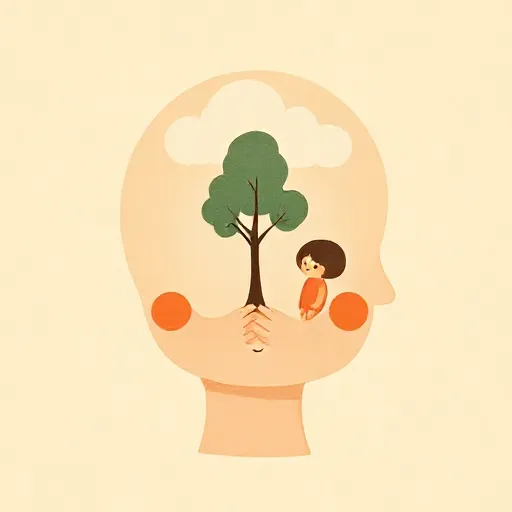
Philosophers have long assumed something that feels obvious: you have a special, private way of knowing what you’re thinking. You don’t need to look around or do experiments to find out whether you believe that water is wet. You just seem to know it directly. This idea is often called self-knowledge (or more technically, armchair self-knowledge, because you can access it without getting up from your chair). Even if a mad scientist secretly gave you a new brain, surely you’d still know your own thoughts, right?
But externalism challenges that cozy picture. The Twin Earth story suggests that what you are thinking — the actual meaning of your thought — depends on your real-life history and your physical surroundings. Oscar and Twin Oscar are internally the same, yet they’re thinking about different stuff. If that’s correct, then just looking inside your own mind might not be enough to know what you are thinking about. You might need to know something about your environment, too.
This creates a direct clash with another deeply held belief: that we can know our own minds a priori, meaning without conducting any empirical investigation (no lab coats, no telescopes, no field trips). The incompatibilist says you can’t have both externalism and armchair self-knowledge. The compatibilist says they can live together, even if the fit is awkward. To see why this matters, we need to follow the argument that made the incompatibilists so worried.
The Reductio: How Armchair Thoughts Might Reveal the World
Here’s a way to turn the tension into a sharp problem. Suppose externalism is true, and a thought like “water is wet” actually requires that water (H₂O) exists somewhere in your world or your community. And suppose you can know a priori that you’re having that thought — that’s the self-knowledge part. Then, from your armchair, you could know two things:
- If I am thinking that water is wet, then water (or a community that talks about water) exists.
- I am thinking that water is wet.
From those, you could logically conclude that water (or the community) exists. But knowing that there’s water in the world is an environmental fact! That’s something you’d normally need to check by going outside, not something you can figure out just by sitting and thinking. The incompatibilist, like Michael McKinsey (1950–2018) and Paul Boghossian (born 1957), argues that this is absurd. So externalism and self-knowledge can’t both be true.
Compatibilists have several ways to push back. One reply is that the first premise isn’t really knowable a priori. Just because a thought is about water doesn’t logically require water; maybe you could have the thought purely by being in a community, or even by imagining the molecule yourself. Another reply is that, even if both premises are true, the logical deduction doesn’t transmit new knowledge to the conclusion — it might just presuppose what we’re trying to prove. This is called transmission failure: you can’t get a genuinely new piece of evidence about the world just by shuffling around what you already assume.
A third reply is to bite the bullet: maybe self-knowledge isn’t really a priori at all. After all, you acquired the concept “water” by interacting with the world in the first place. So maybe all your water thoughts rest on earlier empirical knowledge. That still leaves you with privileged access — you might know your thoughts better than anyone else — but not a magical, evidence-free window. The debate remains fierce, with further twists involving what happens when a concept is empty, like “unicorn.”
The Slow Switch: When Your Own Thoughts Slip Away

There’s a second famous challenge, based on a different thought experiment. This time, Oscar isn’t just compared to a twin. Instead, imagine he is secretly kidnapped during the night and flown to Twin Earth, while still unconscious. He wakes up, goes about his day, and everything seems normal. Over time, however, his word “water” begins to refer to XYZ instead of H₂O, because that’s what he keeps encountering. The switch is “slow” — he never notices the change. His brain feels exactly the same, but the content of his water-thoughts has shifted.
Now the question: from the armchair, can Oscar ever tell which kind of thought he’s having — an H₂O thought or an XYZ thought? It seems he can’t. And if he can’t discriminate, can he truly know what he’s thinking? The incompatibilist, including Tyler Burge (born 1946) in his earlier work, used this to cast doubt on self-knowledge. A later version, the memory argument, adds that after the switch, Oscar might even forget what he originally meant, yet not notice he’s forgotten anything. That makes armchair self-knowledge look fragile.
Compatibilists have many replies. Some argue that slow switches are so bizarre and far-fetched that they shouldn’t count as “relevant alternatives” we need to rule out in order to know something. Others point to a special kind of thought that seems immune to the switch: when Oscar thinks, “I am thinking, with this very thought, that water is wet,” the very act of thinking it makes the judgment true, no matter which environment he’s in. These are called self-verifying judgments, and Burge himself later used them to defend compatibilism. Yet another radical reply says memory itself is externalist: when Oscar recalls a past water-thought on Twin Earth, the memory shifts to be about XYZ, so he never really loses track — but that leads to its own puzzles about forgetting.
Two Big Ideas, One Tough Choice

Why does all this matter beyond philosophy classrooms? Because the externalism/self-knowledge debate isn’t just about a clever sci-fi story. It’s a collision between two of the most fundamental ideas in the history of thought.
On one side stands a tradition going back to René Descartes (1596–1650). The Cartesian view says you can know your own thoughts clearly and distinctly, independently of anything physical. Even if an evil demon were tricking you about the whole external world, you could still be sure you’re thinking. On the other side stands the insight of Gottlob Frege (1848–1925) and later Putnam: meaning, or content, determines what a word refers to. If “water” refers to different stuff on Earth and Twin Earth, then the content of the word must be different, despite identical brain states. That pushes us straight into externalism.
So either the Cartesians were wrong about the certainty of introspection, or the Fregeans were wrong to think content determines reference. One of these paradigm-defining ideas has to give way. That’s not just a technical squabble. It touches how we understand ourselves. If externalism wins, then to know your own mind, you might need to investigate the world around you — a humbling thought. If self-knowledge retains its a priori status, then meaning can’t be fully determined by your environment, and something more internal must be at work.
The conversation is far from over. Every few years, new tools from linguistics, cognitive science, and epistemology shed fresh light on the puzzle. And as long as we care about what our thoughts are really about, and how we can know them, the debate will keep evolving.
Think about it
- Imagine you grew up calling only fizzy, flavored water “water,” and your friend grew up calling only still tap water “water.” You both say, “Water is my favorite drink.” Do you mean the same thing? How would you settle that from the inside of your own head?
- If you discovered tomorrow that everything you’d ever called “trees” were actually sophisticated plastic replicas, would your past thoughts about trees change meaning? Or were you always thinking about those plastic things without realizing it?
- Suppose a machine could record exactly what’s happening in your brain when you think “I’m hungry.” If a scientist looking at the recording could predict your thought, does that make your self-knowledge less special, or just a different kind of knowing?