

Does the World Decide What You're Thinking?
A Planet Just Like Ours—Except for One Thing
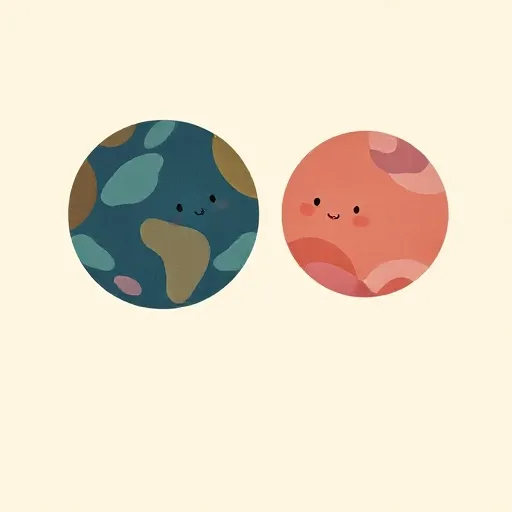
Imagine a planet exactly like Earth—every tree, every city, every person. On this planet, there’s even a molecule-for-molecule duplicate of you, reading a duplicate of this article at the same moment. The only difference? The clear, tasteless liquid that fills the oceans, flows from faucets, and quenches thirst isn’t made of H₂O. It’s something else entirely, a strange substance with a totally different chemical recipe. Yet it looks, tastes, and feels just like water to the people there. For now, call it twater.
This is the Twin Earth thought experiment, dreamed up by philosopher Hilary Putnam (1926–2016) in 1975. Putnam set his story in 1750, long before anyone knew about hydrogen and oxygen. He then asked: when you and your twin both say, “Water is wet,” do your sentences mean the same thing? Putnam’s answer was no. Your word water picks out the real stuff on Earth—H₂O. Your twin’s word, even though it sounds the same, picks out twater. The meaning of your sentence is tied to the actual substance in your environment, not just to what’s in your head.
This didn’t stop at words. If the meanings differ, then your thoughts differ too. You think about water; your twin thinks about twater—even though your brains, your internal states, every cell in your body, are identical. Putnam’s conclusion was shocking: mental content—what your thoughts are about—isn’t fixed by your brain alone. The world outside your skin helps determine what you’re thinking. This is content externalism, the claim that at least some of your thoughts depend, for their identity, on things beyond your biological boundaries.
How Your Community Can Change Your Thoughts

Putnam showed that physical stuff in nature can shape your thoughts. But what about the social world? Another philosopher, Tyler Burge (born 1946), gave a different twist on externalism in 1979.
Imagine a man named Larry. Larry has many beliefs about arthritis: he knows it’s painful, he believes he has it, and he thinks it has flared up in his thigh. However, arthritis is strictly an inflammation of the joints; it can’t occur in a thigh. So Larry’s belief is false. But it’s still an arthritis-belief—a thought about arthritis—because Larry lives in a community where doctors and dictionaries use the word “arthritis” that way, and Larry would correct himself if an expert told him so.
Now imagine a counterfactual Larry. Inside his skin and skull, he is exactly the same as the real Larry—same brain states, same past experiences, same dispositions. The only difference is that his linguistic community uses the sound “arthritis” for a wider set of aches, including both joint inflammations and muscle pains like Larry’s. In that world, Larry’s belief isn’t about arthritis at all; it’s about a different condition we might call tharthritis. And it’s true.
Burge’s point is sharp: the very content of Larry’s thought changes depending on the social practices around him, even though nothing inside Larry changes at all. Content externalism is therefore not just about the natural environment—it’s also about the rules and customs of the people you live among. The bound of your mind, in this sense, stretches beyond your skull and into your community.
Your Notebook Might Be Part of Your Mind

So far, we’ve talked about the content of thoughts. But what about the physical carriers of those thoughts—the vehicles? In the late 1990s, philosophers Andy Clark (born 1957) and David Chalmers (born 1966) proposed something even more radical: the extended mind thesis. Some of the stuff that makes up your mind lies outside your body.
Consider Otto, who has early-stage Alzheimer’s. To get around, he writes important information in a notebook he always carries. He sees a notice about an exhibition at the Museum of Modern Art. He looks in his notebook, finds the sentence “The Museum of Modern Art is on 53rd Street,” and heads there. Clark and Chalmers argued that Otto’s notebook entry functions exactly like a belief does for someone with an unimpaired memory. It’s constantly available, he automatically trusts it, and he acts on it. From a functionalist perspective—where a mental state is defined by the job it does rather than what it’s made of—the entry just is one of Otto’s beliefs. And if that’s right, the belief is located in the notebook, not in Otto’s head.
This is state-oriented extended mind: the idea that a mental state (a belief) can be literally constituted by an external object (a sentence). The boundary of the thinking agent bleeds out into the world. But is that really tenable?
The Battle Over the Extended Mind
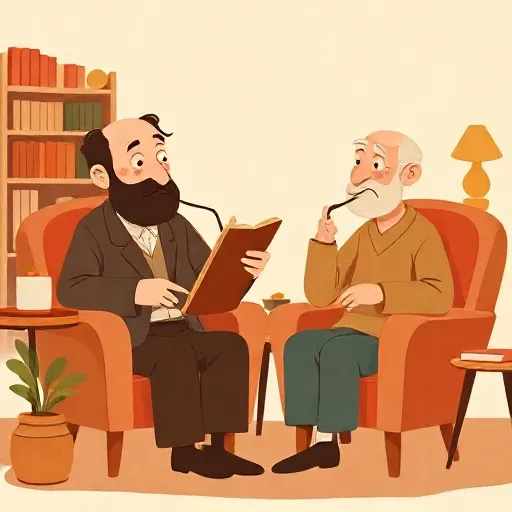
Many philosophers pushed back hard. One objection is cognitive bloat. If Otto’s notebook counts as part of his mind, what stops a library, an encyclopedia, or the entire internet from becoming part of his mind too, since he could access them just as easily? Clark and Chalmers added conditions: the information must be something Otto consciously endorsed at some point, and he must have entered it himself. But critics noted that we have subliminal beliefs we never consciously endorsed, and functionalism shouldn’t care how a belief got there—only what it does.
A deeper worry is the coupling-constitution confusion. The external environment might be tightly coupled with your brain, working together smoothly, but that doesn’t mean it’s constituted by your mind. The notebook helps Otto, but is it really mental? A mosquito bite causes swelling; we don’t say the mosquito is part of your body. Similarly, the notebook may cause Otto’s successful navigation, but that doesn’t make it a literal part of his thinking.
Another challenge comes from original intentionality. The mark of the mental, many philosophers argue, is that mental states have original meaning—they don’t need to be interpreted by someone else. A sentence in a notebook, however, only has derived meaning: it’s just shapes on paper until Otto reads and understands it. If beliefs must carry original intentionality, the notebook cannot itself be a belief.
Defenders of extended mind sometimes shift to a process-oriented version. They don’t claim the static sentence is a belief; instead, the whole act of flipping through the notebook, scanning pages, and recognizing information is part of Otto’s remembering process. This process wraps around brain, hands, notebook, and eyes. Such a view may avoid the bloat and intentionality objections, because now we’re talking about an ongoing activity rather than a frozen object. But the fight isn’t settled—philosophers still debate whether that activity is truly mental or just heavily scaffolded by the environment.
Why It Matters: Knowing Yourself—and Owning Your Actions

These ideas aren’t just strange puzzles. If content externalism is true, then something as personal as your own thoughts is partly determined by things outside you—by the chemicals in your environment, by the words your community uses. That makes self-knowledge tricky. You seem to know what you’re thinking just by looking inward, without checking the world. But if the contents of your thoughts depend on hidden facts about your environment (like whether that liquid is really H₂O or twater), then introspection alone might not reveal exactly what you’re thinking. You’d have to investigate the world to fully know your own mind.
The extended mind raises similar questions about responsibility. If your mind literally includes a notebook, your mobile phone, or even parts of your social network, then your actions are guided by a system that isn’t entirely inside your skin. When you do something wrong, how much of “you” is responsible? If your memory relies on a device that fails or lies to you, does the blame shift? Courts and moral thinking often assume the mind sits neatly inside the individual—but externalism complicates that picture.
And there’s a deeper question about mental causation. If your beliefs extend into the world, or their content depends on distant facts, how do they cause you to raise your hand or speak? Some worry that only the purely internal brain states do the real causal work. Others argue that wide, worldly content can still explain why you act as you do—it’s not that the external part pushes your muscles, but it structures the meaning of your action.
So next time you take a sip of water, or scribble a reminder on your hand, or argue with a friend about a word’s definition, you’re brushing up against a huge philosophical question. Where does your mind end and the rest of the world begin? Philosophers are still drawing the line, and you might spend a lifetime wondering where it falls.
Think about it
- If you grew up in a community that used the word “gold” for both real gold and a shiny fake, would your belief “this ring is gold” be different from someone’s belief in our society? How could you ever find out?
- When you use a phone to remember all your friends’ birthdays, could you honestly say the phone is part of your memory? What would you lose if the phone vanished—facts, or a piece of your mind?
- Imagine scientists could scan your brain right now and perfectly predict the next choice you’ll make. Would that mean your choice wasn’t truly yours, or does it still matter that your mind was shaped by the world? Which side of this debate feels closer to your own experience?