Is the World Just a Movie in Your Head? Scotland’s Philosophy War
The Farmer and the Professor: A Scottish Standoff

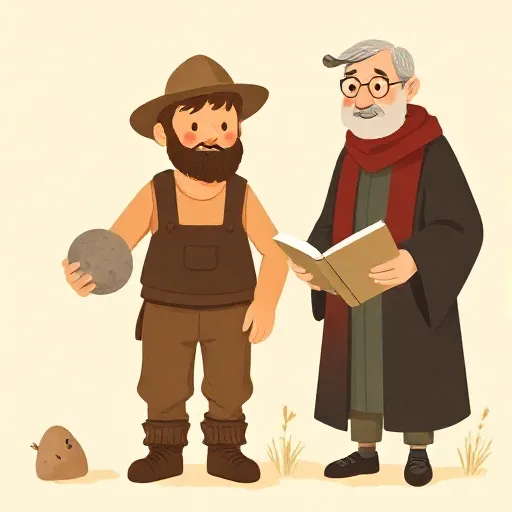
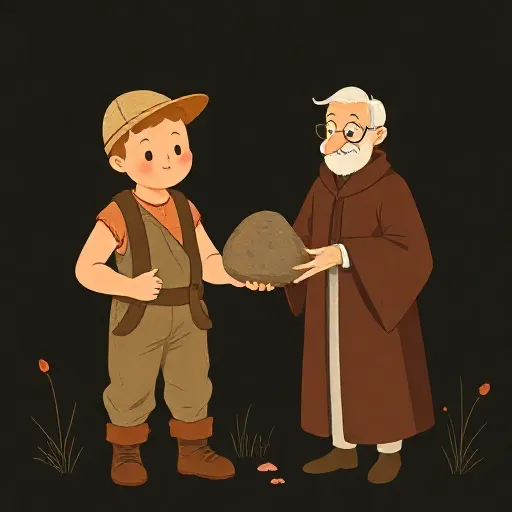
Imagine you are a Scottish farmer in 1790. You pick up a rock. It’s cold, heavy, and solid. You know it’s there—you could throw it through a window. Then a university professor tells you, “You’ve never touched a real rock. All you’ve ever known are ideas inside your own head.”
That clash between a farmer’s instinct and a philosopher’s theory lies at the heart of a century-long argument in Scotland. It began among the giants of the 18th-century Scottish Enlightenment, who shared a bold project: a science of mind. Like modern scientists study planets or frogs, they wanted to observe the human mind and discover its laws.
But they immediately split over the method.
On one side sat David Hume (1711–1776). He insisted that all our knowledge comes from what he called impressions (the raw stuff of experience, like a flash of red or a twinge of pain) and ideas (the fainter copies our minds store afterward). Since we never meet anything beyond our impressions, Hume thought we cannot prove that a real rock exists at all—we just have a habit of believing in it. This approach is often called the way of ideas.
On the other side stood Thomas Reid (1710–1796). He thought Hume’s starting point was a disaster because it instantly locked the mind inside its own private cinema. Reid argued that common sense —not mere popularity, but the basic principles our minds naturally use to make sense of the world—shows we directly perceive real objects. When you feel that rock, you are not touching an impression; you are touching the rock itself. Philosophers call this direct realism.
By the early 1800s, Scottish thinkers were still stuck between these two camps. And that is when a poet-doctor with a love of drama stepped in.
Thomas Brown’s Bellow and Whisper

Thomas Brown (1778–1820) was not a typical philosopher. He wrote poetry and trained as a physician before taking the Chair of Moral Philosophy at Edinburgh in 1810. His medical background gave him sympathy for Hume’s careful observation of the senses, yet he also saw truth in Reid’s appeal to instinct.
Brown captured the whole standoff in a single, much-quoted remark that has been handed down in a friend’s memoir:
Reid bawled out that we must believe in an outward world; but added, in a whisper, we can give no reason for our belief. Hume cries out that we can give no reason for such a notion; and whispers, I own we cannot get rid of it.
In other words, each side secretly admits what the other side insists upon. Reid thunders that we just must believe in the rock, then mumbles that reason can’t back him up. Hume yells that reason can’t prove the rock, then confesses he can’t stop believing in it anyway. Brown’s lectures, published after his death, became hugely popular across Britain and America, because he made the quarrel feel human and almost comical.
But popularity is not the same as a solution. Brown’s clever balancing act did not settle the question; it just made the next generation hungry for something stronger. And the strongest voice of that generation was a man with a towering reputation and a habit of claiming he could unite everything.
Sir William Hamilton: The Grand Unifier?
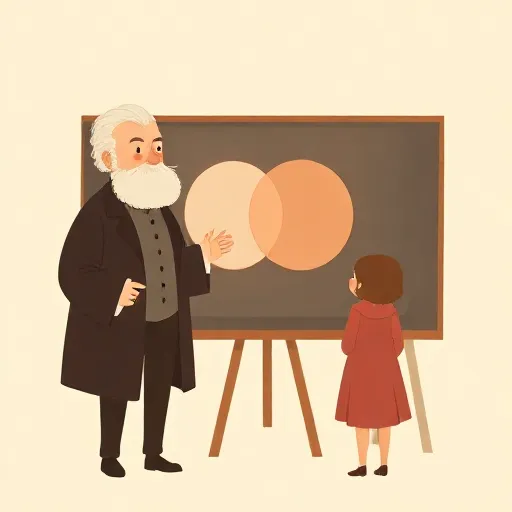
Sir William Hamilton (1788–1856) was appointed Professor of Logic and Metaphysics at Edinburgh in 1836. In his day he was admired across Europe and America. At Yale University, the president wrote that Hamilton was the greatest living teacher of philosophy in the English-speaking world. Hamilton knew the Scottish tradition inside out—he edited Reid’s collected works—but he also read German philosophers such as Immanuel Kant in the original language, back when very few people in Britain could do that.
Hamilton set himself an enormous task. He wanted to fuse Reid’s common-sense realism with Kant’s idea that we can only ever know phenomena—the way things appear to our minds—and never the hidden “things-in-themselves.” If he could show that the two views actually fit together, the century-long argument would be over.
His proposal ran something like this: when you see a tree, your eye undergoes a physical change, you feel a mental sensation, and you have a perception of the tree itself. Reid had treated sensation and perception as separate steps; common sense simply moves you from one to the other by a built-in instinct. Hamilton disagreed. He insisted that sensation and perception are really simultaneous—two sides of the same coin. There is no gap to leap across, so the problem vanishes.
It was a bold move, but many readers felt it was more like moving the finish line than crossing it. Critics such as the English philosopher John Stuart Mill attacked Hamilton’s arguments in a book-length examination in 1865. At the same time, an Idealist critic named James Hutchison Stirling hammered Hamilton from a completely different direction. Within a decade of Hamilton’s death, his system had collapsed in the eyes of most philosophers. The dispute was still wide open.
Alexander Bain: How the Brain Became a Laboratory
If Hamilton tried to build a bridge and saw it crumble, Alexander Bain (1818–1903) simply stepped to one side and built something completely new. Bain, who became Regius Professor of Logic at Aberdeen in 1860, was a friend of John Stuart Mill and shared Mill’s conviction that grand metaphysical systems were wasting everyone’s time.
Instead of asking whether the rock is really there, Bain asked a different question: “What are the regular patterns that connect ideas in a human mind?” He championed associationism, the theory that our ideas link together through habits, much as Hume had suspected. Two ideas become connected if they repeatedly show up together (contiguity) or if they resemble each other (similarity). These are not deep logical truths; they are simply the way the mind happens to work.
Crucially, Bain argued that this study should happen before any attempt at philosophical theory. He insisted that psychology—a new experimental science of the mind—must be pursued separately from metaphysics, the attempt to find the ultimate nature of reality. For Bain, the best place to catch the mind’s raw associations was not in reasoned debate but in dreaming and madness, where rational rules don’t tidy things up. In those messy states, you can watch associations chaining along like dominoes.
Bain’s move had an enormous consequence. By turning the “science of mind” into empirical psychology, he partly fulfilled the Enlightenment dream of studying people the way you study bodies. But he also left the original philosophical riddle untouched: psychology could describe how you form the belief that a rock exists, but it could not tell you whether that belief is true.
And while Bain was building laboratories, another thinker was about to flip the whole conversation upside down.
James Ferrier Flips the Table: Mind Over Matter

James Frederick Ferrier (1808–1864) was a close student of Hamilton, but he ended up defending a view that Hamilton and Reid would have found outrageous. In a fiery pamphlet titled Scottish Philosophy, the Old and the New (1854), Ferrier declared that his philosophy was “Scottish to the very core,” even though it flatly rejected what Reid had taught.
Ferrier argued that the whole distinction between a “thing” and its “appearance” is a false abstraction. He turned to an unlikely hero: George Berkeley (1685–1753), the Irish philosopher who famously argued that physical objects exist only when they are perceived. Reid had called Berkeley’s position something “no man in his senses could believe.” Ferrier, by contrast, called Berkeley “the champion of common sense.”
On Ferrier’s reading, Berkeley was not trying to deny the reality of the rock. Instead, he was insisting that when you hold a rock, the rock and your perception of it are not two separate events that need to be glued together. The rock is the appearance; the appearance is the rock. To say the rock exists independently of any mind is to invent a ghost behind the one and only reality you can ever meet.
By pushing the argument in this direction, Ferrier set fire to the assumption that philosophy should copy the methods of natural science. For him, the real science of mind was the careful introspection of your own consciousness—the theater inside your head where everything shows up. Philosophy, he thought, is just consciousness trying to understand itself better.
Ferrier’s ideas helped open the door to later Scottish Idealists such as Edward Caird (1835–1908), who would develop an even grander vision: all of reality is ultimately one single mind, or Absolute, of which our individual minds are parts. That direction kept some Scottish philosophers busy at the end of the century, but it also seemed to move the conversation very far from the farmer and his stone.
Why This Old Fight Still Echoes in Your Head

The 19th-century Scottish debate did not end with a winner. Instead, it split into two streams that still flow today.
One stream became psychology. When you read about experiments that measure how fast you react, how memories form, or why your brain can be tricked by an optical illusion, you are walking through the door that Bain opened. Psychology gives us powerful tools to describe what the mind does, but it was never designed to answer the question the farmer asked: “Is this rock really there, or not?”
The other stream kept the big philosophical questions alive. Reid’s and Ferrier’s questions—about direct realism, about whether consciousness is all there is—never went away. They return every time a scientist discusses whether we can ever escape the “movie” playing inside our skulls. They return when you put on a virtual-reality headset and wonder if the world you see is fundamentally different from the one outside the goggles. And they return in ordinary moments: when you wake from a vivid dream that felt utterly real, you catch yourself asking, “How do I know I’m not dreaming right now?”
The Scottish argument also left us with a human reminder. Reid’s method was a dialogue between the vulgar and the learned—taking both the farmer’s instinct and the philosopher’s analysis seriously, without letting one bully the other. That spirit matters today whenever an expert tells you to ignore your own experience, or whenever common sense dismisses careful thinking too quickly. The 19th-century Scots didn’t agree on an answer, but they showed why the quarrel itself is worth having.
Think about it
- If you put on a perfect virtual‑reality helmet that fooled all your senses, would the things you touched inside the simulation be “real” in any way that matters? Why or why not?
- Suppose a brain scientist could read every thought you have and predict your next choice perfectly. Would that mean you are not really choosing?
- Can you trust your own experience when it clashes with what an expert tells you? Can you think of a time when your gut instinct was wrong—and a time when it was right?