Can You Trust Your Own Eyes? Thomas Reid's Common Sense Revolution
A Whisper of Doubt: Can You Trust Your Senses?

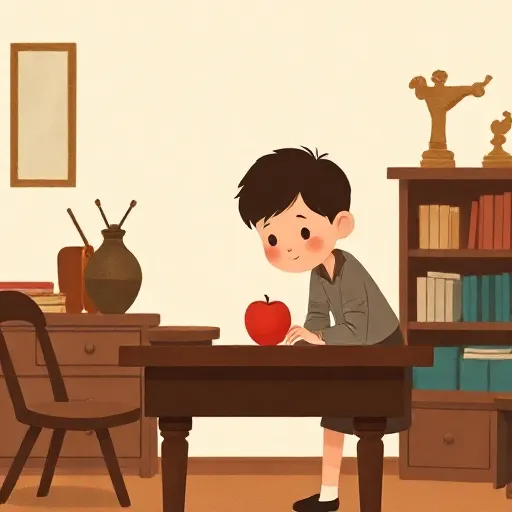
You open your eyes and see a red apple on the table. You reach out, feel its smooth skin, and take a bite. What could be more certain? But then your friend says, “You don’t really see the apple. You only see a picture of it inside your head — an idea.” If that’s true, how can you ever be sure the apple is really there? What if your whole world is just a movie playing in your mind?
This kind of doubt has haunted philosophy for centuries. In the 1600s, René Descartes (1596–1650) imagined an evil demon tricking him into believing the world existed when it didn’t. By the 1700s, many thinkers — John Locke (1632–1704), George Berkeley (1685–1753), and especially David Hume (1711–1776) — had built a powerful system called the Way of Ideas. They claimed that whenever you perceive, remember, or think, the only thing you are directly aware of is an idea in your mind, never the world itself. The result? A deep skepticism: you might never know anything outside your own head.
Thomas Reid (1710–1796), a Scottish minister and philosopher, thought this was a disaster. He believed ordinary people — and even philosophers outside their studies — already knew better. Reid set out to defend what he called common sense — a set of basic beliefs that all humans share and that don’t need complicated proofs. His battle would change how we think about perception, freedom, and right and wrong.
The Way of Ideas: How It Led to a Dead End
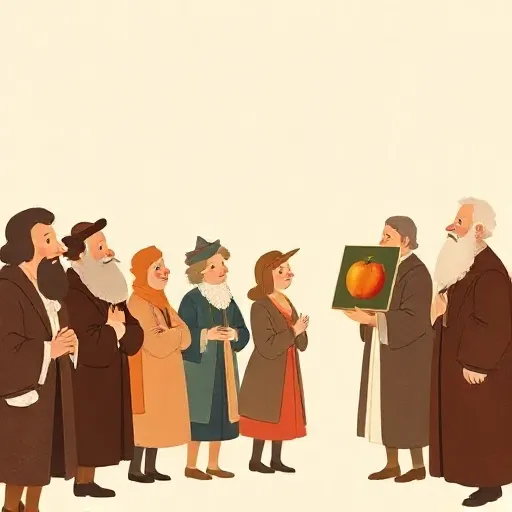
To understand Reid’s revolution, you need to see the trap he wanted to escape. The representational theory of perception said that when you look at a tree, the tree causes a sensation — a feeling — and from that your mind forms an idea or image. What you actually “see” is that idea. The tree is outside, but you only ever encounter its mental copy.
Reid saw two huge problems. First, if all you ever perceive are your own ideas, how can you compare them with real objects to check if they match? You can’t step outside your mind to look. So you could never know whether your idea of a tree resembles a real tree, or whether any tree exists at all. That’s a recipe for skepticism.
Second, Reid asked a simple question: Is it really easier to explain how a mind connects to an idea than how it connects to a real object? If we don’t understand direct awareness of a table, why would adding a middleman — an idea — make things clearer? He argued that the Way of Ideas actually makes the mystery worse. It’s like saying, “I don’t know how a letter gets from New York to London, but I do know how it gets halfway by being put on a plane.” You still have to explain the whole journey.
Seeing the World Directly: Reid’s New Model of Perception
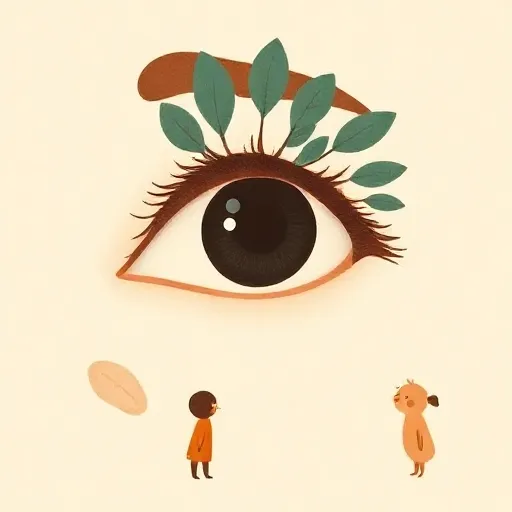
Reid proposed direct perception. When you see the apple, the apple itself is the object of your awareness. The process works like this: the apple acts on your sense organs, causing a sensation — a specific feeling of color, touch, or smell. That sensation is a natural sign, not a picture. Just as the word “apple” makes you think of the fruit without looking like an apple, the sensation immediately and automatically leads your mind to conceive of the apple as having redness, roundness, or hardness. You don’t infer the apple from the sensation; the connection is built into your nature.
This means you are aware of the apple’s qualities, including its primary qualities like shape and size, and its secondary qualities like color and smell. Primary qualities are intrinsic — the apple really is round. Secondary qualities are powers: redness is the apple’s power to cause a certain visual sensation in you under normal lighting. You perceive the apple’s redness, but what you perceive is a relation between the apple and your senses, not a property the apple has all by itself. Both are real, but in different ways.
Reid had a clever reply to one of Hume’s favorite arguments. Hume noted that a table looks smaller when you step back, even though the real table doesn’t shrink. He concluded that what you directly see must be a mental image that changes size. Reid distinguished between visible figure and tangible figure. The visible figure is the shape the table projects in your field of view — a two-dimensional outline that changes with distance, but according to precise geometric rules. That visible figure isn’t a mental image; it’s a real relationship between the physical table, the light, and your eyes. Two people standing at the same spot see the same visible figure, because it’s objective. So things looking smaller doesn’t prove we see only ideas.
Reid didn’t claim to prove beyond all doubt that an external world exists. He thought that belief — that the objects we perceive are real and just as they appear — is a first principle of common sense. You can’t prove it without already assuming it. If a skeptic says the world might be a dream, Reid asks: Why trust reason, which the skeptic uses to argue, more than perception? Both are gifts of our nature. The skeptic hasn’t shown his position is any better; he’s just shifted the burden of proof. Reid put it back where he thought it belonged — on the skeptic.
Are You Really Free? Reid on the Power to Choose
The Way of Ideas also threatened your sense of being a free agent. Hume argued that causation is nothing but constant conjunction — when one event always follows another, we say it causes it, but there’s no necessary connection. Applied to human action, your choices are just one event (a motive) regularly followed by another (an action). You’re a link in a chain, not the author.
Reid agreed that we never see causation directly, but he thought the concept of efficient causation — a real power that brings about an effect — is a basic ingredient of thought. He distinguished between physical causation (the law-like regularities science discovers) and efficient causation, which requires an agent with a mind and will. A billiard ball doesn’t really cause another to move; it just moves according to laws. Only beings who can plan and exert effort are true causes. Reid argued we experience our own power whenever we deliberately raise an arm — we aren’t just watching an arm go up, we’re aware of making it go up.
He gave three main arguments for moral liberty, the idea that you are the efficient cause of your own actions. First, when you deliberate — whether to share your lunch or study instead of play — you assume the decision is up to you. Deliberation would be pointless without that belief. Second, we hold people responsible. We praise generosity and blame cruelty, but we don’t blame an earthquake for destroying buildings. Our practices of praise, blame, and punishment make sense only if people are genuine causes of what they do.
Third, Reid pointed to planning. If you have the wisdom to design a plan, you must also have the power to carry it out, or it wouldn’t really be your plan — just a wish. Critics said motives cause actions like laws of nature. Reid asked what “strongest motive” means. If it just means “the one you end up acting on,” that’s trivially true. If it means the one felt most intensely, we often resist that urge. If it means the one judged best by reason, we sometimes give in to temptation. No single definition makes it both true and non-trivial that we always follow the strongest motive. That left room for freedom.
Feeling Right and Wrong: Reid’s Moral Sense

Just as Reid defended common sense about perception and freedom, he defended our ordinary moral judgments. When you say “Bullying is wrong,” you don’t just mean it makes you feel bad. You mean the action itself has a property of wrongness. Reid was a cognitivist: moral statements are true or false, not just expressions of feeling.
He believed we have a moral sense or conscience, a faculty that works like perception. Through it, we directly apprehend certain first principles of morals, such as “Some actions deserve praise and others blame,” and “We should prefer greater good to less.” These principles aren’t proved by reasoning; they’re self-evident to anyone with a mature conscience, just as basic perceptual beliefs are self-evident.
But feelings still play a role. When you judge that someone has done something brave, your judgment comes with a feeling of approval. Moral approval isn’t dry calculation; it’s warm. Reid thought the rationalist philosophers missed the emotional side, while the sentimentalists like Hume were right to notice feelings but wrong to drop the truth-claim. Reid blended both: moral judgments are true or false, but they naturally stir our hearts.
This also explains why sometimes we know something is wrong yet aren’t motivated to do the right thing. A judge may sentence a criminal out of duty, even while feeling pity. The judge’s moral judgment isn’t just a strong desire; it’s a response to moral facts as he sees them. Reid’s view allows that moral knowledge and motivation can come apart — a psychopath might know stealing is wrong but not care. In a properly functioning person, moral perception usually brings motivation with it.
Why It Still Matters: Common Sense Lives On

Reid’s ideas didn’t end the debate, but they shifted it. He showed that skepticism about the external world, free will, or morality isn’t the default reasonable position — it’s one that needs to overcome strong, built-in beliefs we all share. If someone claims you can’t know a tree is real, they owe you a better argument than just pointing out you might be dreaming. Reid put the burden of proof back on the skeptic.
His work also opened a door for belief in God without demanding complicated proofs. Reid didn’t list “God exists” among his first principles, but he argued that belief in a wise creator could be rational even without demonstrative proof. Later defenders of religious belief, like Alvin Plantinga, drew on Reid’s insight that some beliefs are rational simply because they arise from properly functioning mental faculties. More broadly, Reid’s defense of direct perception and memory as basic, trustworthy sources of knowledge shaped how we understand science and everyday life. We don’t need to prove our senses work before trusting them; we start by trusting them and go from there.
But perhaps the deepest legacy is how Reid kept philosophy connected to ordinary life. He didn’t want a system only experts could understand. He thought that the farmer, the child, and the philosopher all share a set of beliefs wiser than any clever theory that denies them. The next time you walk outside and see a tree, remember: according to Reid, you’re looking at the tree itself, not a picture in your head. And when you struggle to choose between right and wrong, you’re not just feeling emotions — you’re using a moral sense as real as your eyesight. Common sense, for Reid, wasn’t the end of thinking. It was the foundation.
Think about it
- If a scientist could prove that you have no free will — that every choice was caused by brain activity before you were even aware of it — would it still be fair to praise or blame people for their actions? Why or why not?
- Imagine someone blind from birth suddenly gains sight. Would she immediately see shapes and distances the way you do, or would she need to learn by touching things first? What does that tell us about how perception works?
- Is there a moral rule you think every human being, no matter their culture, agrees on? If so, what makes it so universal? If not, does that mean morality is just a matter of opinion?