
Should All Sciences Be United? The 300-Year Search for One Big Idea
A Giant Map of Knowledge
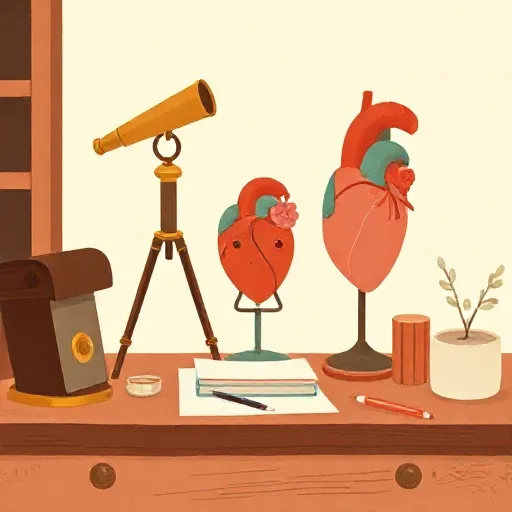
In 1751, in a Paris workshop, two French thinkers were busy with a colossal project. Denis Diderot (1713–1784) and Jean le Rond d’Alembert (1717–1784) were editing the Encyclopédie, a series of huge books meant to capture all human knowledge. They drew an enormous diagram — a tree of knowledge with roots, trunk, and branches. Each branch stood for a different science or art: physics, chemistry, medicine, ethics, music, painting. The tree showed that all learning, from the study of stars to the craft of blacksmithing, could be connected into a single, glorious whole.
That idea — that all the sciences could be unified — did not start with Diderot. It traces back to ancient Greece, where philosophers asked whether the world’s many things could be explained by a few basic building blocks. Over centuries, the dream of one unified science appeared again and again. But by the 20th century, a fierce debate erupted: can we really reduce everything to a single fundamental science, like physics? Or is our knowledge a messy, broken-up patchwork? That question is still alive today.
The Dream of a Pyramid: Physics at the Bottom
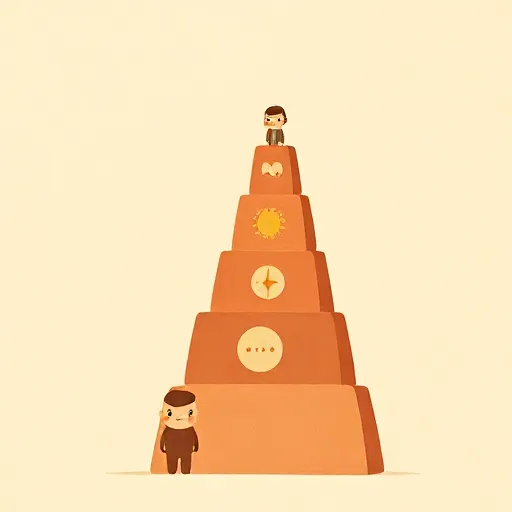
In the 1920s and 1930s, a group of philosophers and scientists in Vienna — the Vienna Circle — took up the challenge. They rejected vague metaphysical talk and wanted to unify all genuine knowledge using logic and observation. One of their stars, Rudolf Carnap (1891–1970), designed a blueprint for a unified science. He imagined a hierarchy of sciences, like a pyramid. At the bottom: fundamental physics, the study of the most basic particles and forces. One level up: chemistry, because chemical reactions are just physics of atoms. Then biology, which could be explained by chemistry and physics. Then psychology, and finally the social sciences like sociology. If this pyramid worked, every scientific fact could be logically reduced—translated step by step—into statements about tiny physical things. That huge project is called reductionism.
But reduction is extremely difficult. You need bridge principles that connect, say, a biological concept like “gene” to a precise chemical description of DNA sequences. And you must be able to deduce all the higher-level laws from the lower-level ones. Carnap believed that if we did this, science would become completely rational, objective, and unified — a single system with no gaps. Many scientists still find this dream appealing: it offers a neat, tidy picture of a layered world.
A Mosaic Instead of a Pyramid: Neurath’s Boat

Another Vienna Circle member, Otto Neurath (1882–1945), thought Carnap’s pyramid was a beautiful fantasy. Real scientific knowledge, he argued, doesn’t sit on a firm foundation. He compared science to a boat at sea. You can’t dock the boat and rebuild it from a perfect base; you must repair it plank by plank while floating, using whatever materials you find. Neurath imagined science as an encyclopedia or a mosaic of different pieces that connect locally, not a strict pyramid. He wanted a “universal jargon” that would let experts from physics, biology, sociology, and economics borrow ideas and work together without demanding that everything be reduced to physics. Unity, for Neurath, would happen “at the point of action”—when researchers tackle messy real-world problems like forest fires or unemployment, they need insights from many fields at once. So his version of unity was weaker and more flexible; it didn’t erase the distinct languages of different sciences.
Neurath’s boat metaphor stuck. It suggested that we can’t wait for a perfect unified foundation before we solve problems — we have to use the sciences as they are, patched together.
The Patchwork World: Why Some Think Unity Is Impossible

Later critics went even further. The American philosopher Jerry Fodor (1935–2017) argued that some sciences, like psychology, simply cannot be reduced to physics. His key idea: a single psychological state — like believing “it’s raining”—can be realized by countless different brain states (and even in non-brains, like a computer). This is called multiple realizability. Since there is no one physical description that matches all cases, you can’t write a neat bridge law from physics to psychology. Fodor claimed that while every individual mental event is physical — token-physicalism — the special sciences are autonomous and have their own laws that don’t reduce.
Nancy Cartwright (working since the 1980s) pushed the anti-unity view even harder. She argued that even the fundamental laws of physics are not universal. They only work inside highly controlled environments, such as a laboratory setup where scientists shield off outside interference. She called these shielded arrangements nomological machines. Outside the lab, nature is a patchwork of different local regularities — like a quilt, each patch sewn with its own pattern. There is no single pyramid of laws covering the whole world. Cartwright’s picture is a landscape of disconnected, local knowledge: we can’t boil it all down to one science.
This pluralism challenges the whole reductionist pyramid. It says there are many equally real ways to describe the world, and no one level is more fundamental.
Why This Fight Still Matters Today

Why does this ancient argument matter to you? Because it shapes how scientists work together — and how they solve problems that touch your life. Climate change, for instance, involves physics (how gases trap heat), chemistry, biology, geology, economics, and human behavior. Should we try to build one giant climate model that reduces everything to physics? Or should we accept a patchwork where different fields offer partial pictures that don’t fit perfectly? The answer influences policies, funding, and what we teach in school.
Medical research faces a similar fork. Some doctors focus on a single molecular cause of disease (reduction). Others insist that social factors — like stress, poverty, and inequality — play irreducible roles (pluralism). Drawing a pyramid or stitching a quilt changes how we design cures, allocate resources, and think about health.
So the fight over unity isn’t just dusty history. It’s alive in every lab, every classroom, and every big decision. And you’re part of it: whenever you wonder why biology class can’t just be replaced by physics, or why economists argue with politicians, you’re brushing against the question of how our knowledge hangs together.
Think about it
- If scientists developed a single set of equations that could predict everything — from a raindrop’s path to your next thought — would we still need separate sciences like biology or psychology? Why or why not?
- Do you think you can fully explain a funny joke only by describing brain chemicals and electrical signals, or is there something about humor that can’t be captured that way?
- Imagine you’re a city planner trying to reduce traffic jams. You could use physics (traffic flow as particles), psychology (driver habits), or economics (congestion pricing). Which approach would be most useful, and why might you need all three?