Why Is Ecology So Messy? The Science of Struggling Together
The Science That Began with a Struggle
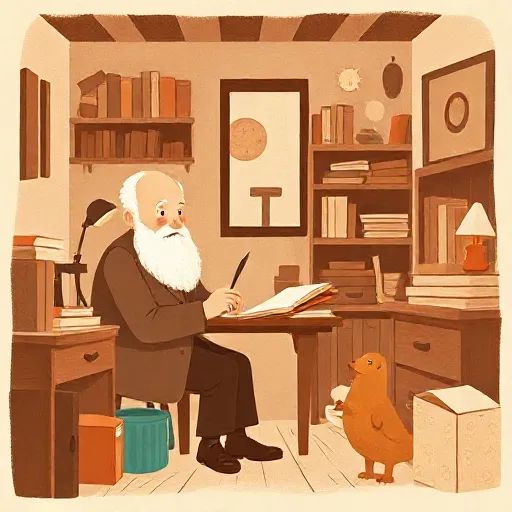
In 1859, Charles Darwin (1809–1882) described nature as a tangled bank where every plant, bug, and bird struggles for food, light, and space. A German scientist, Ernst Haeckel (1834–1919), gave that struggle a name: ecology. He wanted a science that would study exactly those fights for existence — the way living things interact with each other and with water, soil, and sunlight.
But ecologists soon faced a struggle of their own. The living world is so complicated that their science itself became a philosophical puzzle. The questions multiplied: Is a forest a single super‑creature or just a crowd of separate trees? Can we discover real laws of nature for a meadow? Does calling a species “invasive” make it bad? These puzzles don’t just live in university halls — they change how we protect real places and how we think about science itself.
Is a Forest One Big Creature?
One of the oldest battles in ecology is about what a community really is. A community is all the living things — elm trees, squirrels, mushrooms, bacteria — in a particular area. But are those parts deeply connected, like organs in a body? Or are they just plants and animals that happen to live near each other?
The American botanist Frederic Clements (1874–1945) saw communities as superorganisms. He believed that a pine forest grew, matured, and even “died” as one coordinated whole. Each species was like a cog in a machine; you couldn’t understand the machine by looking at a single cog. Another botanist, Henry Gleason (1882–1975), disagreed fiercely. For him, a community was just a loose collection of species, each doing its own thing. The mix changed whenever a seed drifted in or a deer wandered away.
Why does this old argument matter? If Clements was right, then damaging one part of a community might collapse the whole system. If Gleason was right, then communities don’t have a hidden “life” to protect — we are just preserving a snapshot. Today most ecologists stand somewhere in the middle. They agree that communities have real internal links — predator-prey loops, shared nutrients — but they are not as tightly bound as a single animal. The debate is a reminder that in ecology, definitions shape what you see.
The Invisible Job: What’s a Niche?
If you’ve ever wondered why warblers and chickadees can share the same tree without starving, you’ve brushed against the idea of the niche. The British ecologist Charles Elton (1900–1991) thought of a niche as a species’ job: one bird is the branch‑gleaner, another is the trunk‑tapper. Elton said, “When an ecologist says ‘there goes a badger’ he should include in his thoughts some definite idea of the animal’s place in the community… just as if he had said ‘there goes the vicar.’”
Later, G. Evelyn Hutchinson (1903–1991) turned the niche into a multidimensional space. Imagine every environmental need — temperature, food type, hiding spots — as an axis. The region where a species can actually live is its fundamental niche; the smaller corner it’s forced into by competitors is its realized niche. This picture explained a powerful rule: the competitive exclusion principle. It says that two species with identical niches cannot coexist. One will outcompete the other or push it into a different niche.
But not everyone loves the niche. In 2001, ecologist Stephen Hubbell proposed neutral theory, which suggests that differences between species might be irrelevant to their success. Instead, random birth and death, migration, and pure chance determine which species dominate a community. If neutral theory is right, niches matter far less than we thought. Ecologists are still fighting over whether niches and competition are the real story, or whether randomness is king. Some philosophers even argue that the niche concept is so messy it should be tossed out. This debate reveals a bigger question: when is a scientific concept truly useful?
Where Are the Laws of Nature?
In physics, you have Newton’s laws — simple, universal, no exceptions. Many ecologists have longed for something similar. They proposed candidates: the competitive exclusion principle, density‑dependent population growth, the equilibrium theory of island biogeography. But every candidate broke down in the messy real world. Keystone species don’t behave the same way in every bay. A rule that works for squirrels might fail completely for dragonflies. The problem is that ecological systems are complex: they have countless interacting parts, feedback loops, history dependencies, and staggering variation between places.
This has led to a kind of “physics envy.” Some ecologists worry that without universal laws, ecology isn’t real science. Others, including many philosophers, push back. They argue that a law doesn’t need to be exceptionless to be valuable. What matters is whether a generalization is invariant — stable enough in a given context to help you explain, predict, or intervene. The ecologist Richard Levins (1930–2016) famously said that we should build different kinds of models for different purposes, sacrificing perfect realism for generality or precision when it makes sense. That shift — from demanding perfect laws to embracing useful, imperfect tools — is a philosophical insight that ecology has given to all of science.
Invaders or New Neighbors? A Battle Over Words
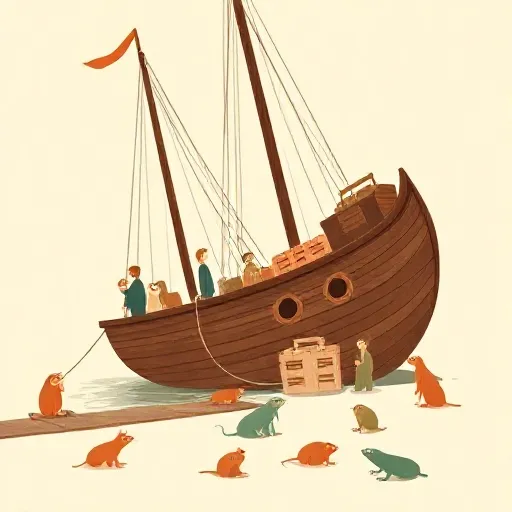
When you hear the word invasive, you probably picture a scary takeover — kudzu smothering a forest, or rats eating island bird eggs. Invasion biology is the sub‑discipline that studies species that enter new areas, often with dramatic effects. But deciding what counts as invasive is harder than it sounds. Is a plant “alien” if humans carried it 500 years ago? Do we only worry if it causes obvious harm?
A fierce debate has erupted among scientists and philosophers. On one side, many invasion biologists argue that invasive species cause immense damage — driving natives extinct, altering whole ecosystems — and that strong language like “alien” is justified. They accuse doubters of “invasion denialism.” On the other side, critics say the talk of “invasion” and “aliens” sounds xenophobic. They point out that most introduced species cause little harm, and some even help — providing food for natives, holding soil against erosion. They worry that labeling every newcomer as a threat leads to expensive, harmful removal projects that don’t work.
This fight isn’t just about facts. It’s about values. Deciding how to manage a landscape means weighing human livelihoods, the well‑being of individual animals, and the health of an ancient community — all judgments that science alone can’t settle. Ecology, more than many sciences, wears its ethics on its sleeve.
Why the Tangle Matters to You

Ecology’s philosophical struggles aren’t just for field biologists in muddy boots. They pop up whenever you try to understand any complex system. Why does one joke spread through your school while another dies? Why can’t you perfectly predict which lunch table will be the “cool” one next semester? Complex systems — a coral reef, a cafeteria of middle‑schoolers, a social media feed — are full of feedback, random chance, and unique history. They resist simple rules. That’s not a failure of science; it’s a lesson in humility.
And when you hear about a plan to bulldoze a meadow for houses, or to wipe out an introduced snail, you’re not just hearing a science report. You’re hearing a nest of values: what kind of world do we want? Should we try to freeze nature at some perfect past moment, or guide it toward a new future? Ecology doesn’t hand us clean answers. Instead, it gives us careful ways to ask the questions — and reminds us that good thinking means staying curious about the tangle.
Think about it
- If one person calls an introduced species a “clever survivor” and another calls it a “dangerous invader,” can both be looking at the same facts? What might they be valuing differently?
- A forest has changed a lot over 200 years. If we want to “restore” it, which version of the past should we aim for — and who gets to decide?
- Should a scientific field that can’t produce universal, exception‑free laws still be considered a real science? What makes a way of knowing “scientific” in your view?