What Makes a Discovery Truly Revolutionary?
A Book That Made Earth Move
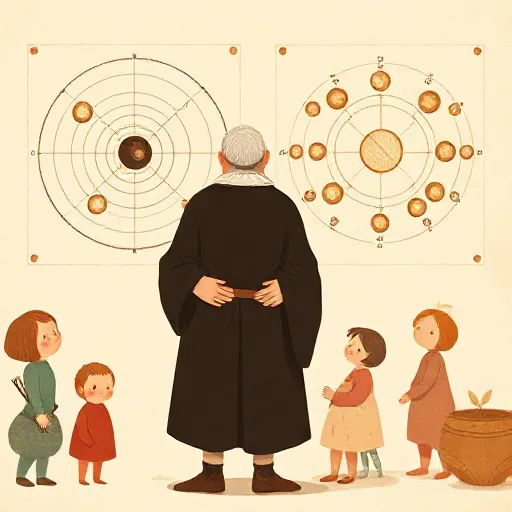
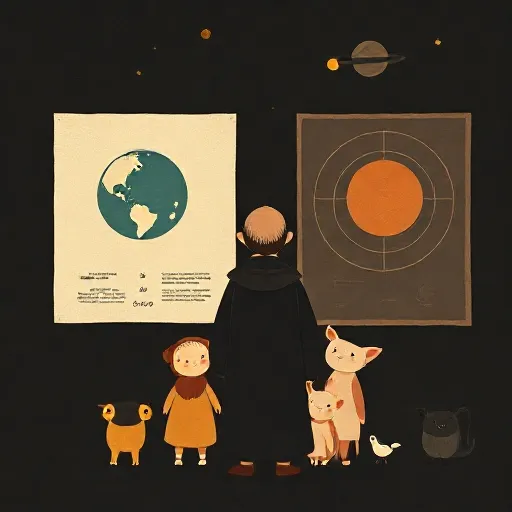
In 1543, a Polish astronomer named Nicolaus Copernicus published a book called On the Revolutions of the Heavenly Spheres. It placed the Sun, not the Earth, at the center of the solar system. That idea disturbed almost everyone who read it. Yet Copernicus himself did not think he was starting a revolution. He just thought his mathematical model tidied up the messy orbits. So what makes a discovery truly revolutionary? That question drives the work of Thomas Kuhn (1922–1996), a physicist turned historian who changed how we think about science.
Normal Science: When Everything Fits
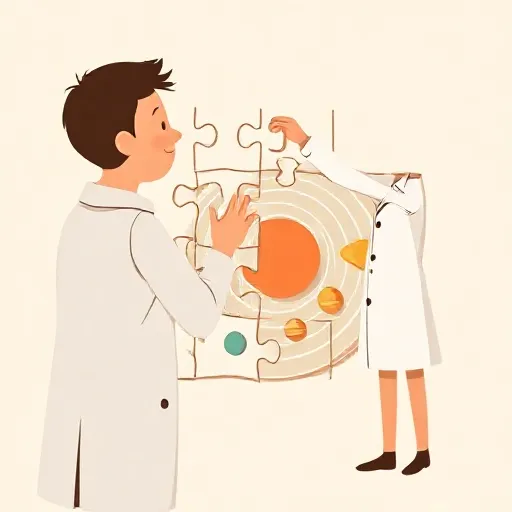
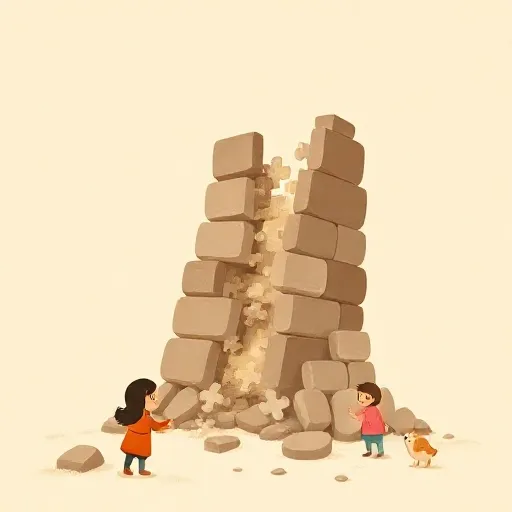
Kuhn noticed that most of the time, scientists are not trying to overthrow everything. They work inside a shared paradigm: a set of accepted examples, rules, and techniques that define what good research looks like. A paradigm is like a jigsaw puzzle box cover that shows you the picture you are trying to build. Scientists spend their days solving puzzles that the paradigm has already marked out. Kuhn called this normal science.
During normal science, researchers know what questions to ask and roughly what answers to expect. They extend the paradigm, fill in gaps, and make it more precise. A physicist measures a star’s light, a chemist synthesizes a new compound, a biologist maps a gene — all within a framework that tells them what counts as a successful result. It feels like steady progress, like adding bricks to a growing tower.
Kuhn argued that this kind of work is essential. Without a shared paradigm, every experiment would be a guessing game. Normal science works because it is convergent: it pulls everyone in the same direction and discourages wild, untested ideas.
Anomalies That Won’t Go Away
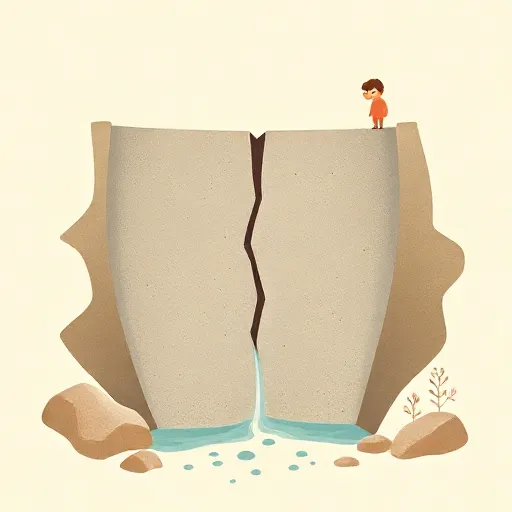
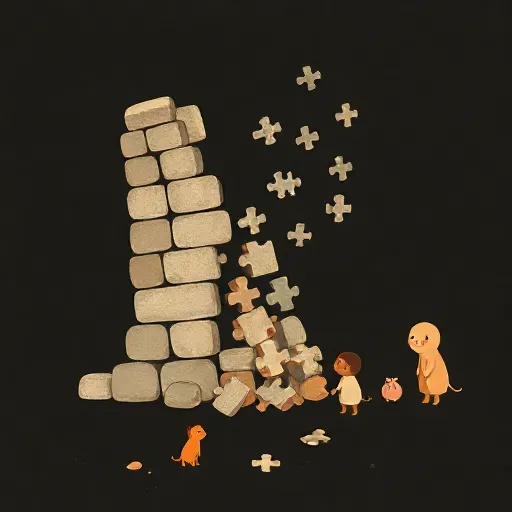
But jigsaw puzzles have stubborn pieces that don’t seem to fit anywhere. In science, anomalies are observations or experimental results that refuse to settle nicely into the paradigm. Every paradigm has them from the start. At first, scientists ignore small anomalies or patch them up with extra rules. A planet’s orbit that bends the wrong way gets an extra circle; a strange chemical result gets a side explanation.
Kuhn said that normal science, because it is so focused and detailed, is bound to turn up more and more anomalies. Most eventually get solved, but some resist the best efforts. When too many respected researchers fail to resolve a particularly annoying anomaly, the mood in the community can shift. The paradigm stops feeling like a reliable guide. Doubt creeps in.
The Crisis: Choosing a New World

When a few stubborn anomalies pile up, the field enters a crisis period. Now scientists are willing to entertain radical alternatives — ideas that would have been laughed at before. A competitor paradigm may emerge, offering a completely different puzzle picture. For example, in the late nineteenth century, classical physics faced puzzling results like the photoelectric effect and blackbody radiation, which refused to obey Newton’s rules. Out of that crisis, quantum mechanics was born.
Kuhn described the switch from one paradigm to another as a scientific revolution, or a paradigm shift. This is not just adding a new fact. It is reorganizing the entire body of knowledge, including what counts as a problem, what counts as a solution, and even how scientists use words. The new paradigm overturns the old one, not by proving it wrong point by point, but by displacing it as a competent way to do science. The old guard may never accept the new ideas; the younger generation often leads the charge.
Kuhn compared this to a political revolution, where the old government is replaced by a new one that operates by different rules. In both cases, there is no neutral umpire to settle the dispute. You cannot step outside both paradigms to judge which one is better, because your judgment would itself depend on a paradigm.
Can Scientists Even Understand Each Other?
This leads to Kuhn’s most controversial claim: that competing paradigms are incommensurable. That word means there is no common measure, no neutral set of rules or facts, that both sides can use to settle the debate. The same terms — like “mass,” “planet,” or “atom” — can change meaning so deeply that scientists on different sides talk past each other. In effect, they live in different worlds.
Consider light. In the early 1800s, most physicists thought light was a stream of particles. Then evidence accumulated that it behaves like a wave. The shift was not just a new fact; it changed the whole concept of light. A particle is a tiny bullet, a wave is a moving ripple. Trying to compare the two frameworks using the old meaning of “light” is like trying to judge a swimming race and a cycling race by the same set of rules. The very question “Is light a particle or a wave?” made no sense until the quantum revolution invented a new concept: wave–particle duality.
Kuhn insisted that revolutions are not decided by pure logic or experiment alone. Social factors, persuasion, and even generational turnover play a role. Many philosophers were shocked. They saw science as the one human activity that delivers objective, cumulative truth. Kuhn seemed to be saying that truth depends on which paradigm you happen to accept — a kind of relativism.
Does Science Still Make Progress?
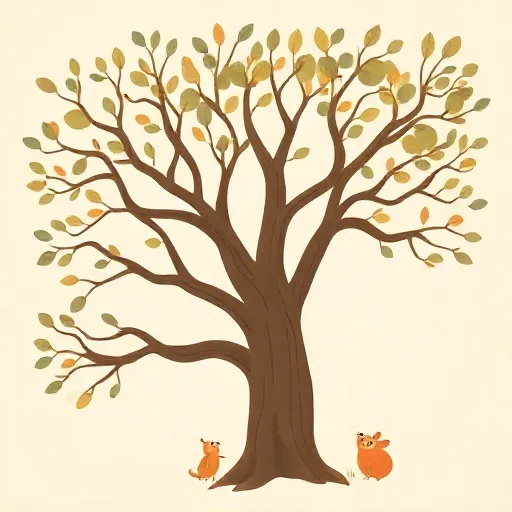
If paradigms jump without a common yardstick, does science truly progress? Kuhn’s answer is yes, but not in the old-fashioned sense of getting ever closer to a final, true picture of the universe. He compared science to biological evolution: species do not evolve toward a goal; they simply branch away from earlier forms. In the same way, successive paradigms solve problems that the previous one could not, and they open up new, fertile questions. There is Kuhn loss — some old solved problems get abandoned or forgotten — but the overall capacity to predict and control the world increases.
Late in his career, Kuhn revised his view. He imagined revolutions not as the overthrow of an entire discipline but as speciation: a group of scientists drifts apart until they can no longer fruitfully talk to the mainstream. They form a new subfield with its own vocabulary and journals. Incommensurability becomes a local barrier, not a global catastrophe. This later picture makes revolutions look less dramatic and more like the gradual branching of a tree.
Still, the big message remained: a simple story of smooth, cumulative progress is wrong. Science changes its mind in jumps, and those jumps are not inevitable — they depend on historical accidents, creative leaps, and social choices.
Why It Matters When You Open a Textbook
Today, historians and philosophers still argue over whether there really was one Scientific Revolution in the 1500s and 1600s, or whether Kuhn’s pattern of crisis followed by revolution fits every major change. But Kuhn’s ideas have seeped far beyond academia. The very phrases “paradigm shift” and “revolutionary science” are now part of everyday language.
When you learn in science class that dinosaurs are not sluggish reptiles but possibly warm-blooded relatives of birds, you are touching a paradigm shift. When doctors stopped believing that stomach ulcers were caused by stress and instead accepted that a bacterium, Helicobacter pylori, was the culprit, that was a miniature revolution — resisted at first, then embraced. Each time you hear scientists say “We used to think X, but now we know Y,” you might be witnessing a small piece of a larger conceptual reorganization.
Kuhn’s challenge remains: if even science, our most reliable way of knowing, sometimes flips its framework entirely, how can we be sure that today’s truths won’t be tomorrow’s discarded paradigms? That question does not make science untrustworthy. It just reminds us that knowledge is alive, shaped by communities of people who, like you, ask questions and sometimes dare to imagine a completely different world.
Think about it
- If two scientists in rival paradigms cannot fully understand each other, can they still have a fair debate? What would a fair debate look like?
- Think of a time you had to give up a belief you once felt sure of (maybe about a friend, a skill, or how something works). Did it feel like a puzzle piece clicking into place, or like the whole picture changing?
- When you read about a scientific “fact” today, should you trust it completely? How could you decide when to be open to a new idea and when to hold your ground?