Does Science Get Closer to the Truth, or Just Solve More Puzzles?
The Tower of Knowledge That Collapsed
Imagine you’re building a tower of knowledge. Each time a scientist discovers a new fact, they place it neatly on top of the last one. By the 1800s, many thinkers were sure science worked exactly this way—slowly, steadily, piling up certain truths one after another. The French philosopher Auguste Comte (1798–1857) called this view positivism: science would eventually uncover all the laws of nature, and each discovery would never be overturned.
But in 1962, a historian of science named Thomas Kuhn (1922–1996) published a book that shook that picture. Kuhn had studied real scientific history—like the shift from thinking the Earth was the center of the universe to accepting that the sun is. He noticed that science doesn’t just add bricks. Sometimes the whole tower gets knocked down and rebuilt in a completely new shape. Kuhn called these upheavals scientific revolutions.
The Scientist Who Saw Scientific Revolutions
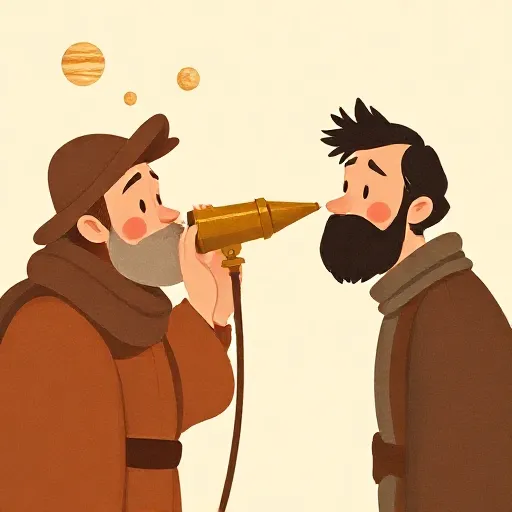
Kuhn argued that most of the time, scientists work inside a paradigm—a shared set of theories, methods, and examples that tells them what problems to solve and how to solve them. This everyday puzzle-solving is called normal science. A chemist testing reactions or a biologist classifying new species is doing normal science. It’s like working on a jigsaw puzzle where you know the picture on the box.
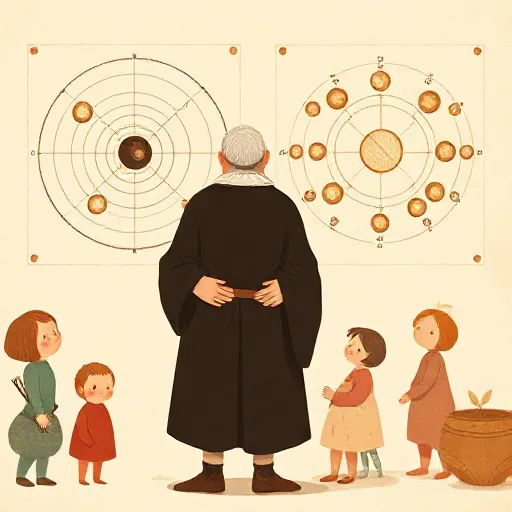
But sometimes a puzzle refuses to fit. These stubborn failures are anomalies. Enough anomalies, and the paradigm itself comes into question. Then a revolution can happen: the old paradigm is tossed aside, and a new one takes over. For instance, when astronomers moved from Ptolemy’s Earth-centered model to Copernicus’s sun-centered one, they weren’t just adding a new fact—they were seeing the whole sky differently.
Kuhn noticed that after a revolution, the new paradigm often couldn’t be measured against the old one using the same rules. He used the term incommensurability to describe this: the two sides seem to speak different languages about different worlds. Even the way scientists observe the world is theory-laden—what you see depends on the theory you already accept. So a follower of Ptolemy and a follower of Copernicus could look at the same planet and “see” very different things.
This raised a giant question: if we can’t compare old and new theories fairly, how can we say science is making progress? Later, Kuhn softened his view, admitting that scientists could learn each other’s paradigms. But the challenge stuck: maybe there’s no neutral yardstick to measure whether we’re getting closer to the truth.
Popper’s Bet: Aim for the Truth Without Claiming It
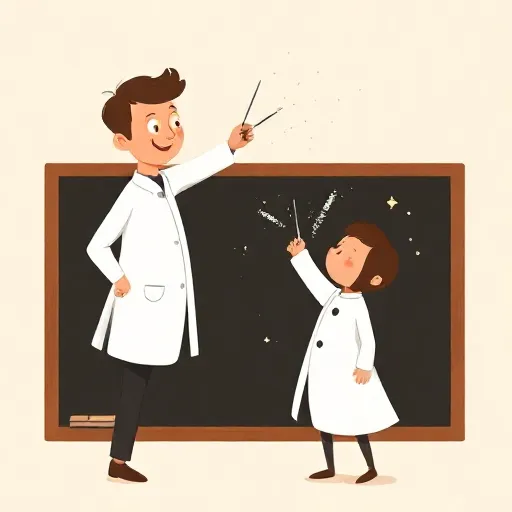
A philosopher named Karl Popper (1902–1994) also thought the old “tower of truths” picture was wrong. But he believed science does make progress toward the truth, even though we can never be sure we’ve arrived. Popper said scientists should make bold guesses, then try their hardest to prove them wrong. If a theory survives many serious tests, we can trust it more—but never completely. This method is called falsification.
Popper still wanted a measure of progress. He introduced the idea of verisimilitude, or truthlikeness—how close a theory gets to the whole truth. Even a false theory can be better than another if it contains more true statements and fewer false ones. But his early attempt to compare false theories ran into trouble: you couldn’t always say one false theory was closer to the truth than another using his rule.
Later philosophers, like Ilkka Niiniluoto (b. 1946), refined the idea by thinking of truth as a target and theories as points around it. Using a concept of distance, they defined truthlikeness: a theory is more truthlike if it’s located nearer to the complete true answer in a space of possibilities. This way, even two false theories can be compared—one can be a better approximation. They also distinguished between real progress (measured by truthlikeness toward the unknown true answer) and estimated progress (our best guess based on current evidence). We might never know the final truth, but we can have rational reasons to believe a new theory is getting us closer.
How a Wrong Theory Can Still Be Better
Take the history of planetary motion. Ptolemy’s geocentric model placed the Earth at the center and described orbits with complicated circles. It was false. Copernicus moved the sun to the center and simplified the orbits, but still used perfect circles—also false, but a step closer to reality. Then Kepler used elliptical orbits, which match how planets actually move; his theory was true in its main structure. The chain from Ptolemy to Copernicus to Kepler shows increasing truthlikeness, even though the first two were wrong.
Philosophers who favor truthlikeness say this is science’s real progress: not just collecting more facts, but bringing our overall picture of the world closer to the way things really are. The realist hope is that, over time, our theories converge toward the truth. Even when we can’t see the final target, we can track the distance we’ve traveled by checking how well new theories explain the data and withstand tests.
Some critics push back with the pessimistic meta-induction: history shows that many successful theories were later thrown out, so maybe today’s theories will be tossed too. But realistic optimists reply that for each abandoned theory, scientists have found a successor that was more truthlike—getting us closer, not just starting over.
Truth, Puzzles, or Understanding? The Fight Continues
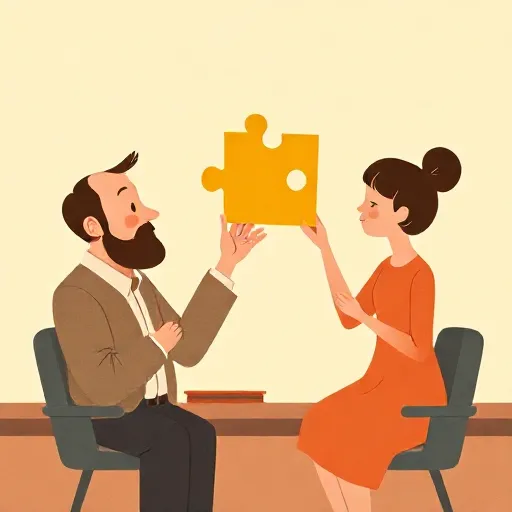
Not everyone agrees that truth is the right goal. Larry Laudan (b. 1941) argued that truth is an unreachable ideal, so progress should be judged by a theory’s problem-solving power: how many empirical puzzles it resolves, minus the new puzzles and conceptual problems it creates. On this view, even a completely false theory could count as progressive if it solved more problems than its rivals—like the phlogiston theory of fire, which was useful even though phlogiston doesn’t exist.
Others have proposed different yardsticks. Alexander Bird (b. 1964) says science progresses when it accumulates knowledge that is both true and justified. That seems to return to a cumulative model, but Bird tries to handle past false theories by saying they were actually “approximately true” and counted as knowledge of approximations. Critics point out that scientists at the time couldn’t know the margins of error.
More recently, Finnur Dellsén suggests progress is about increased understanding—grasping how to explain and predict phenomena—even if the explanations aren’t known to be true. For instance, Einstein’s explanation of Brownian motion using the kinetic theory of heat advanced our understanding before the kinetic theory was fully confirmed.
And there is an even deeper challenge: if standards of good science change over time and depend on a community’s values, can we say there is any objective progress at all? This skeptical view, sometimes called meta-normative relativism, worries that “progress” might be just a word each generation uses for its favorite theories.
Why It Matters When You Read the News

You live in a world where headlines announce new findings every day: a particle discovered, a fossil that rewrites evolution, a brain region linked to an emotion. When you read those stories, you’re jumping into the middle of this long argument. Is that new claim a genuine step closer to the truth, or just a useful new tool that might be replaced in twenty years?
The answer shapes how much you should trust science. If science merely gives us better instruments for predicting and controlling the world, then it’s like an ever-improving set of recipes. But if science increasingly converges on the truth, then every discovery, even a small one, is like finding a new piece of the ultimate map. Philosophers still debate which vision is right—but what they agree on is that the question itself matters. It’s not just about how science worked in the past; it’s about what we can hope for from science in the future.
Think about it
- If every scientific theory we have today gets replaced someday, does that mean science isn’t making real progress? Why or why not?
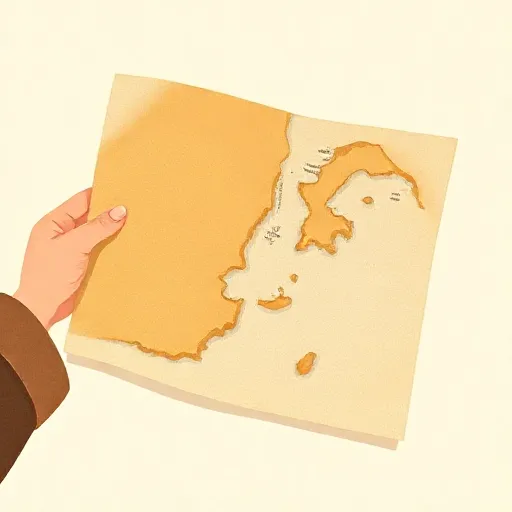
- Suppose you have two maps of a city—one hand-drawn with huge errors, the other detailed but still not perfect. Which map gets you closer to the real city? Can you call that progress?
- If scientists in two different paradigms can’t agree on what counts as evidence, can we ever say one paradigm is better than the other?