Is the Universe Just a Blind, Hungry Monster?
The philosopher who tried to out-talk Hegel

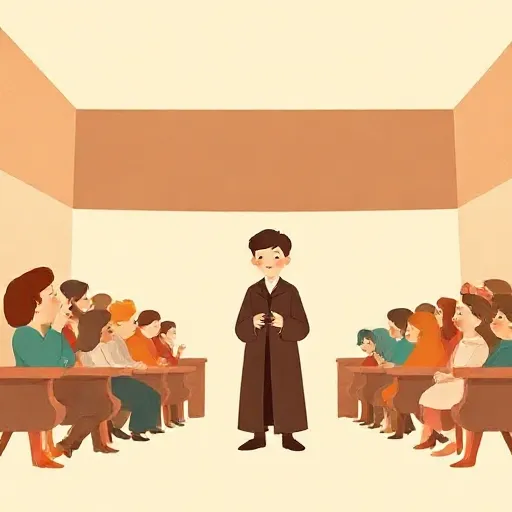
In 1820, a young philosophy professor marched into the University of Berlin and scheduled his lecture at the exact same hour as the most popular teacher in the country — Georg Wilhelm Friedrich Hegel (1770–1831). The result was a disaster: almost no one showed up. The young professor was Arthur Schopenhauer (1788–1860), and he had already decided that the famous Hegel was a fraud. That kind of absolute confidence — and a taste for lonely battles — became the signature of one of philosophy’s darkest, most captivating minds.
Schopenhauer was born in Danzig (today Gdańsk, Poland) into a wealthy merchant family. His father dreamed of an international trading career for his son, even choosing a name spelled the same in German, French, and English. But when his father died suddenly, likely by suicide, the seventeen-year-old Arthur slowly abandoned business. His mother, a novelist who ran a lively literary salon in Weimar, encouraged his studies — until the two clashed so fiercely that he left her home for good. Fate, and a series of excellent teachers, pulled him toward philosophy.
He studied at Göttingen and Berlin, soaking up Immanuel Kant’s (1724–1804) dense theories and the emerging German Idealism he would spend his life attacking. By age twenty-five he had written his doctoral dissertation, a close study of one big, strange question: why do we think everything must have a reason?
Why do we always ask “why”?
Open any science book or ask a small child “why” five times, and you will meet what philosophers call the principle of sufficient reason. The German thinker Gottfried Wilhelm Leibniz (1646–1716) stated it boldly: for every fact there must be a reason why things are this way and not otherwise. It feels obvious. Yet Schopenhauer noticed that the principle works only if we are very careful about what we are explaining and how we explain it.
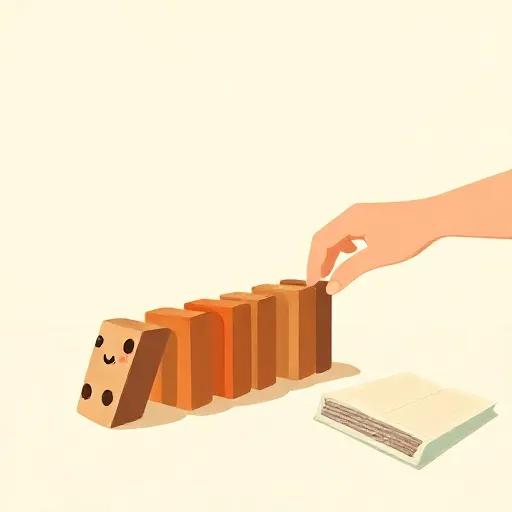
In his dissertation The Fourfold Root of the Principle of Sufficient Reason (1813), he argued that human thought has four separate tracks of explanation, and mixing them leads to nonsense. Physical objects and events, for instance, are explained by cause and effect — the domino that pushes the next domino. Abstract concepts are explained by logic, not by causes. Mathematical and geometrical truths depend on numbers and space, while choices and actions are explained by motives and intentions — what Schopenhauer called moral reasoning.
Who cares about these categories? Schopenhauer cared because he saw brilliant philosophers around him sneakily crossing the tracks. Arguments that started with logic or cause-and-effect often ended by claiming they had proved the existence of God. To Schopenhauer, that was like playing chess and suddenly declaring a checkmate in a game of checkers. He accused Hegel and his fellow German Idealists of exactly this mistake, calling them “charlatans” who built grand systems on broken rules.
But Schopenhauer’s fourfold root did more than attack rivals. It set up his deepest discovery: behind everything we see and explain, there is something that refuses to be a neat, rational object.
The secret inside your own body

Look at your own hand. You can study it coldly, as a surgeon might — a collection of bones, muscles, and skin obeying the laws of physics. But at the very same time, you inhabit your hand. You feel it from the inside; you can will it to move without knowing how you do it. Schopenhauer seized on this double knowledge: among all the objects in the universe, your body is the one thing you know both as representation — the outer, objective picture — and as something else entirely.
That inner something he called Will. Not a thoughtful, planned will like a decision to study an extra hour. Schopenhauer’s Will is a blind, relentless, wordless rush — a craving that never stops. It is the force that makes a seed push through soil, a heart beat in the dark, and a teenager scroll for one more video. And if we take our own body’s double nature as a clue, Schopenhauer argued, we must conclude that all things — stones, trees, insects — have an inner side too, and that side is Will.
This was his answer to a problem left by Kant. Kant had argued that we can never know the thing-in-itself, the true reality behind the appearances our minds organize. Schopenhauer thought Kant was almost right, but he disagreed on one vital point: the thing-in-itself isn’t hidden behind a wall of unknowable objects. It is the same reality as our representations, only seen from the inside. He compared it to two sides of a coin. One side is the world as representation — the scene we see, measure, and catalog. The other side is the world as Will — a surging, hungry unity.
He found a similar vision in ancient Indian philosophy, especially the Upanishads, which describe objective and subjective aspects of the universe called Brahman and Ātman. The Eastern idea that the core of everything is a single, restless life-force gave his own theory a new, explicitly godless depth.
Why everything fights — and what beauty does about it
If the universe’s inner nature is one great surge of Will, why do we experience it as a world of separate, colliding things? Because, Schopenhauer answered, the human mind can’t help but shatter the Will into pieces. The very same principle of sufficient reason that helps us do science — dividing the world into distinct objects in space and time — takes a unified, blind drive and snaps it into billions of individuals.
The result is nightmarish. Once cut apart, the Will turns against itself. Every living thing fights every other. Schopenhauer’s favorite image was the Australian bulldog ant: if you cut one in half, the head and tail battle each other to the death. For him, that was the whole of nature. Life itself “is suffering,” he wrote, a never-ending, pointless hunger locked in a war of all against all.
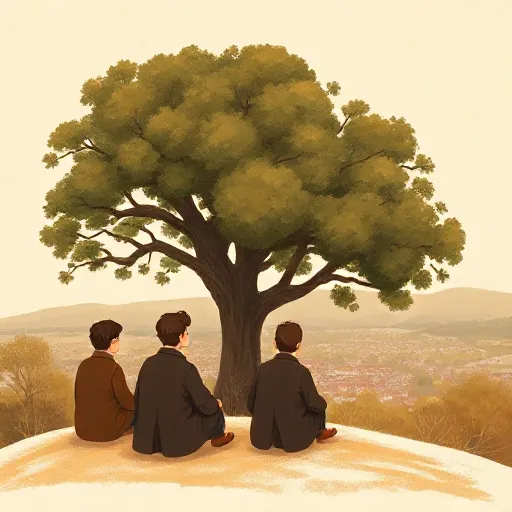
And yet, he offered an escape route. When you gaze at a great painting, a mountain, or a tree in a certain way, something shifts. You stop seeing the object as one more thing to use or fear. Instead, you perceive its timeless, universal essence — what Schopenhauer called its Platonic Idea. In that instant, you forget your own wants; you become, for a moment, a pure, will-less mirror. The world no longer bites.
Schopenhauer gave music an even higher rank. Notes don’t copy individual things; they copy the structure of the Will itself. Bass notes rumble like inorganic nature, harmonies move like the animal kingdom, and melodies soar like human longing. Music, he claimed, is a direct copy of the Will, expressing pure emotion — sadness itself, joy itself — without the painful circumstances that normally accompany them. For a few measures, you are lifted out of the battlefield and into a calm, knowing surrender.
The quiet at the heart of the storm
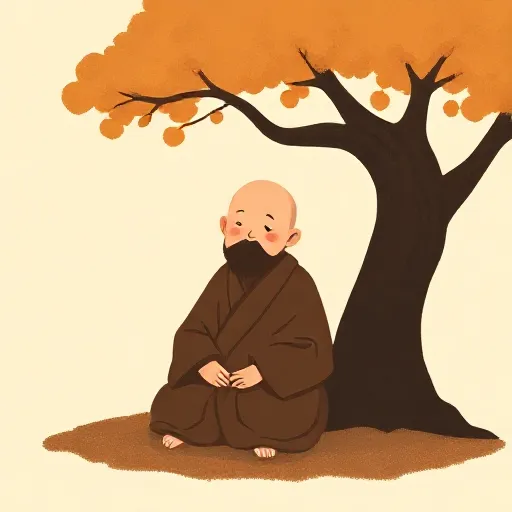
Art and music offer a brief truce, but Schopenhauer thought a deeper stillness was possible. It begins with a simple, shattering insight: if everything is one Will, then the stranger across the street is you in another form. The difference between tormentor and tormented is an illusion created by the same mental machinery that breaks the world into separate objects. With this realization, your will naturally quietens. You feel the inner life of others not as an abstract principle but as your own. That compassionate awareness, he said, is the heart of every real morality.
From there, a few people travel further. Seeing that every desire just fuels more suffering, they turn against life’s craving itself. They embrace an ascetic life — voluntary poverty, simplicity, a stilling of wants. Schopenhauer pointed to figures like St. Francis and the Buddha: people who, in their different ways, lived as if the ordinary game was no longer worth playing. At the extreme, the ascetic enters a mystical state where even the subject-object split dissolves. No will, no representation, no world — only a peace that ordinary language cannot capture.
Schopenhauer sometimes added a cautious note. In later writings he admitted that Will might be only how the thing-in-itself appears to us, not the final truth. This leaves a puzzle he never fully solved: if the ultimate reality is not a hungry monster, why does our experience feel so much like one? Still, by tying his whole system back to the human point of view, he left room for a mystery beyond relentless struggle.
Why a grumpy German still matters

Schopenhauer was a famously unpleasant man — he once got into a shoving match with a seamstress over hallway noise and held grudges with impressive energy. Yet his ideas travelled far beyond his rented rooms in Frankfurt. Writers as different as Leo Tolstoy, Marcel Proust, Thomas Mann, and Jorge Luis Borges drank deeply from his dark vision. Composers like Richard Wagner and Gustav Mahler tried to turn his philosophy into sound. Friedrich Nietzsche began as his admirer before rebelling, and Sigmund Freud’s picture of unconscious drives owes a quiet debt to Schopenhauer’s blind Will.
More than any specific doctrine, Schopenhauer left behind a mood. He gave a voice to the feeling that life often feels like a hungry chase that ends nowhere. And he offered, not a solution, but a handful of real experiences that loosen the chase for a while: the way a melody can hold you, the way a landscape can silence your thoughts, and the way genuine sympathy for another person can make your own cravings seem small. None of it lasts, but all of it reminds you that you are not stuck forever inside a hungry monster — or at least, that you can learn to sit quietly within it.
Think about it
- If you could press a button that made you never want anything ever again, would you press it? What would you gain, and what would you lose?
- Has a sad piece of music ever made you feel lighter instead of heavier? Can sadness without a real-life cause actually help you understand your own feelings?
- If all living things share the same inner force, as Schopenhauer believed, does it make sense to treat animals — or people you dislike — differently from yourself? What would that change about your daily choices?