
Did the Universe Have to Turn Out This Way? Hegel’s Answer
Three Friends, One Giant Question

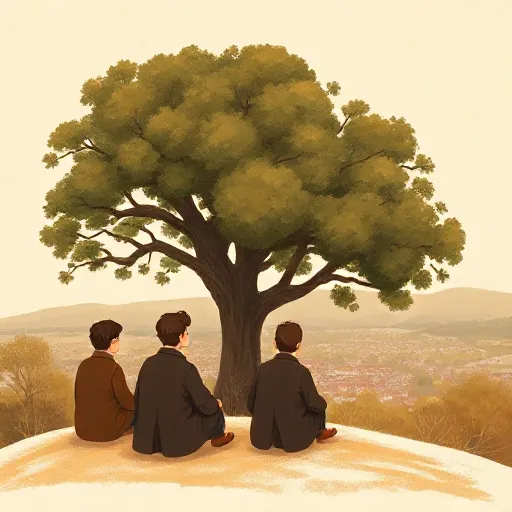
In 1788, a quiet but intensely curious student named Georg Wilhelm Friedrich Hegel (1770–1831) arrived at the university in Tübingen, a small town in what is now Germany. He shared a room with two other young men who would also become famous: the poet Friedrich Hölderlin and the philosopher Friedrich von Schelling. They stayed up late arguing about freedom, God, and the meaning of history. The French Revolution was erupting nearby, and everything seemed to be changing. Together, they asked: Does history just stumble from one accident to the next, or is there a hidden pattern driving it forward?
Hegel spent the rest of his life trying to answer that question. His conclusion was astonishing. He believed that all of reality — nature, human societies, art, religion, and even your own thoughts — is part of a single, logical process. He called this process spirit (in German, Geist). Spirit, he thought, is not a ghost or a god sitting outside the world. It is the world’s own drive to understand itself, and it works through a method he called dialectic. To see why that matters, we have to watch how thoughts grow.
The Dialectic: Why Your Thoughts Can’t Sit Still

Imagine you are staring at a single grain of sand and you think, “This right here is the most certain thing I know.” Hegel would smile and say: try to describe it without using any general words. You can’t. The moment you call it “this grain,” you’re using the idea “grain,” which applies to zillions of grains. What seemed completely immediate and unique turns out to rely on universal concepts. The original certainty collapses — but something new emerges. You now realize that even the simplest experience is shaped by thought.
That’s a tiny example of the dialectic. Hegel saw it everywhere. A dialectic is a three-step movement: a starting position (thesis) bumps into its opposite (antithesis), and the clash produces a richer, more complete idea (synthesis) that keeps what was true in both. This isn’t just a trick of argument; Hegel thought it’s the way reality itself develops. In his Science of Logic, he showed how the bare category of being — the idea that something just is — turns out to be empty unless you also think of nothing, and together they give rise to becoming. A seed isn’t yet a tree (nothing), but it has the potential to be one (being), and so it becomes. History, for Hegel, runs on the same engine.
The Struggle for Recognition: How You Need Others to Be You
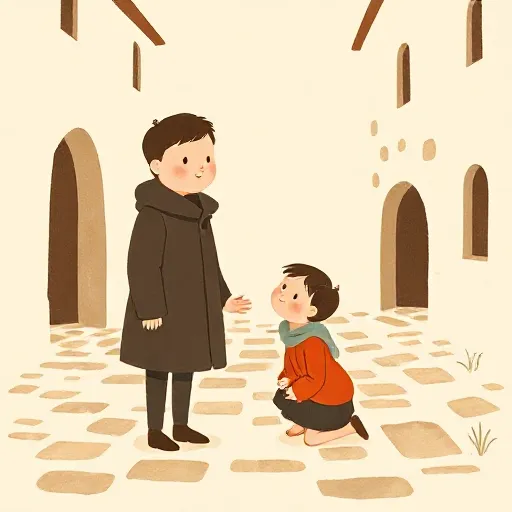
One of Hegel’s most famous stories appears in his book Phenomenology of Spirit (1807). It’s not a historical event; it’s a kind of fable about how self-consciousness arises. Two people meet. Each wants to be recognized as a free, independent being. But at first, the only way they know how to prove this is to risk their lives in a struggle. One gives in, becoming the servant; the other becomes the master.
Now watch the dialectic flip everything. The master thinks he’s won, but he has a problem: the recognition he gets comes from someone he sees as less than human. That’s worthless. The servant, meanwhile, works on the world — building, shaping, making things — and in doing so comes to see his own power reflected back at him. He realizes he is not just a thing. Through labour and discipline, the servant achieves a deeper self-consciousness than the master. Hegel’s point is electrifying: you can’t become a full self all alone. You need other people to recognize you, and you need to recognize them back. Recognition — the mutual acknowledgment between free beings — is the hidden glue of all society.
Freedom Needs a Shape: Why Hegel Loved the State

If freedom is about being recognized and reasoning together, then it can’t be just about doing whatever pops into your head. A person who follows every impulse is a slave to those impulses. Real freedom, Hegel argued in his Philosophy of Right (1821), needs a structure. It needs laws, institutions, and a community that makes rational life possible.
He called this community the state, but he didn’t mean a bossy government crushing individuals. He meant the whole network of families, workplaces, and public institutions through which people shape a shared life. In a well-ordered state, the rules aren’t just chains — they are the expression of what reason demands. When you stop at a red light, you aren’t being unfree; you’re participating in a system that lets everyone move safely. Hegel believed that only in a community where everyone is recognized as a bearer of rights, and where citizens have a voice through representative bodies, can individuals become fully free. That doesn’t mean he thought every state in his day was perfect. But he did think history was moving toward states that embody greater freedom — and that this movement is the very meaning of history.
The World Spirit Wakes Up: What History Is Really About

So what is the grand story? Hegel believed that history is the autobiography of spirit becoming conscious of itself. Each great civilisation — ancient Greece, Rome, modern Europe — lived by a certain principle, a deep assumption about what a human being is. But once a society acts on its principle, the results and memories of that action make the principle visible, and it can be questioned. That leads to contradictions, collapse, and a new principle that takes what was true and pushes further. The whole process is the path of spirit toward absolute knowing — the point where it understands that reality is nothing but its own rational activity.
Now, you might be thinking: this sounds like Hegel claimed to know the secret plan of the universe. Many readers have thought exactly that. They picture Hegel as a kind of cosmic know-it-all who saw himself as the endpoint of history. But other philosophers, especially in recent decades, read him differently. They argue Hegel wasn’t claiming private access to God’s diary. He was completing a project started by Immanuel Kant (1724–1804): showing that our most basic categories of thought aren’t just in our heads — they structure the world we can know, and they develop historically. On this view, Hegel’s “spirit” isn’t a spooky super-mind; it’s the shared, language-shaped space of reasons that human communities build and revise over time. The debate is still alive.
Why This Still Matters (Even When You’re Choosing Pizza)

You might wonder why a thinker who died almost 200 years ago matters when you’re just trying to decide what to do after school. Here’s why: Hegel forces you to look at your own freedom differently. If you are only free when nobody tells you what to do, then every rule, every relationship, every history that shaped you looks like a prison. But if Hegel is right, those are the very things that make freedom possible. You think with concepts that took centuries to develop. You become an individual only through others recognizing you. Even your simplest feelings — hunger, pride, curiosity — are not raw facts; they’re shaped by the world you grew up in, a world that has been thinking for thousands of years.
Does that mean everything was fated to happen exactly as it did? Hegel’s answer is neither a simple yes nor a simple no. The path of history, he thought, has a rational pattern, but it runs through countless accidents, passions, and individual choices. Your decisions matter because they are part of the story. Hegel’s biggest challenge to us is this: stop imagining freedom as escape. Start seeing it as participation — in a community, in a conversation, in the long, messy, astonishing project of spirit waking up.
Think about it
- If you could watch your own life as a movie from beginning to end, would it look like a random collection of scenes or like a story with a direction? What would make the difference?
- Can you be truly independent if every word you speak and every desire you feel came from a culture you didn’t choose?
- When you help make a rule in your family or school that everyone follows, are you giving up freedom or gaining a new kind of it?