Hegel Loved the French Revolution. So Why Did He Defend a King?
The Revolutionary Who Kept a King

It’s July 14, 1821. In a Berlin apartment, a gray-haired professor raises a glass of champagne. For the past 30 years, Georg Wilhelm Friedrich Hegel (1770–1831) has toasted the fall of the Bastille — the start of the French Revolution. He called it a glorious dawn. But later that same year, he published a book called Philosophy of Right that said the ideal state needs a hereditary king, traditional families, and strict laws. How could the same thinker love both a revolution and a king?
Some readers thought Hegel was a dangerous conservative. They pointed to a famous line in his book: “What is rational is actual, and what is actual is rational.” They took this to mean that whatever exists — even the authoritarian Prussian state where he lived — is rational and therefore justified. In the 20th century, Karl Popper (1902–1994) even called Hegel the “father of modern historicism and totalitarianism.” But other scholars noticed that Hegel’s book actually supported many progressive reforms: trial by jury, a free press, and limits on royal power. He cheered the French Revolution his whole life. Today, most philosophers agree that Hegel wasn’t an authoritarian. At the same time, he wasn’t a simple liberal either. His ideas are hard to label — and that’s what makes them so interesting.
So what was Hegel really arguing? To understand, we need to look at his big idea: freedom.
Freedom Is More Than Doing Whatever You Want

Hegel didn’t think freedom was just about having lots of options — like choosing chocolate or vanilla ice cream. For him, freedom means that your will is actually in charge of your life, not just following random impulses. In his Philosophy of Right, he asked: when is my will really free, and not just arbitrary?
He started with a surprising first step: property. If I pick up an apple, I make my free will have a physical existence in the world. But owning something isn’t enough, because I could just be grabbing what I want like an animal. Real ownership, Hegel said, requires mutual recognition: another person must agree that the apple is mine. Without that, my “ownership” is just a wish. So the first moment of something called right (Recht) appears when two people form a kind of agreement — a contract — about who owns what. It’s not a paper contract with lawyers; it’s the simple idea that we share an understanding about what belongs to whom.
This is a powerful thought. Your freedom to own something only becomes real when another free person acknowledges it. Your will and their will connect. That connection is the foundation of all rights. But what happens when that connection breaks?
Why Punishment Can Be a Good Thing

Hegel imagined three ways that mutual recognition can fail, which he called wrong (Unrecht). The first is an innocent mistake: both sides think they agree, but one is accidentally wrong. This isn’t punishable, because both still respect the idea of right. The second is deception: one person pretends to respect right but secretly doesn’t. More serious. The third is crime: someone acts as if right doesn’t matter at all, directly attacking the shared recognition that makes freedom possible.
For Hegel, crime isn’t just breaking a rule — it’s denying the very idea that people’s free wills should respect each other. So how should we respond? He argued that punishment is a way to restore right. By punishing a theft, we send a message: “No, this shouldn’t have happened — and the victim’s right still stands.” At first, he sounds like a retributivist (someone who thinks punishment is about giving wrongdoers what they deserve, nothing else). He even said the cancelling of crime “is retribution.”
But here’s the twist. In Hegel’s full system, punishment isn’t only about what the offender deserves. Later, in the section on law and society, he added that how we punish also depends on how dangerous a crime is to the community. The same theft might be punished more severely during a civil war than in peacetime, because it poses a bigger threat to society’s stability. So his view isn’t pure retribution — it’s a blend of retribution, deterrence, and rehabilitation, what some scholars call a “unified theory.” That makes it harder to pin him down, which is very Hegel.
The Empty Moral Rule

Before we get to the full picture, Hegel paused to examine morality — the part of life where you ask, “What should I do, just based on my own conscience?” He believed that morality considered purely in the abstract is empty. If you sit alone and try to invent a perfect moral law, you might end up with a formula that sounds good but has no real content.
He aimed this criticism at the famous philosopher Immanuel Kant (1724–1804). Kant’s moral rule was the Formula of Universal Law: act only in accordance with that maxim through which you can at the same time will that it become a universal law. Hegel said this was just a glorified “duty for duty’s sake” — an empty demand not to contradict yourself. Many philosophers have defended Kant, pointing out that he gave several versions of the rule to help connect it to real feelings and situations. But Hegel’s deeper point was that any moral theory that stays inside your head will remain incomplete. To know what you should do, you need to look at how you actually live with other people — that’s where the next stage, ethical life (Sittlichkeit), begins.
The Secret to Real Freedom: It Takes a Village

Hegel now moved from abstraction to real-life institutions. He called this Ethical Life, and it has three layers: the family, civil society, and the state.
First, the family is a bond based on love, not a contract. For Hegel, marriage is a permanent commitment that creates a new unity — ideally producing children who carry that unity forward. He endorsed the traditional family of his time, even arguing that men and women embody different qualities that join together like opposites in his logic. These ideas have been strongly criticized by feminists ever since. Interestingly, Hegel himself fathered a child outside of marriage and supported him his whole life — so his life didn’t perfectly mirror his ideal.
Second, civil society is the world of work, trade, and law. It’s where you pursue your own needs and talents, but you do it through a network of others: you become a baker, a teacher, a carpenter, and you join a kind of professional group (a corporation) that supports you. Hegel thought that through work, you develop your identity and connect to society — like a second family. But he also saw a dark side: poverty. Capitalism, he admitted, makes some people poor, and poverty can turn into a rabble, a group of people who feel completely alienated from society and rebel against it. He never found a convincing solution to this problem.
Third, the state brings everything together. It’s where the family’s loving unity and civil society’s individual pursuits are transformed into a shared patriotic community. Here, your freedom becomes concrete because you’re recognized by the law as a full citizen with rights and responsibilities. But what should this state look like?
Why Hegel Wanted a King (and Juries)
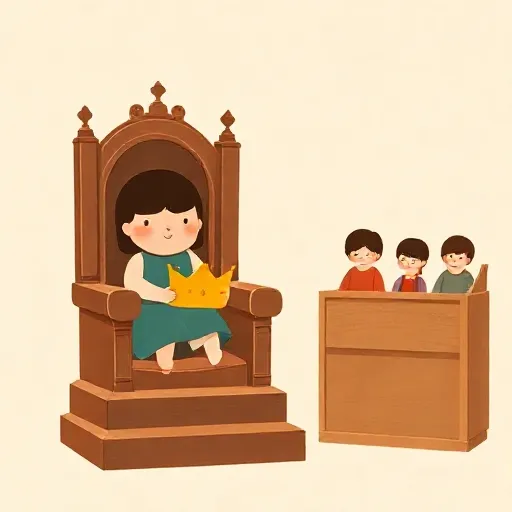
Hegel designed a state that combined three traditional forms: monarchy, aristocracy, and democracy. He proposed an Estates Assembly with two chambers — one for landowners and one for tradespeople — so that citizens were represented not by where they live, but by what they do. At the top, there would be a hereditary monarch. Why a king? Hegel argued that a head of state needs to stand above the political fights of parties. An elected president might favor one group, but a hereditary monarch — free from partisan battles — could symbolically unite the whole country. Most of the time, he said, the monarch’s job is simply to say “yes” to laws passed by the assembly, dotting the “i” so to speak.
The real governing work would be done by a cabinet of educated ministers advised by experts. But Hegel also insisted on trial by jury for ordinary citizens. Without a jury of regular people, he worried that law would become a secret language of professionals, cutting off ordinary people from understanding the justice that applies to them. This shows how seriously he took the idea that freedom requires being able to grasp and participate in the rules that govern you.
He also returned to punishment here. Because laws are made for specific times, he said a penal code is “a product of its time and of the current condition of civil society.” The same crime might be punished differently depending on whether society is at war or at peace. That’s a far cry from simple retribution — and it brings together themes of desert, public safety, and reform all at once.
What Would Hegel Say About Your School?

So why does all this matter today? Hegel’s ideas challenge a very common belief: that freedom means having no rules. In his vision, you’re not free when you ignore others and do whatever pops into your head. You become free when you live in a community where the rules are reasonable, where you can understand them, and where you have a say in how they’re made. That’s a startling thought. It means that a well-designed school, for example, doesn’t imprison you — it gives you the structure to learn and grow into a free adult.
Of course, plenty of institutions aren’t well designed. Hegel’s own plans for a monarch and a male-dominated family seem outdated and unfair to many people today. But his central question remains: What kind of rules and shared life actually make us more free, and what kind just limit us? He didn’t think we had to accept whatever exists. He thought we could use reason to find the “rational” inside the “actual” — and change what needs changing. That’s a puzzle worth toasting, with or without champagne.
Think about it
- Imagine your school has a strict dress code. Would Hegel say that makes you less free? What would he need to know about the rules to decide?
- Hegel believed that punishment should partly depend on how much a crime threatens the whole community. Do you think a judge should give a lighter sentence for the same crime during peaceful times? Why might that be fair — or unfair?
- If you discovered that all your choices could be predicted perfectly by a scientist, would that mean you aren’t free? How would Hegel’s idea of freedom (being mutually recognized in a community) compare to just doing what you want?