
Why Did God Put the Universe Here and Not Two Feet to the Left?
A Princess, Two Philosophers, and a Very Strange Question

In 1715, Princess Caroline of Ansbach (1683–1737) found herself in the middle of a war of ideas. In one hand she held a letter from her old teacher, the German thinker Gottfried Wilhelm Leibniz (1646–1716). In the other was a reply from the English Newtonian Samuel Clarke (1675–1729), a close friend of Isaac Newton. The letters bounced back and forth through Caroline’s hands, and soon they arrived at a truly strange question: Why did God put the whole universe here and not two feet to the left?
Caroline had invited Clarke to defend Newton’s new science against what Leibniz saw as dangerous muddles. But the argument quickly spilled far beyond physics. It turned into a fight about freedom, about whether the world must have a reason for every tiny detail, and about what space itself really is. That fight, which never really ended, still shapes how philosophers think about choice — yours included.
The Rule That Everything Must Have a Reason
Leibniz insisted on a rule he called the Principle of Sufficient Reason (PSR): nothing happens without a full explanation for why it happens that way rather than any other. If you find a book on a table, there must be a reason it’s there and not on the floor. For Leibniz, even God follows this rule. God always chooses the best possible option, and the best option contains its own reason for being picked. In other words, God never faces a tie.
Clarke agreed that the PSR is a powerful tool. He used it himself to argue for the existence of God and the order of nature. But he drew a line. Sometimes, Clarke said, the sufficient reason is simply God’s “mere will” — a free choice not forced by any better reason. Imagine God looking at infinite empty space, completely uniform in every direction, and deciding where to place the world. Every spot looks exactly alike. If you had to have a reason to prefer one spot over another, you couldn’t choose any. God would be frozen. Yet the world exists here. So, Clarke concluded, God must be able to choose without a reason that tips the scales.
Leibniz thought that was nonsense. He pointed to a second principle: the identity of indiscernibles. If two things are absolutely alike in every property, they are not two things at all — they are one and the same thing. Applying that to space, he argued you cannot have two different but identical empty places; you either have one indistinct space or you’re imagining something that makes no sense. Since Clarke believed space is a real, independent thing (not just the order of objects), Leibniz charged him with inventing a world where God would have to break the PSR. Clarke shot back that two identical drops of water or two identical atoms could exist separately, even if we can’t spot a difference. The tie doesn’t vanish just because our minds want a reason; God acts, and that’s reason enough.
What Is Space? The Great “Sensorium” Fight
Behind the argument about God’s choices lay a deeper disagreement. What is space? Clarke believed in absolute space — a real, infinite container that would exist even if every planet and atom vanished. You cannot think space away, he argued, because trying to remove all of space is still thinking about space. To him, space was not a thing made of stuff, but it was also not nothing. It had properties, like being everywhere and being unmoving.
In a move that made Leibniz furious, Clarke described space as God’s “sensorium” — the organ-like field through which God perceives and acts on the world, just as your brain uses your senses. Leibniz shot back that this made it sound like space was some kind of divine nervous system, as if God needed a body. He argued that space is simply the order in which things exist side-by-side, not a thing itself. The sensorium metaphor, Leibniz warned, turned God into the world’s soul, bound up in matter — a dangerous idea that could slide toward making the universe itself God.
Clarke tried to soften the language, but he never abandoned the core claim: God is really present everywhere, all the time, not by being spread out like jelly but by a necessary consequence of his own being. Space, for Clarke, depended on God, not the other way around. Yet that still left a ticklish problem. If God is everywhere, and space has parts (even if you can’t move them), does God’s mind get divided into pieces? Clarke’s answer — that space’s “parts” aren’t real separable parts, and that time extends without breaking God’s unity either — satisfied few of his critics. The puzzle of how an infinite being relates to the space you walk through never went away.
Miracles: Tinkering or Perfect Design?
The same clash erupted over miracles. According to Clarke, matter has no power to move itself. Every atom is dead weight; every push and every orbit is done directly by God or by created immaterial agents carrying out God’s will. So what we call a “miracle” — like the sun stopping in the sky — is unusual to us only because God usually acts in a regular rhythm. From God’s perspective, no act is harder or stranger; it’s all part of the same eternal design.
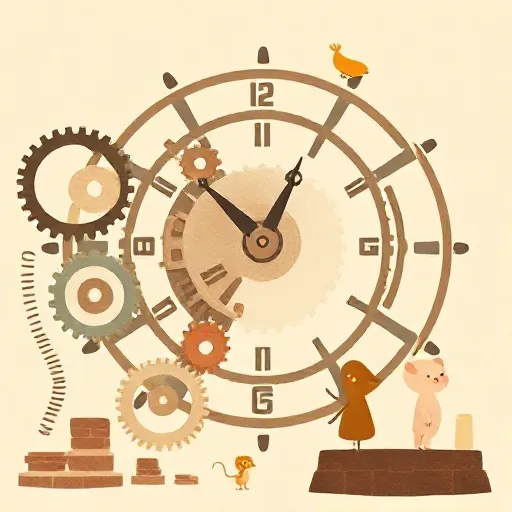
Leibniz found this picture unworthy of a perfect creator. A truly wise God, he argued, would design a world that runs by its own laws, like a clock that never needs winding. If God constantly has to step in, it’s as if the universe is poorly built. Clarke countered that a clock that runs itself would eventually run without a clockmaker at all — a world that needs no God. Worse, if laws of nature are absolutely necessary and matter can move itself, you end up with a blind mechanism where everything happens by fate, crushing freedom. The dispute wasn’t just about what counts as a miracle. It was about what kind of world a perfectly free and rational God would create: one where his fingerprints are always fresh, or one so complete that he can step back and watch.
Why You Might Be the Next Domino Falling
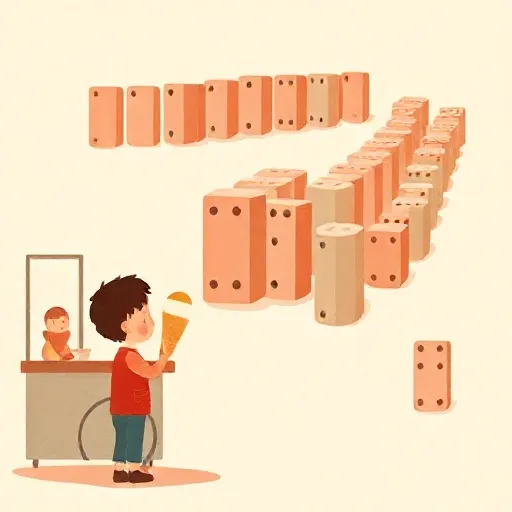
The two thinkers’ views on God spilled straight into their views on you. Clarke defended libertarian free will — the idea that a person (or God) has a genuine power to choose between options, a power not forced by any previous event. He argued that your judgments about what’s best are reasons, not causes. A reason is like a signpost; it can’t push you. Only you, the agent, can cause your own choice. If you didn’t have that power, Clarke said, you’d be a completely passive thing, a domino merely falling when nudged.
Leibniz was not impressed. He called Clarke’s version of free will a violation of the PSR. If all conditions are exactly the same and yet you could choose A or B, then the choice is random, not free. A free agent, he thought, is one whose inner reasons fully determine the choice — and that’s not slavery, that’s rationality. Clarke’s critics, like Jonathan Edwards (1703–1758), sharpened the attack: if each volition must be caused by something active, and your past thoughts are passive, you’d need an endless chain of earlier volitions to explain the first one. Clarke replied that the will itself, not some past volition, is the active cause. But he never fully quieted the charge that a cause without a reason is a leap in the dark.
Today, scientists study brains and talk about determinism, and teenagers at an ice cream cart still feel there’s a real fork in the road. Clarke and Leibniz were really asking: Is that feeling of freedom a reliable sign of what’s true, or a trick of being a limited creature inside a vast, reason-governed world? The letters Caroline passed didn’t settle it; they gave us vocabulary that every argument about choice still borrows.
Think about it
- If God knew everything you would ever do before you were born, could you still be free right now? Why or why not?
- Suppose a brain scanner could map every atom of your mind and predict your every decision. Would it still be fair to punish people for bad choices?
- Think of a moment when you were completely torn between two options. Did you feel you could really have chosen either one? Is that feeling enough to prove your choice wasn’t determined?