The Monk Who Said Concepts Are Lies—but You Still Must Follow Rules
A Debate That Could Change Everything
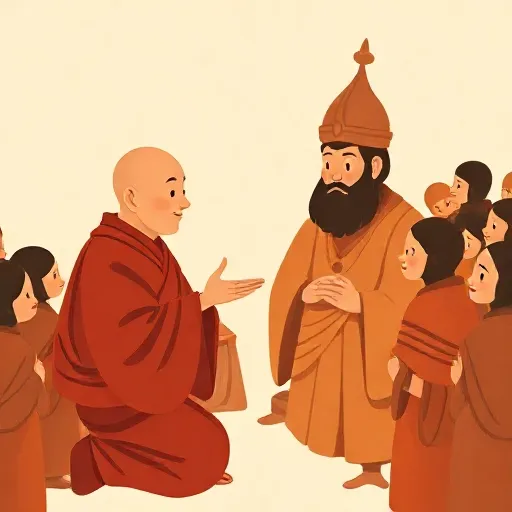
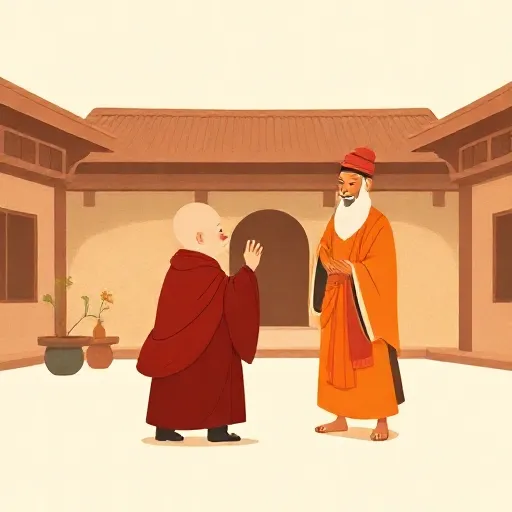
As the crowd gathered in the Sakya monastery high in the Himalayas, a monk in dark red robes stepped forward. He was Sakya Pandita (1182–1251), and he was about to challenge a visiting Hindu scholar to a debate that would put the entire Buddhist tradition on trial. Sakya Pandita had studied Sanskrit with the greatest Indian teachers of his day, and he believed that Tibetans were making dangerous mistakes about how words, ideas, and even morality actually work.
He argued that every single concept in your mind—like “chair,” “justice,” or “Buddha”—is completely unreal, a trick created by your past actions. Yet he also insisted that you had to follow extremely precise rules in order to become enlightened. It sounds like a contradiction. But for Sakya Pandita, the whole point of Buddhist philosophy was to hold both truths at once: ideas are empty illusions, and still, you have to take them seriously.
Words Are Magic Tricks Made by Karma

Sakya Pandita was what philosophers call an anti-realist about concepts: he thought that general ideas have no existence outside your mind. In reality, the world is made of unique, momentary flashes—what Buddhists call momentary particulars. When you call a pug, a husky, and a greyhound all “dogs,” you are ignoring all their differences and lumping them together with a mental habit. This process is called apoha (exclusion): you build a concept by cutting out everything that doesn’t belong.
So why do these imaginary groupings work? Why do you and your friend both know what “water” means, even though the concept isn’t real? Sakya Pandita’s answer was karma. Your mind has been shaped by endless past actions, and you share karmic tendencies with other beings. Like a group of people who all have the same eye disease and see floating hairs, you all project the same illusions and then agree on what to call them.
This was a direct attack on other Tibetan thinkers of his time, like Chapa Chokyi Senge (12th century), who wanted to say that at least some concepts or mental objects have a kind of real status—a moderate realism. Sakya Pandita found that sloppy. He was following the Indian master Dharmakirti (7th century), who argued that only real, momentary things can do anything causal, while all conceptual objects are just useful fictions built on habit.
Why Mixing Up Your Vows Was Dangerous
If all concepts are karmic illusions, then why can’t you just mix and match rules however you like? This was not a theoretical question—it was a practical emergency for Sakya Pandita. In his book A Clear Differentiation of the Three Vows, he listed ten mistakes he saw Tibetans making. At the heart of his worry was people blending the three great systems of Buddhist practice: monastic vows (for monks and nuns), bodhisattva vows (for those on the Great Vehicle path), and tantric vows (from the Mantra tradition).
Someone had argued that if you take monastic vows while also feeling the altruistic intention of a bodhisattva, then those monastic vows no longer end at death—they follow you into future lives. Sakya Pandita shot back: if that were true, then gods and newborn babies would still be monks, breaking all the rules! The vows last only as long as your body, he insisted, not beyond.
He applied the same strict logic to the idea of dedicating ultimate reality. Some people claimed you could dedicate “all the virtue that exists in past, present, and future” to the benefit of all beings, and that this pile of virtue was the same as the unchanging, ultimate reality called the dharmadhātu. Sakya Pandita replied that ultimate reality is completely beyond concepts, free of numbers, and cannot change. You can’t dedicate something that is neither wholesome nor unwholesome. And yet—this is the twist—you must still perform the dedication ritual, because in the conventional world of karma and actions, such practices actually move you along the path. Different systems of vows are like different fences around a field: each one is valid inside its own boundary, but you can’t leap over one side and claim you’re still protected.
The “One Trick” That Was Too Good to Be True
Perhaps nothing angered Sakya Pandita more than the teaching known as the White Self-sufficient Remedy. Some teachers in his day claimed that a single practice called Mahamudra (the Great Seal) could, all by itself, bring you to perfect enlightenment. You didn’t need to study, generate compassion, or follow all those complicated rituals—one moment of insight was enough. To Sakya Pandita, this wasn’t wisdom; it was a fast track to moral nihilism.
He pointed out that if the mind were already perfect in its natural, unaltered state, the Buddha would never have needed to teach anything at all. Resting in a relaxed, non-conceptual state without cultivating both compassion and analytical wisdom simply wasn’t the Great Vehicle path—it was closer to giving up. Sakya Pandita even linked this view to a Chinese monk, Hvashang Mohoyen, whose teachings had been officially rejected in Tibet centuries earlier. Whether his opponents were truly cutting corners or just using bold language, he saw the Self-sufficient Remedy as a bomb planted under the very idea of a step-by-step path. Because if everything is empty anyway, what’s to stop you from skipping the hard work? His answer: your actions and their karmic effects still chain you to suffering, no matter how enlightened you feel.
Why Study Dead Languages? Because One Bad Translation Can Ruin Everything

Sakya Pandita did not just criticize; he built. In his Gateway to Learning, he laid out a complete education for anyone who wanted to defend the dharma as he did. The most urgent skill, he thought, was language. When Tibetan translators long ago had rendered the Sanskrit word jñāna (knowledge) as ye shes, later generations read the ye part as “primordial” and started dreaming up a mystical, timeless wisdom. But that was never in the original—it was a translation accident. Without rigorous study of Sanskrit and Indian thought, you would never catch the mistake.
His philosophy of language pushed even deeper: words have no natural connection to what they mean. Meaning comes entirely from the speaker’s intention in a specific situation. So if you want to preserve the Buddha’s teachings, you don’t just memorize words; you rebuild, as best you can, the original context and intention. This required a whole community of trained scholars—a kind of Buddhist guard—who could spot errors and keep the transmissions clean. For Sakya Pandita, defending Buddhism wasn’t about nostalgia; it was about making sure that the path still worked, generation after generation.
What This Means for You: No Shortcuts, Even in a Made-Up World

It’s easy to read Sakya Pandita and think he was just a grumpy traditionalist. But his point is surprisingly alive today. You live in a world where many things—grades, money, social rules—are clearly human inventions. So you could say, “why bother?” If rules are just made up, what’s the difference? Sakya Pandita would answer: consequences. Even though concepts are unreal, your actions inside the conventional world have real karmic effects on your mind and your experience. Skipping your homework because grades are “just a number” still leaves you unprepared. Breaking a promise because it’s “just words” still damages trust.
His whole life was a reminder that emptiness does not mean “anything goes.” It means that because things are empty of fixed essence, you have the responsibility to understand which illusions help and which ones trap you. The only way to do that is the long way: study, reflection, careful attention to context. No single magic trick will do the job.
Think about it
- If words have no fixed meaning and depend entirely on intention, how can we ever be sure we understand what someone else is really saying?
- Sakya Pandita thought mixing different rule systems leads to chaos. Can you think of a situation in your life where two sets of rules collided, and what you decided to do?
- If all concepts are karmic illusions, does it still make sense to follow strict traditions? Why or why not?