
Can You Prove That a Chair Is Real? This 9th‑Century Thinker Said No
The Lion That Crushes Every Proof

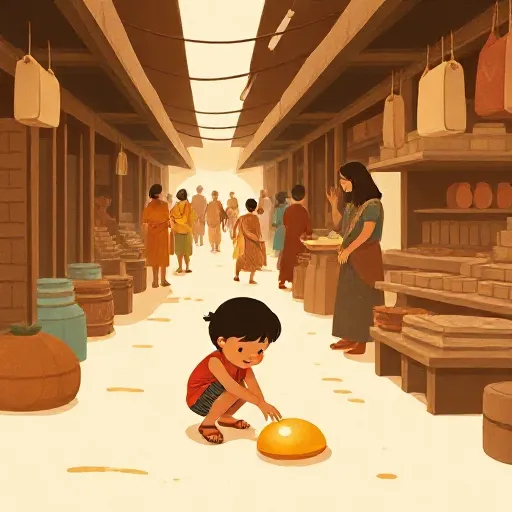
Sometime around 825 CE, in a busy town probably in southern India, a scholar named Jayarāśi Bhaṭṭa handed a friend a book made of dried palm leaves. The title was terrifying: Tattvôpaplava‑siṁha, which means “The Lion That Destroys All Categories.” A category is a basic idea that philosophers use to understand the world — like “cause,” “object,” or “knowledge.” Jayarāśi did not offer a new theory. Instead he took aim at every school of thought around him. His goal? To show that nobody had ever defined a trustworthy way of proving anything, and that the whole business of trying was stuck in a circle.
In Indian philosophy, a reliable way of knowing is called a pramāṇa (you can say it like pra‑MAA‑na). The main ones were perception, inference, and the words of an authority. If you see a mango, you know it is there — that is perception. If you see smoke and guess there is fire, that is inference. If a teacher tells you a fact you could not verify yourself, that is testimony. Jayarāśi went through every one of these pramāṇas and examined their definitions with a ferocious logic. He was not trying to prove that nothing is real. He was asking: “Can any definition of a pramāṇa survive its own scrutiny?”
The Circle That Traps Every Knower

Jayarāśi began with a simple but devastating observation. To decide whether a way of knowing is reliable, you need a definition. But to test that definition, you need to compare it against real things. And to know what real things are, you need a reliable way of knowing. The whole thing is a loop.
Suppose you try to define perception as “direct awareness of external objects.” That sounds reasonable. But how do you know what a real external object is? You would have to use perception. And how do you know that perception is trustworthy? You would need to check whether the objects you perceive are genuine — which again requires perception. Every attempt to ground perception pulls you back to perception. The same problem appears for inference and testimony. Inference needs data from perception; testimony needs some other pramāṇa to verify that the speaker actually knew the truth. We keep walking in a circle.
Jayarāśi pointed out that even a simple experience like seeing water on a road might be a mirage. Without a watertight definition of perception, you cannot tell for sure which perceptions are true and which are tricks. Philosophers had tried for centuries to draw a line. He showed that every definition either begged the question or fell apart when you tried to apply it. That did not mean he thought your eyes are useless. It meant the philosophical project of defining a perfect pramāṇa had failed.
Three Paths, All Dead Ends: The Case of the Universal

Jayarāśi’s weapon was a type of argument called reductio ad absurdum (or prasaṅga in Sanskrit). He would take a claim, list every consequence that a particular school of thought had to accept, and show that each one leads to an impossible result. If every path from a claim ends in a dead end, the claim itself must be rejected.
One of his favorite targets was the idea of a universal — a single quality shared by many similar things, like “chairness” or “redness.” If you say a universal exists, Jayarāśi reasoned, it has to fit only one of three patterns:
- The universal is completely different from all the individual chairs.
- It is not different at all — identical to each chair.
- It is partly different and partly the same as the chairs.
Now take these one by one. If chairness is totally separate from every real chair, then it is something floating in a ghostly nowhere; you could never see it or point to it, so why believe in it? If chairness is exactly the same as each chair, then every chair would have to be the very same object — you would be sitting on all chairs at once, which is absurd. If it is partly the same and partly different, the universal would have to be in a chair but also outside it at the same time, a sort of half‑presence that makes no sense.
With all three options destroyed, Jayarāśi concluded bluntly: “Universals do not exist.” He was not saying chairs do not exist. He accepted the chairs you can touch. He was saying the abstract label “chairness” has no footing in reality — it is just a word we use.
A Materialist Who Could Not Trust His Own Proofs

So was Jayarāśi a total sceptic who believed in nothing? Not exactly. He came from a tradition known as Cārvāka or Lokāyata, the materialist school of ancient India. Materialists held that everything is made of just four elements — earth, water, fire, air — that consciousness is a product of the body, and that there is no soul, no afterlife, no karma, and no gods. The only pramāṇa they usually accepted was perception. Inference and scripture, they said, are unprovable guesswork.
Jayarāśi quoted the legendary teacher Bṛhaspati, the founder of the materialist tradition, with deep respect. He called him “the preceptor of gods” and linked his own project to Bṛhaspati’s ideas. Yet he went further than any standard materialist was willing to go. He argued that even perception cannot be defined without flaws. If you cannot define a pramāṇa, you cannot claim it works. So Jayarāśi rejected the whole pramāṇa model — all of the ways that philosophers used to label something “proven.”
Nonetheless, he held a set of positive views. He plainly denied the existence of invisible entities like demons, atoms, or gods. He said consciousness comes from the combination of material elements, not from an immaterial soul. He accepted the reality of middle‑sized objects — the pots, trees, and people of everyday life — while rejecting universals and invisible atoms. He was a materialist in his picture of the world, but a ruthless sceptic about the idea that any definition of knowledge could give it a solid foundation.
The Worldly Path: Living Without a Final Answer

If all definitions fall apart, what should a person do? The very first verse Jayarāśi included in his book offers a clue: “The worldly path should be followed.” A little later he adds an old saying: “With respect to everyday practice, the fool and the wise are similar.” The point is sharp and freeing. When you are buying fruit, talking with a friend, or crossing a street, you do not pause to produce a flawless logical proof that the world is real. You just act.
At the end of his treatise, after dissolving every category, he writes that once all these philosophical labels have been cleared away, “all practical actions can be enjoyable, without being reflected upon.” This is not the cry of a cynic who thinks life is meaningless. It is the cheerful shrug of someone who sees that our hunger for final, airtight proof outstrips what any system can deliver. Jayarāśi wanted to show that philosophers who promise certainty are chasing a mirage. Instead of panicking, he suggests, we should admit our limits, trust the rough‑and‑ready experience of living, and get on with it.
He never stopped arguing. His method was a perpetual investigation — always testing, always finding cracks, never settling. But he did not let the investigation poison the part of life that actually works. He kept the world while throwing out the philosopher’s demand for a perfect manual of knowing.
Why It Still Matters: The Chair You Cannot Prove

Jayarāśi’s challenge never went away. Think about it the next time you are absolutely sure of something: Where did that certainty come from? If you trace it backwards — “I know because I saw it,” “I know because a reliable person told me,” “I know because it follows from something else” — you eventually hit a point where you have to say, “Well, I just accept it.” That is the circle Jayarāśi drew in the sand twelve hundred years ago.
Today philosophers still argue about whether any knowledge can rest on unshakeable foundations, or whether all knowledge is a web of beliefs that support one another without a solid bottom. The scientist who trusts her microscope, the friend who trusts a memory, the judge who trusts a witness — all are betting on pramāṇas whose final justification remains elusive. That does not make them foolish. Jayarāśi himself would likely have smiled and pointed to the market: people are living just fine.
His gift is not a tidy answer. It is a habit of asking the next question. The next time you doubt whether you really know what you think you know, remember the lion that devoured every definition and yet left the world standing. You might find that uncertainty is less scary when you realize you are in good company.
Think about it
- If a friend asked you to prove that the chair you are sitting on is real, what would you say? What if they kept demanding “prove it” for every reason you give? Where would that conversation end?
- Jayarāśi thought that even without airtight certainty, you can still enjoy life. Do you think knowing things for sure is essential for a good life, or is good‑enough guessing usually fine?
- Think of a time you were completely sure about something that later turned out to be wrong. Could you have been mistaken about that, even though you felt certain? What does that tell you about how much we can rely on our feeling of certainty?